


- ¥1700 - 4000
- GeneTex

- 美国
- GTX100539
- 2025年07月15日
- WB, ICC/IF, IHC-P, IHC-Fr, IP, FISH, IHC
- Rabbit
- Human, Mouse, Rat, Golden Syrian Hamster

企业认证
相关产品推荐更多 >
![Collagen IV antibody [MSVA-704R] HistoMAX](https://custom.dxycdn.com/trademd/upload/pic/2013/11/12/A1383891150.jpg!small.t.1)
![Ephrin A2 antibody [2B7]](https://img1.dxycdn.com/2022/0328/767/3284196480568500453-14.jpg!wh200)
![B-Raf antibody [1E2]](https://img1.dxycdn.com/2022/0328/194/8006770711088500453-14.jpg!wh200)
万千商家帮你免费找货
0 人在求购买到急需产品
相关阅读
细胞污染识别与处理全攻略:5 种常见类型+关键误区Cytoscape 教程来了!快速实现顶刊同款通路网络图五大应用案例:Mustang Q 膜层析应用全解析1 个小工具,一次性搞定流程图、质粒图谱和信号通路图- 详细信息
- 文献和实验
- 技术资料
- 免疫原:
Recombinant protein encompassing a sequence within the center region of human PCNA. The exact sequence is proprietary.
- 亚型:
IgG
- 形态:
Liquid
- 保存条件:
Store as concentrated solution. Centrifuge briefly prior to opening vial. For short-term storage (1-2 weeks), store at 4ºC. For long-term storage, aliquot and store at -20ºC or below. Avoid multiple freeze-thaw cycles.
- 克隆性:
Polyclonal
- 标记物:
Unconjugated
- 适应物种:
Human, Mouse, Rat, Golden Syrian Hamster
- 保质期:
12 months from the shipping date of the product.
- 抗原来源:
Human
- 目录编号:
GTX100539
- 级别:
Primary Antibodies
- 库存:
Available
- 供应商:
GeneTex
- 宿主:
Rabbit
- 应用范围:
WB, ICC/IF, IHC-P, IHC-Fr, IP, FISH, IHC
- 浓度:
0.11 mg/ml (Please refer to the vial label for the specific concentration.)
- 靶点:
IP/MS validation was supported by references (PMID:30377373)
- 抗体英文名:
PCNA antibody
- 抗体名:
PCNA 抗体
- 规格:
100 μl/25 μl
| 规格: | 100 μl | 产品价格: | ¥4000.0 |
|---|---|---|---|
| 规格: | 25 μl | 产品价格: | ¥1700.0 |
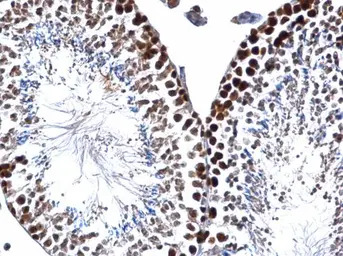
PCNA antibody detects PCNA protein at nucleus on mouse testis by immunohistochemical analysis.
Sample: Paraffin-embedded mouse testis.
PCNA antibody (GTX100539) dilution: 1:500.
Antigen Retrieval: Trilogy™ (EDTA based, pH 8.0) buffer, 15min
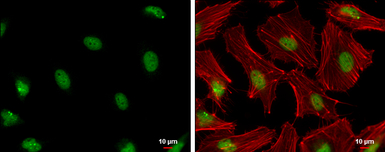
PCNA antibody detects PCNA protein at nucleus by immunofluorescent analysis.
Sample: HeLa cells were fixed in 4% PFA at RT for 15 min.
Green: PCNA protein stained by PCNA antibody (GTX100539) diluted at 1:500.
Red: Phalloidin, a cytoskeleton marker, diluted at 1:200.
Scale bar = 10 μm.
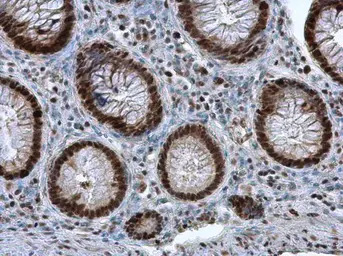
PCNA antibody detects PCNA protein at nucleus in human colon by immunohistochemical analysis.
Sample: Paraffin-embedded human colon .
PCNA antibody (GTX100539) diluted at 1:500.
Antigen Retrieval: Citrate buffer, pH 6.0, 15 min
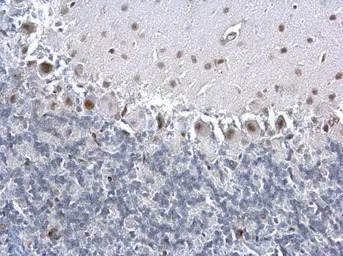
PCNA antibody detects PCNA protein at nucleus on rat hind brain by immunohistochemical analysis.
Sample: Paraffin-embedded rat hind brain.
PCNA antibody (GTX100539) dilution: 1:500.
Antigen Retrieval: Trilogy™ (EDTA based, pH 8.0) buffer, 15min
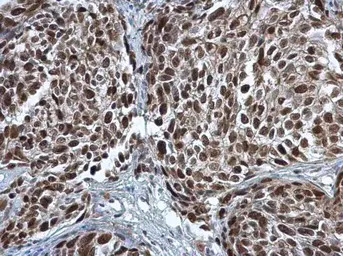
PCNA antibody detects PCNA protein at nucleus in human cervical carcinoma by immunohistochemical analysis.
Sample: Paraffin-embedded human cervical carcinoma.
PCNA antibody (GTX100539) diluted at 1:500.
Antigen Retrieval: Citrate buffer, pH 6.0, 15 min
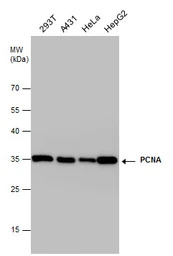
PCNA antibody detects PCNA protein by Western blot analysis. Various whole cell extracts (30 μg) were separated by 12% SDS-PAGE, and the membrane was blotted with PCNA antibody (GTX100539) diluted at 1:2500.
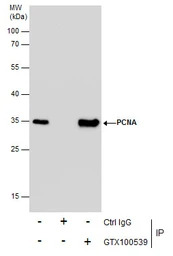
Immunoprecipitation of PCBP2 protein from HeLa whole cell extracts using 5 μg of PCBP2 antibody (GTX100539).
Western blot analysis was performed using PCBP2 antibody (GTX100539).
EasyBlot anti-Rabbit IgG (GTX221666-01) was used as a secondary reagent.
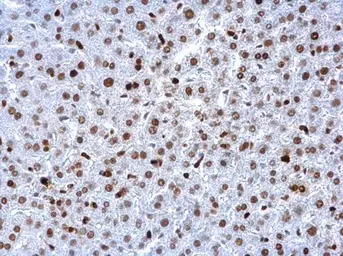
PCNA antibody detects PCNA protein at nucleus on mouse testis by immunohistochemical analysis.
Sample: Paraffin-embedded mouse testis.
PCNA antibody (GTX100539) dilution: 1:500.
Antigen Retrieval: Trilogy™ (EDTA based, pH 8.0) buffer, 15min
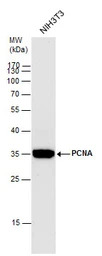
PCNA antibody detects PCNA protein by western blot analysis.
A. 30 μg NIH-3T3 whole cell lysate/extract
12% SDS-PAGE
PCNA antibody (GTX100539) dilution: 1:2500
The HRP-conjugated anti-rabbit IgG antibody (GTX213110-01) was used to detect the primary antibody.
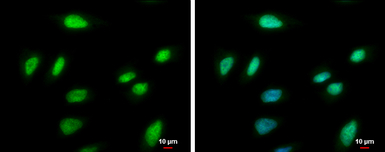
PCNA antibody detects PCNA protein at nucleus by immunofluorescent analysis.
Sample: HeLa cells were fixed in ice-cold MeOH for 5 min.
Green: PCNA protein stained by PCNA antibody (GTX100539) diluted at 1:1000.
Blue: Hoechst 33342 staining.
Scale bar = 10 μm.
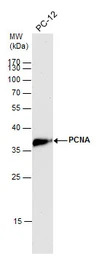
PCNA antibody detects PCNA protein by western blot analysis.
A. 30 μg PC-12 whole cell lysate/extract
12% SDS-PAGE
PCNA antibody (GTX100539) dilution: 1:2500
The HRP-conjugated anti-rabbit IgG antibody (GTX213110-01) was used to detect the primary antibody.
风险提示:丁香通仅作为第三方平台,为商家信息发布提供平台空间。用户咨询产品时请注意保护个人信息及财产安全,合理判断,谨慎选购商品,商家和用户对交易行为负责。对于医疗器械类产品,请先查证核实企业经营资质和医疗器械产品注册证情况。
 文献和实验
文献和实验In Vitro PCNA Modification Assays
Modification of the replicative sliding clamp, PCNA, by monoubiquitin, polyubiquitin, and SUMO contributes to the processing of DNA damage during replication. In order to investigate the properties of the relevant conjugation enzymes
Detection of PCNA Modifications in Saccharomyces cerevisiae
PCNA modifications by members of the ubiquitin family are associated with a range of different transactions during replication of damaged and undamaged DNA. This chapter describes detailed protocols for the detection and isolation
Flow Cytometric Detection of Proliferation-Associated Antigens, PCNA and Ki-67
The rapid evolution of monoclonal antibody (MAb) technology has resulted in an ever-growing repertoire of proteins becoming accessible for study using immunohistochemical techniques. Nuclear antigens represent a class of proteins
 技术资料
技术资料暂无技术资料 索取技术资料

