


Tocris货号6053现货LDN 193189 dihyd
rochloride上海睿安生物19121878899安迪Bio-Techne(R&D Systems-Tocris)官方正式授权代理商- ¥3500.01
- Tocris bioscience
- 6053
- 2026年07月05日

企业认证
相关产品推荐更多 >
Sigma货号MAK310氨检测试剂盒13611631389上海睿安生物
¥1747.56
Sigma货号D9132-5g现货2,2-联※苯基-1-苦基肼基(DPPH)上海睿安生物13611631389
¥5430.22
Sigma货号P8169-5Kg现货Phytagel植物凝胶13611631389上海睿安生物
¥14217.52
Tocris货号6227-1mg现货AT-Gap19上海睿安生物19121878899安迪Bio-Techne(R&D Systems-Tocris)官方正式授权代理商
¥4256.01
Tocris货号0821现货ICI 118,551 hydrochloride上海睿安生物19121878899安迪Bio-Techne(R&D Systems-Tocris)官方正式授权代理商
¥13678.01
万千商家帮你免费找货
0 人在求购买到急需产品
相关阅读
AJE 润色服务限时 8 折起,权威机构信任 15+ 年Cytoscape 教程来了!快速实现顶刊同款通路网络图五大应用案例:Mustang Q 膜层析应用全解析1 个小工具,一次性搞定流程图、质粒图谱和信号通路图- 详细信息
- 文献和实验
- 技术资料
- 英文名:
LDN 193189 dihydrochloride
- CAS号:
1435934-00-1
- 保质期:
1年
- 保存条件:
-20°C
- 库存:
30⁺瓶
- 供应商:
上海睿安生物19121878899
- 规格:
10mg/瓶
Tocris货号6053-1mg现货LDN 193189 dihydrochloride上海睿安生物19121878899
安迪Bio-Techne(R&D Systems-Tocris)官方正式授权代理商
Tocris货号6053-10mg现货LDN 193189 dihydrochloride上海睿安生物19121878899
安迪Bio-Techne(R&D Systems-Tocris)官方正式授权代理商
Tocris货号6053-50mg现货LDN 193189 dihydrochloride上海睿安生物19121878899
Chemical Name:4-[6-[4-(1-Piperazinyl)phenyl]pyrazolo[1,5-a]pyrimidin-3-yl]quinoline dihydrochloride
Purity:≥98%
Biological Activity
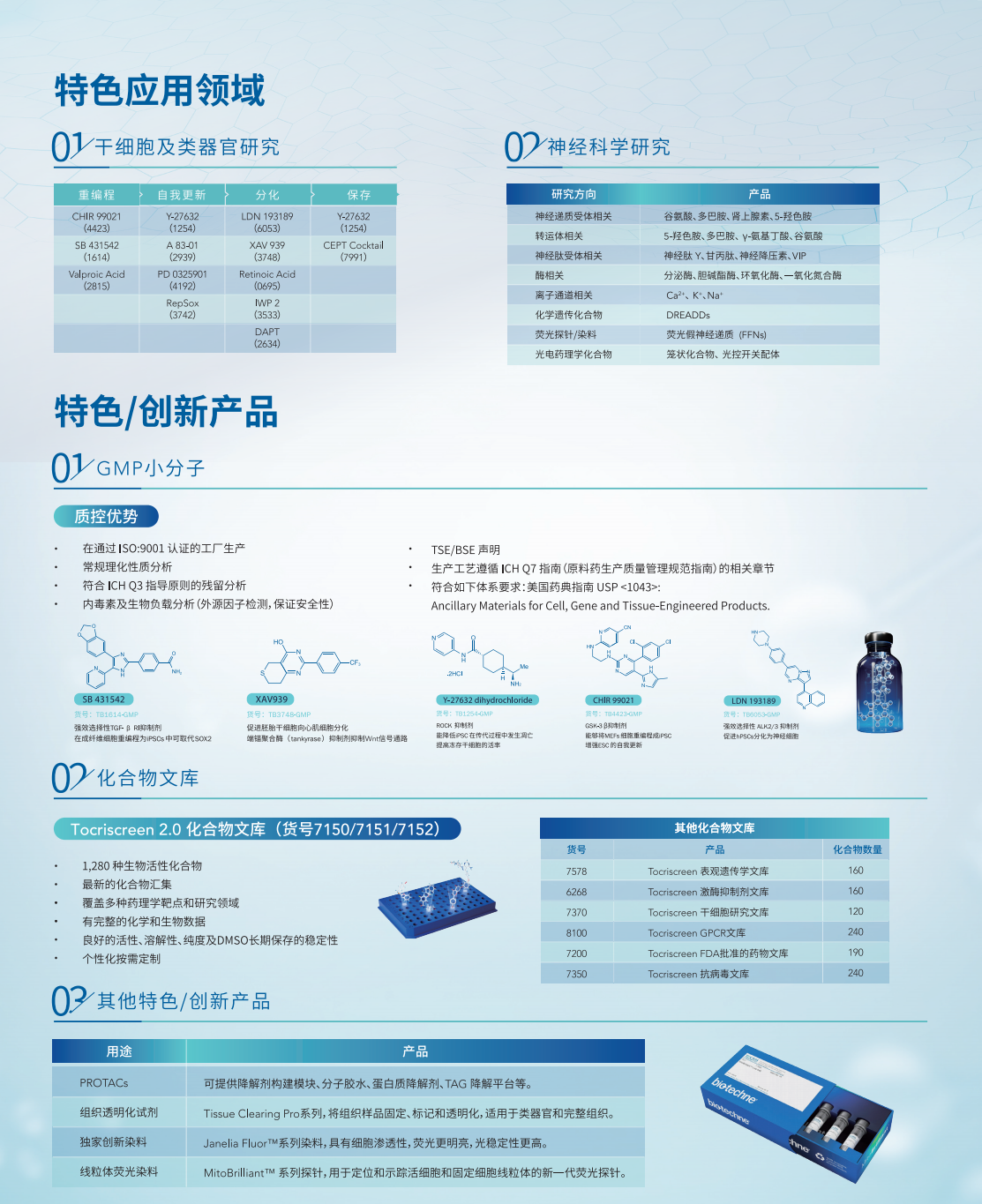
LDN 193189 dihydrochloride is a potent and selective ALK2 and ALK3 inhibitor (IC50 values are 5 and 30 nM, respectively); inhibits BMP4-mediated Smad1/5/8 activation. Exhibits >200-fold selectivity for BMP signaling over TGF-β signaling. Also exhibits selectivity over AMPK, PDGFR and MAPK signaling. Promotes neural induction of hPSCs in combination with SB 431542 (Cat.No. 1614). Also induces differentiation of hPSCs into nociceptive sensory neurons in combination with SB 431542 (Cat.No. 1614), SU 5402 (Cat.No.3300), CHIR 99021 (Cat.No. 4423) and DAPT (Cat.No. 2634). Used in protocols to generate pancreatic beta cells, or midbrain dopaminergic neurons from hPSCs (see below).
LDN 193189 synthesized to cGMP guidelines and LDN 193189 in solution also available.
For more information about how LDN 193189 dihydrochloride may be used,see our protocols: Generation of β cells from hPSCs,Generating Midbrain Dopaminergic Neurons from hPSCs,Accelerated Induction of Cortical Neurons from hiPSCs.
Scientific Data
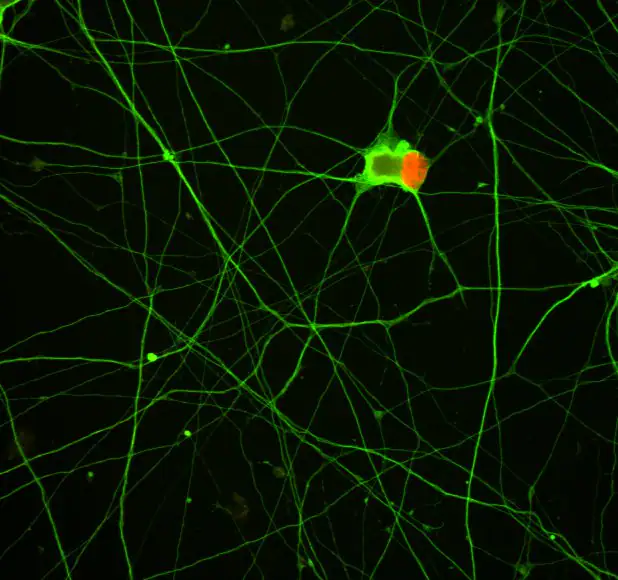
Application of LDN 193189 in motor neurons differentiated from iPSCs. Image shows IBJ6 human fibroblast induced pluripotent stem cells which have been differentiated into motor neurons. This was performed using a combination of LDN 193189 (100 nM) and SB 431542 (Catalog # 1614, Tocris) followed by Retinoic acid (Catalog # 0695, Tocris) and Purmorphamine (Catalog # 4551, Tocris) culture on Laminin for 18 days. Commitment to the motor neuron fate was assessed using the motor neuron marker anti-Human Islet-1 (red, R&D Systems, Catalog # AF1837) and the general neuronal marker, beta III tubulin (green, R&D Systems, Catalog # MAB1195). For visualization, the neurons were stained using Northernlights™ 557-conjugated Donkey anti-Goat Secondary Antibody (R&D Systems, Catalog # NL001) and Northernlights™ 493-conjugated Donkey anti-Mouse Secondary Antibody (R&D Systems, Catalog # NL009 NL009) and counterstained with DAPI (blue, Catalog # 5748, Tocris).
Technical Data
The technical data provided above is for guidance only. For batch specific data refer to the Certificate of Analysis.
Tocris products are intended for laboratory research use only, unless stated otherwise.
Background References
- Evidence of In�Vitro Preservation of Human Nephrogenesis at the Single-Cell Level
N Pode-Shakk, R Gershon, G Tam, D Omer, Y Gnatek, I Kanter, S Oriel, G Katz, O Harari-Ste, T Kalisky, B Dekel
Stem Cell Reports, 2017;0(0):. - BMP type I receptor inhibition reduces heterotopic ossification.
Yu et al.
Nat.Med., 2008;14:1363 - Combined small-molecule inhibition accelerates developmental timing and converts human pluripotent stem cells into nociceptors.
Chambers et al.
Nat.Biotechnol., 2012;30:715 - Structure-activity relationship study of bone morphogenetic protein (BMP) signaling inhibitors.
Cuny et al.
Bioorg.Med.Chem.Lett., 2008;18:4388 - Chemical approaches to stem cell biology and therapeutics.
Li et al.
Cell Stem Cell, 2013;13:270 - Generation of Cerebral Organoids from Human Pluripotent Stem Cells
Lancaster et al.
Nat.Protoc., 2015;9:2329 - In vitro generation of human pluripotent stem cell derived lung organoids.
Dye et al.
Elife, 2015; - Human blood vessel organoids as a model of diabetic vasculopathy.
Wimmer et al.
Nature, 2019;565:505 - Self-organization of axial polarity, inside-out layer pattern, and species-specific progenitor dynamics in human ES cell-derived neocortex.
Kadoshima et al.
Proc.Natl.Acad.Sci.USA., 2013;110:20284
Citations for LDN 193189 dihydrochloride
The citations listed below are publications that use Tocris products. Selected citations for LDN 193189 dihydrochloride include:
37 Citations: Showing 1 - 10
- A Robust Pipeline for the Multi-Stage Accelerated Differentiation of Functional 3D Cortical Organoids from Human Pluripotent Stem Cells.
Authors: Mustafa Et al.
Curr Protoc 2023;3:e641 - Expansion of ventral foregut is linked to changes in the enhancer landscape for organ-specific differentiation.
Authors: Sara Et al.
Nat Cell Biol 2023;25:481-492 - Generation and characterization of NGLY1 patient-derived midbrain organoids.
Authors: Wei Et al.
Front Cell Dev Biol 2023;11:1039182 - Multidimensional analysis and therapeutic development using patient iPSC-derived disease models of Wolfram syndrome.
Authors: Mark J Et al.
JCI Insight 2022;7 - Substantial somatic genomic variation and selection for BCOR mutations in human induced pluripotent stem cells.
Authors: Richard Et al.
Nat Genet 2022;54:1406-1416 - Classical Complement Pathway Inhibition in a Human-On-A-Chip" Model of Autoimmune Demyelinating Neuropathies."
Authors: Timothy Et al.
Adv Ther (Weinh) 2022;5 - An improved protocol for generation and characterization of human-induced pluripotent stem cell-derived retinal pigment epithelium cells.
Authors: Surendran Et al.
STAR Protoc 2022;3:101803 - Dynamic 3D Combinatorial Generation of hPSC-Derived Neuromesodermal Organoids With Diverse Regional and Cellular Identities.
Authors: Mustafa Et al.
Curr Protoc 2022;2:e568 - Derivation of nociceptive sensory neurons from hiPSCs with early patterning and temporally controlled NEUROG2 overexpression.
Authors: Emmanouil Et al.
Cell Rep Methods 2022;2:100341 - CRISPRi screens in human iPSC-derived astrocytes elucidate regulators of distinct inflammatory reactive states.
Authors: Shinong Et al.
Nat Neurosci 2022;25:1528-1542

风险提示:丁香通仅作为第三方平台,为商家信息发布提供平台空间。用户咨询产品时请注意保护个人信息及财产安全,合理判断,谨慎选购商品,商家和用户对交易行为负责。对于医疗器械类产品,请先查证核实企业经营资质和医疗器械产品注册证情况。
 文献和实验
文献和实验Tocris货号6053-1mg现货LDN 193189 dihydrochloride上海睿安生物19121878899
安迪Bio-Techne(R&D Systems-Tocris)官方正式授权代理商
Tocris货号6053-10mg现货LDN 193189 dihydrochloride上海睿安生物19121878899
安迪Bio-Techne(R&D Systems-Tocris)官方正式授权代理商
Tocris货号6053-50mg现货LDN 193189 dihydrochloride上海睿安生物19121878899
Chemical Name:4-[6-[4-(1-Piperazinyl)phenyl]pyrazolo[1,5-a]pyrimidin-3-yl]quinoline dihydrochloride
Purity:≥98%
Biological Activity
LDN 193189 dihydrochloride is a potent and selective ALK2 and ALK3 inhibitor (IC50 values are 5 and 30 nM, respectively); inhibits BMP4-mediated Smad1/5/8 activation. Exhibits >200-fold selectivity for BMP signaling over TGF-β signaling. Also exhibits selectivity over AMPK, PDGFR and MAPK signaling. Promotes neural induction of hPSCs in combination with SB 431542 (Cat.No. 1614). Also induces differentiation of hPSCs into nociceptive sensory neurons in combination with SB 431542 (Cat.No. 1614), SU 5402 (Cat.No.3300), CHIR 99021 (Cat.No. 4423) and DAPT (Cat.No. 2634). Used in protocols to generate pancreatic beta cells, or midbrain dopaminergic neurons from hPSCs (see below).
LDN 193189 synthesized to cGMP guidelines and LDN 193189 in solution also available.
For more information about how LDN 193189 dihydrochloride may be used,see our protocols: Generation of β cells from hPSCs,Generating Midbrain Dopaminergic Neurons from hPSCs,Accelerated Induction of Cortical Neurons from hiPSCs.
Scientific Data
Application of LDN 193189 in motor neurons differentiated from iPSCs. Image shows IBJ6 human fibroblast induced pluripotent stem cells which have been differentiated into motor neurons. This was performed using a combination of LDN 193189 (100 nM) and SB 431542 (Catalog # 1614, Tocris) followed by Retinoic acid (Catalog # 0695, Tocris) and Purmorphamine (Catalog # 4551, Tocris) culture on Laminin for 18 days. Commitment to the motor neuron fate was assessed using the motor neuron marker anti-Human Islet-1 (red, R&D Systems, Catalog # AF1837) and the general neuronal marker, beta III tubulin (green, R&D Systems, Catalog # MAB1195). For visualization, the neurons were stained using Northernlights™ 557-conjugated Donkey anti-Goat Secondary Antibody (R&D Systems, Catalog # NL001) and Northernlights™ 493-conjugated Donkey anti-Mouse Secondary Antibody (R&D Systems, Catalog # NL009 NL009) and counterstained with DAPI (blue, Catalog # 5748, Tocris).
Technical Data
The technical data provided above is for guidance only. For batch specific data refer to the Certificate of Analysis.
Tocris products are intended for laboratory research use only, unless stated otherwise.
Background References
- Evidence of In�Vitro Preservation of Human Nephrogenesis at the Single-Cell Level
N Pode-Shakk, R Gershon, G Tam, D Omer, Y Gnatek, I Kanter, S Oriel, G Katz, O Harari-Ste, T Kalisky, B Dekel
Stem Cell Reports, 2017;0(0):. - BMP type I receptor inhibition reduces heterotopic ossification.
Yu et al.
Nat.Med., 2008;14:1363 - Combined small-molecule inhibition accelerates developmental timing and converts human pluripotent stem cells into nociceptors.
Chambers et al.
Nat.Biotechnol., 2012;30:715 - Structure-activity relationship study of bone morphogenetic protein (BMP) signaling inhibitors.
Cuny et al.
Bioorg.Med.Chem.Lett., 2008;18:4388 - Chemical approaches to stem cell biology and therapeutics.
Li et al.
Cell Stem Cell, 2013;13:270 - Generation of Cerebral Organoids from Human Pluripotent Stem Cells
Lancaster et al.
Nat.Protoc., 2015;9:2329 - In vitro generation of human pluripotent stem cell derived lung organoids.
Dye et al.
Elife, 2015; - Human blood vessel organoids as a model of diabetic vasculopathy.
Wimmer et al.
Nature, 2019;565:505 - Self-organization of axial polarity, inside-out layer pattern, and species-specific progenitor dynamics in human ES cell-derived neocortex.
Kadoshima et al.
Proc.Natl.Acad.Sci.USA., 2013;110:20284
Citations for LDN 193189 dihydrochloride
The citations listed below are publications that use Tocris products. Selected citations for LDN 193189 dihydrochloride include:
37 Citations: Showing 1 - 10
- A Robust Pipeline for the Multi-Stage Accelerated Differentiation of Functional 3D Cortical Organoids from Human Pluripotent Stem Cells.
Authors: Mustafa Et al.
Curr Protoc 2023;3:e641 - Expansion of ventral foregut is linked to changes in the enhancer landscape for organ-specific differentiation.
Authors: Sara Et al.
Nat Cell Biol 2023;25:481-492 - Generation and characterization of NGLY1 patient-derived midbrain organoids.
Authors: Wei Et al.
Front Cell Dev Biol 2023;11:1039182 - Multidimensional analysis and therapeutic development using patient iPSC-derived disease models of Wolfram syndrome.
Authors: Mark J Et al.
JCI Insight 2022;7 - Substantial somatic genomic variation and selection for BCOR mutations in human induced pluripotent stem cells.
Authors: Richard Et al.
Nat Genet 2022;54:1406-1416 - Classical Complement Pathway Inhibition in a Human-On-A-Chip" Model of Autoimmune Demyelinating Neuropathies."
Authors: Timothy Et al.
Adv Ther (Weinh) 2022;5 - An improved protocol for generation and characterization of human-induced pluripotent stem cell-derived retinal pigment epithelium cells.
Authors: Surendran Et al.
STAR Protoc 2022;3:101803 - Dynamic 3D Combinatorial Generation of hPSC-Derived Neuromesodermal Organoids With Diverse Regional and Cellular Identities.
Authors: Mustafa Et al.
Curr Protoc 2022;2:e568 - Derivation of nociceptive sensory neurons from hiPSCs with early patterning and temporally controlled NEUROG2 overexpression.
Authors: Emmanouil Et al.
Cell Rep Methods 2022;2:100341 - CRISPRi screens in human iPSC-derived astrocytes elucidate regulators of distinct inflammatory reactive states.
Authors: Shinong Et al.
Nat Neurosci 2022;25:1528-1542
- - - - - C687 KGF - - - - - 50ng/ml 50ng/ml - - - CH73 Vitamin C - - - - - - 0.25mM 0.25 mM 0.25 mM 0.25 mM LDN-193189 - - - - - - 0.1μM 0.1 μM 0.1 μM - GDC
- - - - - 5 ng/ml C198 GDNF - - - - - - - 1 ng/ml 2 ng/ml 2 ng/ml - - - - C226 R-spondin 1 - - - - - - - - - 100 ng/ml - - - - CX83 LDN193189 - - - - 100 nM 30 nM 10 nM
 技术资料
技术资料需要更多技术资料 索取更多技术资料

