


- ¥1380 - 2200
- LMAI Bio
- LM-8506R
- 进口/国产
- 2026年05月25日
- WB=1:500-2000 ELISA=1:500-1000 IHC-P=1:400-800 IHC-F=1:400-800 Flow-Cyt=1μg/Test IF=1:50-200 (石蜡切片需做抗原修复)
- Rabbit
- Human, Mouse, Rat, Pig,

企业认证
相关产品推荐更多 >


万千商家帮你免费找货
0 人在求购买到急需产品
相关阅读
AI 赋能培养基定制开发:CHO 培养基是如何实现产量提升Cytoscape 教程来了!快速实现顶刊同款通路网络图五大应用案例:Mustang Q 膜层析应用全解析1 个小工具,一次性搞定流程图、质粒图谱和信号通路图- 详细信息
- 文献和实验
- 技术资料
- 供应商:
上海联迈生物工程有限公司
- 库存:
大量
- 目录编号:
LM-8506R
- 克隆性:
多克隆
- 抗原来源:
Rabbit
- 保质期:
1年
- 抗体英文名:
OSTM1
- 抗体名:
骨硬化病相关跨膜蛋白1抗体
- 宿主:
Rabbit
- 适应物种:
Human, Mouse, Rat, Pig,
- 免疫原:
KLH conjugated synthetic peptide derived from human OSTM1:21-120/334 <Extracellular>
- 亚型:
IgG
- 形态:
Lyophilized or Liquid
- 应用范围:
WB=1:500-2000 ELISA=1:500-1000 IHC-P=1:400-800 IHC-F=1:400-800 Flow-Cyt=1μg/Test IF=1:50-200 (石蜡切片需做抗原修复)
- 浓度:
1mg/ml
- 保存条件:
Store at -20 °C
- 规格:
100ul 200ul
| 英文名称 | OSTM1 |
| 中文名称 | 骨硬化病相关跨膜蛋白1抗体 |
| 别 名 | GAIP-interacting protein N terminus; GIPN; GL antibody Grey lethal osteopetrosis; HSPC019; OPTB5; Osteopetrosis-associated transmembrane protein 1; Ostm1; OSTM1_HUMAN. |
| 规格价格 | 100ul/1380元 购买 200ul/2200元 购买 大包装/询价 |
| 说 明 书 | 100ul 200ul |
| 研究领域 | |
| 抗体来源 | Rabbit |
| 克隆类型 | Polyclonal |
| 交叉反应 | Human, Mouse, Rat, Pig, |
| 产品应用 | WB=1:500-2000 ELISA=1:500-1000 IHC-P=1:400-800 IHC-F=1:400-800 Flow-Cyt=1μg/Test IF=1:50-200 (石蜡切片需做抗原修复) not yet tested in other applications. optimal dilutions/concentrations should be determined by the end user. |
| 分 子 量 | 33kDa |
| 细胞定位 | 细胞膜 |
| 性 状 | Lyophilized or Liquid |
| 浓 度 | 1mg/ml |
| 免 疫 原 | KLH conjugated synthetic peptide derived from human OSTM1:21-120/334 <Extracellular> |
| 亚 型 | IgG |
| 纯化方法 | affinity purified by Protein A |
| 储 存 液 | 0.01M TBS(pH7.4) with 1% BSA, 0.03% Proclin300 and 50% Glycerol. |
| 保存条件 | Store at -20 °C for one year. Avoid repeated freeze/thaw cycles. The lyophilized antibody is stable at room temperature for at least one month and for greater than a year when kept at -20°C. When reconstituted in sterile pH 7.4 0.01M PBS or diluent of antibody the antibody is stable for at least two weeks at 2-4 °C. |
| PubMed | PubMed |
| 产品介绍 | background: OSTM1 (osteopetrosis associated transmembrane protein 1), also known as gl (gray-lethal) or HSPC019, is a 338 amino acid single-pass type I membrane protein that is expressed primarily in osteoclasts and melanocytes as well as brain, kidney and spleen. Bone autosomal recessive osteopetrosis (ARO) is the most severe form of hereditary bone disease whose cellular basis is in the osteoclast and is characterized by abnormally dense bone, due to defective resorption of immature bone. ARO is suggested to be caused by mutations in the OSTM1 gene. The disorder occurs in two forms: a severe autosomal recessive form occurring in utero, infancy, or childhood, and a benign autosomal dominant form occurring in adolescence or adulthood. Defects in the OSTM1 gene are also the cause of the spontaneous gl mutant, which is responsible for a coat color defect in mice. Function: Required for osteoclast and melanocyte maturation and function (By similarity). Subcellular Location: Membrane; Single-pass type I membrane protein. DISEASE: Defects in OSTM1 are the cause of osteopetrosis autosomal recessive type 5 (OPTB5) [MIM:259720]; also called infantile malignant osteopetrosis 3. Osteopetrosis is a rare genetic disease characterized by abnormally dense bone, due to defective resorption of immature bone. The disorder occurs in two forms: a severe autosomal recessive form occurring in utero, infancy, or childhood, and a benign autosomal dominant form occurring in adolescence or adulthood. OPTB5 patients manifest primary central nervous system involvement in addition to the classical stigmata of severe bone sclerosis, growth failure, anemia, thrombocytopenia and visual impairment with optic atrophy. SWISS: Q86WC4 Gene ID: 28962 Database links: Entrez Gene: 28962 Human Entrez Gene: 14628 Mouse Entrez Gene: 499474 Rat Omim: 607649 Human SwissProt: Q86WC4 Human SwissProt: Q8BGT0 Mouse Unigene: 226780 Human Important Note: This product as supplied is intended for research use only, not for use in human, therapeutic or diagnostic applications. |
| 产品图片 | 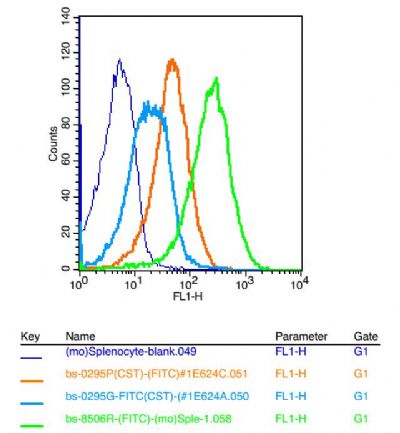 Positive control: mouse Splenocytes(2% Paraformaldehyde-fixed ) Isotype Control Antibody: Rabbit IgG; Dilution: 1μg in 100 μl 1 X PBS containing 0.5% BSA Secondary Antibody: Goat anti-rabbit IgG-FITC; Dilution: 1:200 in 1 X PBS containing 0.5% BSA Primary Antibody :rabbit Anti-OSTM1 (bs-8506R); Dilution: 1μg in 100 μl 1X PBS containing 0.5% BSA |
风险提示:丁香通仅作为第三方平台,为商家信息发布提供平台空间。用户咨询产品时请注意保护个人信息及财产安全,合理判断,谨慎选购商品,商家和用户对交易行为负责。对于医疗器械类产品,请先查证核实企业经营资质和医疗器械产品注册证情况。
 文献和实验
专用间充质干细胞培养基,细胞培养24小时后,再替换为完全的外排体专用间充质干细胞的进行。 20、关于外泌体红色荧光标记染料(PKH26 / PKH67 )相关实验事项注意事项 a、建议用于染料标记的外泌体原始浓度达到0.5~1μg/μL。外泌体浓度过低实验失败风险较高。 b、外泌体染色步骤中去除游离染料的第4、5步必备,以色列游离染料对更新实验的干扰。这一步即将重新去除外泌体,所有外泌体去除封闭方式均适用。 c、去除游离染料的方法是按照外泌体提取方法再次提取外泌体,推荐umibio外泌体提取
TM4SF1:从抗血管新生到免疫逃逸调控,这个四次跨膜蛋白靶点还有多少惊喜?
跨膜4 L6家族成员1(TM4SF1)是四次跨膜蛋白L6超家族成员,在正常组织中低表达,但在胰腺癌、肝癌、卵巢癌、膀胱癌等多种上皮性恶性肿瘤中异常高表达,参与肿瘤细胞增殖、迁移、侵袭和血管生成。近年来,TM4SF1研究已从传统血管新生靶点拓展至免疫微环境调控和铁死亡等前沿领域。2025年《Clinical and Molecular Hepatology》研究揭示TM4SF1通过AKT通路调控肝细胞癌(HCC)细胞衰老和免疫逃逸,高表达TM4SF1与抗PD-1治疗耐药相关,靶向TM
到细胞外;微囊泡(Microvesicles)直径为 100-1000 nm,以出芽的形式释放到细胞外;凋亡小体(Apoptotic body)直径为 50-2000 nm,由凋亡细胞产生。由于各种胞外囊泡的大小可能有交叉,所以要想通过分离手段得到某种纯化的特定囊泡是很难实现的。 图一 胞外囊泡的分泌 (图片来源于文献) 外泌体携带有细胞来源相关的多种蛋白质、脂类和核酸,其中蛋白质包括跨膜蛋白、信号转导蛋白、细胞支架蛋白、酶等,现在很多文献会选择其中的几种膜蛋白和膜内蛋白作为外泌体的鉴定
 技术资料
暂无技术资料 索取技术资料