


- ¥1000
- 钦诚生物
- 上海
- QC0662
- 2026年05月21日

企业认证
相关产品推荐更多 >

万千商家帮你免费找货
0 人在求购买到急需产品
相关阅读
香烟烟雾如何加速声带纤维化?CD44-透明质酸轴是关键通路Cytoscape 教程来了!快速实现顶刊同款通路网络图五大应用案例:Mustang Q 膜层析应用全解析1 个小工具,一次性搞定流程图、质粒图谱和信号通路图- 详细信息
- 询价记录
- 文献和实验
- 技术资料
- 保存条件:
负20度
- 保质期:
2年
- 供应商:
钦诚生物
- 规格:
5ug
基本信息
| 复制子: | ori Ec |
|---|---|
| 终止子: | T1 |
| 质粒分类: | 金黄色葡萄球菌质粒 |
| 质粒大小: | 6.97kb |
| 原核抗性: | 氨苄青霉素Ampicillin |
| 筛选标记: | 氯霉素Chloramphenicol |
| 克隆菌株: | DH5α |
| 培养条件: | 30℃,有氧,LB |
| 表达宿主: | 金黄色葡萄球菌等革兰氏阳性菌 |
| 备注: | 金黄色葡萄球菌基因敲除载体 |
质粒简介
该载体是大肠杆菌-金黄色葡萄球菌穿梭载体,低拷贝,在大肠中抗性为氨苄,在金葡菌中抗性为氯霉素。该质粒具有温度敏感性。
相关的配套菌株为RN4220金黄色葡萄球菌, 相关的载体为pKOR1载体。
Protocols for gene deletion in Staphylococcus aureus Nov. 1, 2007
Preparation of competent Staphylococcus aureus cells
1. Remove Staphylococcus aureus cells from the vial with a sterile toothpick or inoculation loop, and streak it out on LB agar.
2. Incubate at 37°C overnight.
3. Pick a single colony and inoculate it in 5-10 ml of LB. Grow at 37°C overnight.
4. Add 1 ml overnight culture to 100 ml LB medium in a 500 ml flask, and shake at 37°C until an OD600 of 0.4 is reached (approximately 90–120 min).
5. Cool the culture on ice for 5 min, and transfer the culture to a sterile, round-bottom centrifuge tube.
6. Collect the cells by centrifugation at low speed (5-10 min, 2500 x g, 4°C).
7. Discard the supernatant carefully. Always keep the cells on ice.
8. Resuspend the cells gently in 0.5 M sucrose (10-15 ml for a 100 ml culture) at 4°C and keep the suspension on ice for additional 5 min.
9. Collect the cells by centrifugation (5 min, 2500 x g, 4°C).
10. Discard the supernatant carefully. Repeat step 8 and 9.
11. Resuspend the cells carefully in 1 ml ice-cold 0.5 M sucrose and keep the suspension on ice for 15 min.
12. Prepare aliquots of 100–200 μl in sterile microcentrifuge tubes and freeze in liquid nitrogen. Store the competent cells at –70°C.
Construction of deletion vector
1. PCR amplify a 400 bp fragment upstream and a 400 bp fragment downstream of the target gene.
2. PCR amplify the ermB (Em resistance marker) from pECI.
3. Digest the three fragments, ligate, and PCR amplify the ligated product.
4. Purify the PCR product, double digest it, and ligate it into pBT2.
5. Transform the ligated product into E. coli.
6. Pick clones that can grow on the LB plate containing Em (100 mg/ml), purify the plasmid and digest it.
7. If the result of enzyme digestion is correct, get further confirmation by sequencing.
Procedure for electroporation
1. Mix 500 ng of plasmid DNA with electrocompetent Staphylococcus aureus cells and place them in a Gene Pulser cuvette with a 0.2 cm electrode gap.
2. The settings for electroporation are as follows: Voltage, 2.5 kV; capacitor, 50 μF; resistance, 200 ohms.
3. After electroporation the cells are immediately placed in 400 μl of TSB with shaking (200-220 rpm, 37°C) for 1h. Plate the cells on Em-containing medium and incubate at 37°C.
Modify deletion vector
1. Before transform the plasmid into Staphylococcus aureus NCTC8325, the plasmid should be transformed into Staphylococcus aureus RN4220.
2. Pick clones, after overnight growth, extract the plasmid.
3. Then the plasmid is modified and can’t be digested by restriction enzyme system of NCTC8325.
Deletion of target gene
1. Extract plasmid from RN4220, transform it into NCTC8325.
2. Pick up clones, incubate in B-medium, 30°C, grow to late-stationary phase, then change temperature to 40°C, and grow overnight.
3. 1: 100 dilute the culture into fresh B-medium, and grow overnight.
4. Follow step 3, spread 1 μl overnight culture (diluted into 100 μl) on agar plate (containing Em 2.5 mg/ml). Screen clones which are Em-resistant and Cm-sensitive.
5. Repeat step 4 until Em-resistant, Cm-sensitive clones are found.
6. Extract genome DNA of these clones, use PCR for further check.
质粒图谱
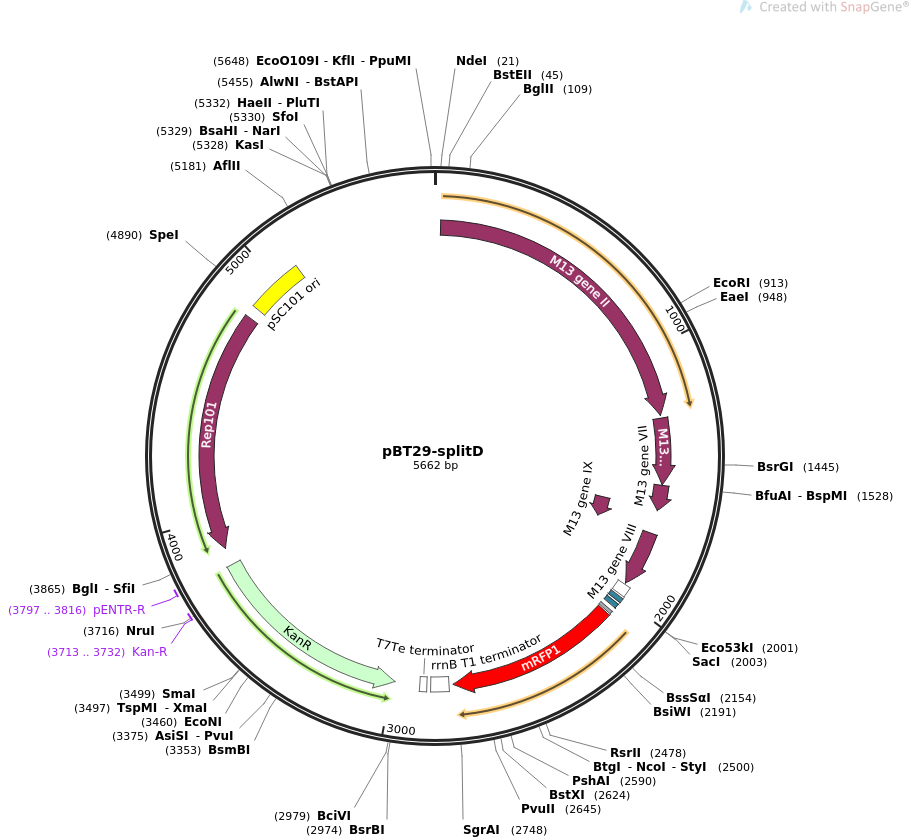
pBT2葡萄球菌表达质粒使用说明:
1、收到质粒干粉后请先5000rpm离心1min,再加入20μl无菌水溶解质粒,室温放置1min;
2、从-80℃冰箱中取出相应的感受态,置于冰盒上解冻,并做好标记;
3、取2μl质粒加至100μl感受态中,冰浴30min;
4、42℃热激90s,再冰浴2min;
5、加入900μl无抗的LB液体培养基,180rpm震荡培养45min;
6、6000rpm离心5min,仅留100ul上清混匀菌体沉淀;
7、混匀后的菌液加至对应抗性的LB平板上,倒入适量玻璃珠,涂匀液体;
8、将平板正向培养1h,再倒置培养12h~16h;
9、挑取单克隆菌落至对应抗性的LB液体培养基中,震荡培养12h~16h,根据实验需要提取质粒。
pBT2葡萄球菌表达质粒注意事项:
1、如果您收到的是甘油菌种,请先四区划线,挑取单克隆培养。
2、如果第二天转化平板长的过多,请将质粒按比例稀释后再转化。
风险提示:丁香通仅作为第三方平台,为商家信息发布提供平台空间。用户咨询产品时请注意保护个人信息及财产安全,合理判断,谨慎选购商品,商家和用户对交易行为负责。对于医疗器械类产品,请先查证核实企业经营资质和医疗器械产品注册证情况。
 询价记录
询价记录 暂无询价记录
 文献和实验
文献和实验研究领域中,CRISPR 技术日渐成熟,当然每家公司所使用的具体 protocol 跟质粒载体不尽相同,做出来的稳定细胞株还是有点差异的,编者就不多赘述。还有少数公司比如汉尹公司,也可以利用 CRISPR/Cas9 技术去提高细胞内源基因的表达,效果可以与转染过表达质粒相媲美,避免了外源基因对细胞的影响,优势显而易见。作为一家成熟的抗体公司,我们也会利用 CRISPR/Cas9 去 knockout 做敲除验证,这对于抗体特异性的判断是用 siRNA 所不能比的。如果研究人员经常利用 CRISPR
发表[1,2,3]。国内针对外源基因在原核细胞中高效表达的关键因素,构建了高效表达载体[4],并在此基础上成功表达了一系列细胞因子的基因[5,6,7]。我们在分析了国内外有关在原核系统中表达蛋白的实验资料的基础上,对在大肠杆菌中高效表达外源蛋白的策略所涉及的内容进行全面的总结,以期有助于我国在这方面的研究。 1.有效表达载体的构型 构建表达质粒需要多种元件,需要仔细考虑它们的组合,以保证最高水平的蛋白质合成。E.coli 表达载体的基本结构[8]。 启动子(以杂和的tac 启动子为例
来源的信息以鉴别 MutH 中的那些氨基酸残基,它们作为可能的候选者,用来感知 d (GATC) 位点的甲基化状态,即一条链上,甲基在腺嘌呤 N6 上存在,而在另一条链上则不存在这样的甲基。 已知在大肠杆菌、流感嗜血杆菌、霍乱弧菌、ShewaneWaoweWensis 和 CoZweZZzasp. 中都鉴定出了 MutH 蛋白;有可能在这些高度同源的蛋白质中,那些负责感知 d (GATC) 位甲基化状态的氨基酸残基是保守的。MutH 与限制性酶,如来自于金黄色葡萄球菌的 Sau3AI 存在
 技术资料
技术资料暂无技术资料 索取技术资料

