

- ¥1380 - 2200
- LMAI Bio
- LM-11272R
- 进口/国产
- 2026年11月02日
- WB=1:500-2000 ELISA=1:500-1000 IHC-P=1:400-800 IHC-F=1:400-800 ICC=1:100-500 IF=1:100-500 (石蜡切片需做抗原修复)
- Rabbit
- Human, Mouse, Rat, Dog, Cow, Horse,

企业认证
相关产品推荐更多 >




万千商家帮你免费找货
0 人在求购买到急需产品
相关阅读
细胞污染识别与处理全攻略:5 种常见类型+关键误区Cytoscape 教程来了!快速实现顶刊同款通路网络图五大应用案例:Mustang Q 膜层析应用全解析1 个小工具,一次性搞定流程图、质粒图谱和信号通路图- 详细信息
- 文献和实验
- 技术资料
- 供应商:
上海联迈生物工程有限公司
- 库存:
大量
- 目录编号:
LM-11272R
- 克隆性:
多克隆
- 抗原来源:
Rabbit
- 保质期:
1年
- 抗体英文名:
WFS1
- 抗体名:
Wolfram综合征蛋白1抗体
- 宿主:
Rabbit
- 适应物种:
Human, Mouse, Rat, Dog, Cow, Horse,
- 免疫原:
KLH conjugated synthetic peptide derived from human WFS1:791-890/890
- 亚型:
IgG
- 形态:
Lyophilized or Liquid
- 应用范围:
WB=1:500-2000 ELISA=1:500-1000 IHC-P=1:400-800 IHC-F=1:400-800 ICC=1:100-500 IF=1:100-500 (石蜡切片需做抗原修复)
- 浓度:
1mg/ml
- 保存条件:
Store at -20 °C
- 规格:
100ul 200ul
| 英文名称 | WFS1 |
| 中文名称 | Wolfram综合征蛋白1抗体 |
| 别 名 | DFNA14; DFNA38; DFNA6; DIDMOAD; WFRS; WFS; Wolfram syndrome 1 (wolframin); Wolfram syndrome; WOLFRAMIN; WFS1_HUMAN. |
| 规格价格 | 100ul/1380元 购买 200ul/2200元 购买 大包装/询价 |
| 说 明 书 | 100ul 200ul |
| 研究领域 | 肿瘤 神经生物学 信号转导 生长因子和激素 糖尿病 新陈代谢 |
| 抗体来源 | Rabbit |
| 克隆类型 | Polyclonal |
| 交叉反应 | Human, Mouse, Rat, Dog, Cow, Horse, |
| 产品应用 | WB=1:500-2000 ELISA=1:500-1000 IHC-P=1:400-800 IHC-F=1:400-800 ICC=1:100-500 IF=1:100-500 (石蜡切片需做抗原修复) not yet tested in other applications. optimal dilutions/concentrations should be determined by the end user. |
| 分 子 量 | 97kDa |
| 细胞定位 | 细胞浆 细胞膜 |
| 性 状 | Lyophilized or Liquid |
| 浓 度 | 1mg/ml |
| 免 疫 原 | KLH conjugated synthetic peptide derived from human WFS1:791-890/890 |
| 亚 型 | IgG |
| 纯化方法 | affinity purified by Protein A |
| 储 存 液 | 0.01M TBS(pH7.4) with 1% BSA, 0.03% Proclin300 and 50% Glycerol. |
| 保存条件 | Store at -20 °C for one year. Avoid repeated freeze/thaw cycles. The lyophilized antibody is stable at room temperature for at least one month and for greater than a year when kept at -20°C. When reconstituted in sterile pH 7.4 0.01M PBS or diluent of antibody the antibody is stable for at least two weeks at 2-4 °C. |
| PubMed | PubMed |
| 产品介绍 | background: Wolfram syndrome protein (WFS1) is an 890 amino acid protein that contains a cytoplasmic N-terminal domain, followed by nine-transmembrane domains and a luminal C-terminal domain. WFS1 is predominantly localized to the endoplasmic reticulum (ER) (1) and its expression is induced in response to ER stress, partially through transcriptional activation (2,3). Research studies have shown that mutations in the WFS1 gene lead to Wolfram syndrome, an autosomal recessive neurodegenerative disorder defined by young-onset, non-immune, insulin-dependent diabetes mellitus and progressive optic atrophy (4). Function: WFS1 is a novel component of Wolfram syndrome, a rare form of juvenile diabetes. WFS1 plays an important role in maintaining homeostasis of the endoplasmic reticulum (ER) in the pancreas. It is normally up-regulated during insulin secretion, whereas inactivation of the protein can cause ER stress. Chronic ER stress is a major involvement in Wolfram syndrome. Subcellular Location: Endoplasmic reticulum; endoplasmic reticulum membrane; multipass membrane protein Tissue Specificity: Highly expressed in heart followed by brain, placenta, lung and pancreas. Weakly expressed in liver, kidney and skeletal muscle. Also expressed in islet and beta-cell insulinoma cell line. DISEASE: Defects in WFS1 are the cause of Wolfram syndrome type 1 (WFS1) [MIM:222300]. A rare autosomal recessive disorder characterized by juvenile diabetes mellitus, diabetes insipidus, optic atrophy, deafness and various neurological symptoms. Defects in WFS1 are the cause of deafness autosomal dominant type 6 (DFNA6) [MIM:600965]; also called non-syndromic sensorineural deafness autosomal dominant type 14 (DFNA14) or non-syndromic sensorineural deafness autosomal dominant type 38 (DFNA38). DFNA6 is a form of sensorineural hearing loss. Sensorineural deafness results from damage to the neural receptors of the inner ear, the nerve pathways to the brain, or the area of the brain that receives sound information. DFNA6 is a low-frequency hearing loss in which frequencies of 2000 Hz and below are predominantly affected. Many patients have tinnitus, but there are otherwise no associated features such as vertigo. Because high-frequency hearing is generally preserved, patients retain excellent understanding of speech, although presbycusis or noise exposure may cause high-frequency loss later in life. DFNA6 worsens over time without progressing to profound deafness. Defects in WFS1 are the cause of Wolfram-like syndrome autosomal dominant (WFSL) [MIM:614296]. A disease characterized by the clinical triad of congenital progressive hearing impairment, diabetes mellitus, and optic atrophy. The hearing impairment, which is usually diagnosed in the first decade of life, is relatively constant and alters mainly low- and middle-frequency ranges. SWISS: O76024 Gene ID: 7466 Database links: Entrez Gene: 7466 Human Entrez Gene: 22393 Mouse Entrez Gene: 83725 Rat Omim: 606201 Human SwissProt: O76024 Human SwissProt: P56695 Mouse Unigene: 518602 Human Unigene: 20916 Mouse Unigene: 229139 Rat Important Note: This product as supplied is intended for research use only, not for use in human, therapeutic or diagnostic applications. |
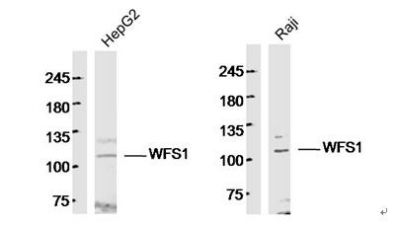
| 产品图片 | 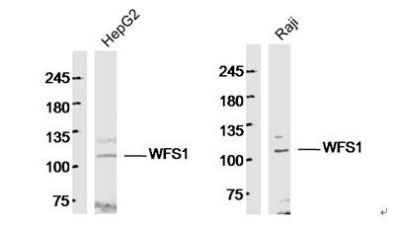 Sample: HepG2 Cell (Human)Lysate at 40 ug Raji Cell (Human)Lysate at 40 ug Primary: Anti-WFS1 (bs-11272R) at 1/300 dilution Secondary: IRDye800CW Goat Anti-Rabbit IgG at 1/20000 dilution Predicted band size: 97 kD Observed band size: 105 kD |
风险提示:丁香通仅作为第三方平台,为商家信息发布提供平台空间。用户咨询产品时请注意保护个人信息及财产安全,合理判断,谨慎选购商品,商家和用户对交易行为负责。对于医疗器械类产品,请先查证核实企业经营资质和医疗器械产品注册证情况。
 文献和实验
藻胆〔蛋白〕体 phycobilisome 在蓝藻和红藻中,其藻胆色素蛋白在活体内以蛋白颗粒状态存在,规则地排列在类囊体的外面,其所捕获的光能可以传给与类囊体膜内的蛋白结合的叶绿素a。此藻胆色素蛋白的聚合体,称为藻胆蛋白体。这是E.Gantt和S.F.Conti(1966)用电子显微镜观察紫球藻时发现的。是藻胆色素蛋白六聚体10至30个聚到一起而成的蛋白颗粒,别藻蓝蛋白六聚体六个单位形成核心,再呈辐射状,最多可排列六条,并由藻蓝蛋白和藻红蛋白六聚体3-4个单位形成棒状聚合
质形态。常用的蛋白质表达系统,例如大肠杆菌、昆虫细胞和哺乳动物细胞等都属于体内系统并且受到细胞膜的约束作用,其产量和稳定性都相对较低。与这些蛋白质表达系统相比,亚诺法推出的这一系统有着显着的优越性。此外,体外小麦胚系统能够经得起自动化高通量小分子生物筛选以及特征描述的考验。 体外小麦胚系统+ 脂质体技术之优势 产量更高 稳定性更高 高表达成功率 天然蛋白构型 易用于自动化 膜蛋白脂蛋白体类别 聚类分化
泛素-蛋白酶体系统(ubiquitin-proteasome system, UPS)是细胞内蛋白质降解的主要途径,参与细胞内80%以上蛋白质的降解。本视频清楚地解析了泛素-蛋白酶体系统的作用及工作流程。 泛素-蛋白酶体系统作用及工作流程
 技术资料
暂无技术资料 索取技术资料