


- ¥1580 - 2480
- gelatins
- jlcR5977
- 国内
- 2025年07月12日
- WB,ELISA等
- 人/动物/植物

企业认证
相关产品推荐更多 >

万千商家帮你免费找货
0 人在求购买到急需产品
相关阅读
香烟烟雾如何加速声带纤维化?CD44-透明质酸轴是关键通路Takara 秋促来袭,提取+反转录+定量套装仅 1200 元abinScience 体内级抗体 全年锁价 低至 ¥1200阿拉丁 22万+ 科研级产品现货速发,品质严控、科研无忧- 详细信息
- 文献和实验
- 技术资料
- 供应商:
江西江蓝纯生物试剂有限公司
- 库存:
149
- 克隆性:
单克隆
- 保质期:
1年
- 抗体英文名:
c-Maf
- 抗体名:
原癌基因cMAF抗体
- 适应物种:
人/动物/植物
- 应用范围:
WB,ELISA等
- 浓度:
1mg/ml
- 保存条件:
-20 °
- 规格:
100ul/200ul
| 规格: | 100ul | 产品价格: | ¥1580.0 |
|---|---|---|---|
| 规格: | 200ul | 产品价格: | ¥2480.0 |
英文名称 : c-Maf
中文名称 : 原癌基因cMAF抗体
别 名 : AS42 oncogene homolog; Avian musculoaponeurotic fibrosarcoma (MAF) protooncogene; Avian musculoaponeurotic fibrosarcoma (v maf); c maf proto oncogene; cMaf; c Maf; MAF; MAF2; MGC71685; Proto oncogene c Maf; v maf musculoaponeurotic fibrosarcoma oncogene homolog (avian); v maf musculoaponeurotic fibrosarcoma oncogene homolog; transcription factor Maf isoform a.
研究领域 : 肿瘤 细胞生物 免疫学 染色质和核信号 转录调节因子
抗体来源 : Rabbit
克隆类型 : Polyclonal
交叉反应 : Human, Mouse, Rat,
产品应用 : ELISA=1:500-1000 IHC-P=1:400-800 IHC-F=1:400-800 IF=1:100-500 (石蜡切片需做抗原修复)
not yet tested in other applications.
optimal dilutions/concentrations should be determined by the end user.
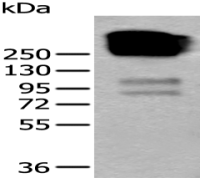
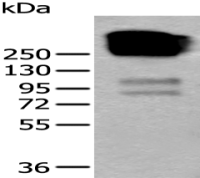
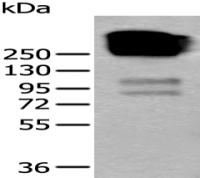
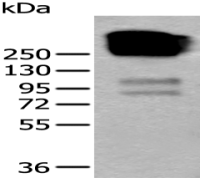
分 子 量 : 41kDa
细胞定位 : 细胞核
性 状 : Lyophilized or Liquid
浓 度 : 1mg/ml
免 疫 原 : KLH conjugated synthetic peptide derived from human c-Maf:341-403/403
亚 型 : IgG
纯化方法 : affinity purified by Protein A
储 存 液 : 0.01M TBS(pH7.4) with 1% BSA, 0.03% Proclin300 and 50% Glycerol.
保存条件 : Store at -20 °C for one year. Avoid repeated freeze/thaw cycles. The lyophilized antibody is stable at room temperature for at least one month and for greater than a year when kept at -20°C. When reconstituted in sterile pH 7.4 0.01M PBS or diluent of antibody the antibody is stable for at least two weeks at 2-4 °C.
PubMed : PubMed
产品介绍 : The protein encoded by this gene is a DNA-binding, leucine zipper-containing transcription factor that acts as a homodimer or as a heterodimer. Depending on the binding site and binding partner, the encoded protein can be a transcriptional activator or repressor. This protein plays a role in the regulation of several cellular processes, including embryonic lens fiber cell development, increased T-cell susceptibility to apoptosis, and chondrocyte terminal differentiation. Defects in this gene are a cause of juvenile-onset pulverulent cataract as well as congenital cerulean cataract 4 (CCA4). Two transcript variants encoding different isoforms have been found for this gene. [provided by RefSeq, Jan 2010].
Function:
Acts as a transcriptional activator or repressor. Involved in embryonic lens fiber cell development. Recruits the transcriptional coactivators CREBBP and/or EP300 to crystalline promoters leading to up-regulation of crystallin gene during lens fiber cell differentiation. Activates the expression of IL4 in T helper 2 (Th2) cells. Increases T-cell susceptibility to apoptosis by interacting with MYB and decreasing BCL2 expression. Together with PAX6, transactivates strongly the glucagon gene promoter through the G1 element. Activates transcription of the CD13 proximal promoter in endothelial cells. Represses transcription of the CD13 promoter in early stages of myelopoiesis by affecting the ETS1 and MYB cooperative interaction. Involved in the initial chondrocyte terminal differentiation and the disappearance of hypertrophic chondrocytes during endochondral bone development. Binds to the sequence 5'-[GT]G[GC]N[GT]NCTCAGNN-3' in the L7 promoter. Binds to the T-MARE (Maf response element) sites of lens-specific alpha- and beta-crystallin gene promoters. Binds element G1 on the glucagon promoter. Binds an AT-rich region adjacent to the TGC motif (atypical Maf response element) in the CD13 proximal promoter in endothelial cells (By similarity). When overexpressed, represses anti-oxidant response element (ARE)-mediated transcription. Involved either as an oncogene or as a tumor suppressor, depending on the cell context. Binds to the ARE sites of detoxifying enzyme gene promoters.
Subunit:
Homodimer or heterodimer with other bHLH-Zip transcription factors. Binds DNA as a homodimer or as a heterodimer. Heterotetramer of two MAF and two USF2. Interacts with PAX6; the interaction is direct. Interacts with MYB; interaction takes place weakly in normal T-cells and increases in T-cells following stimulation through the TCR engagement. Interacts with MYB; the ternary complex formed with MYB and the CD13 promoter is regulated in response to differentiating signals. Interacts with USF2; the interaction inhibits its DNA-binding activity on the L7 promoter. Interacts with CREBBP, EP300 and ETS1.
Subcellular Location:
Nucleus.
Tissue Specificity:
Expressed in endothelial cells.
Post-translational modifications:
Ubiquitinated, leading to its degradation by the proteasome. Ubiquitination is triggered by glucocorticoids.
Phosphorylated by GSK3 and MAPK13 on serine and threonine residues (Probable). The phosphorylation status can serve to either stimulate or inhibit transcription.
DISEASE:
Note=A chromosomal aberration involving MAF is found in some forms of multiple myeloma (MM). Translocation t(14;16)(q32.3;q23) with an IgH locus.
Defects in MAF are the cause of cataract pulverulent juvenile-onset MAF-related (CAPJOM) [MIM:610202]. A form of cataract with nuclear or cortical pulverulent opacities. Pulverulent cataracts are characterized by a dust-like, 'pulverised' appearance of the opacities which can be found in any part of the lens. The phenotype shows significant intra- and interfamilial variation, both in the distribution of the cataract and the degree of opacification. Some patients with cataract pulverulent juvenile-onset can present microcornea and bilateral iris colobomas in addition to cataract.
Defects in MAF are the cause of cataract congenital cerulean type 4 (CCA4) [MIM:610202]. A cerulean form of congenital cataract. Cerulean cataracts are characterized by peripheral bluish and white opacifications organized in concentric layers with occasional central lesions arranged radially. The opacities are observed in the superficial layers of the fetal nucleus as well as the adult nucleus of the lens. Involvement is usually bilateral. Visual acuity is only mildly reduced in childhood. In adulthood, the opacifications may progress, making lens extraction necessary. Histologically the lesions are described as fusiform cavities between lens fibers which contain a deeply staining granular material. Although the lesions may take on various colors, a dull blue is the most common appearance and is responsible for the designation cerulean cataract.
Similarity:
Belongs to the bZIP family. Maf subfamily.
Contains 1 bZIP domain
SWISS:
O75444
Gene ID:
4094
Important Note:
This product as supplied is intended for research use only, not for use in human, therapeutic or diagnostic applications.
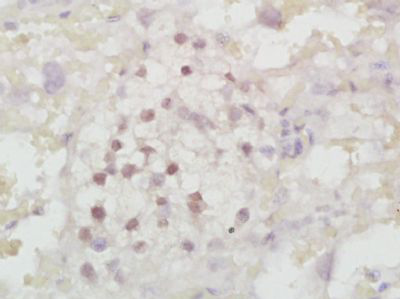
产品图片
风险提示:丁香通仅作为第三方平台,为商家信息发布提供平台空间。用户咨询产品时请注意保护个人信息及财产安全,合理判断,谨慎选购商品,商家和用户对交易行为负责。对于医疗器械类产品,请先查证核实企业经营资质和医疗器械产品注册证情况。
 文献和实验
文献和实验Bcl-2原癌基因被认为是哺乳动物细胞凋亡过程中的负调控剂。本法采用鼠抗Bcl-2单克隆抗体,可通过免疫组化或免疫细胞化学的方法用于检测组织或细胞中的Bcl-2,或者通过Western blots检测细胞粗提物。 样本来源 1. 离心细胞; 2. 细胞涂片、冰冻或石蜡包埋组织切片; 3. 细胞粗提物。 材料与试剂 1. 鼠抗Bcl-2单克隆抗体; 2. 碱性磷酸酶-抗碱性磷酸酶(APAAP); 3. PBS缓冲液 操作步骤 1. 标本固定:用丙酮
【求助】免疫组化, FISH, CGH, LOH, MSI, 克隆性重排等的应用范围及应用”盲点”
性 (2)对疾病的预后和治疗的意义 (3)癌基因蛋白的应用 (4)对肿瘤增生程度的评价 ki67 PCNA (5)微小病灶的发现 微小癌 微小病灶(如羊水栓塞) (6)在肿瘤分期上的意义 (7)指导肿瘤治疗 (8)免疫性疾病的辅助诊断 (9)病原微生物的检测 应用“盲点”:由于抗体稀释度、多克隆抗体特异性问题、试剂盒选择、操作中时间温度染色过程等因素
癌基因和突变型抑癌基因表达的肿瘤抗原 在不同致癌因素和特定条件下,原癌基因可被激活,抑癌基因可发生突变,由此出现的异常表达产物可导致正常细胞癌变。现已发现人类肿瘤中存在着癌基因或突变型抑癌基因,并检测到相应的编码蛋白。这类蛋白在胞内经处理分解为不同小肽,通过MHCI类分子提呈可作为肿瘤特异性抗原肽被T细胞所识别,激活CTL反应。 (1)癌基因编码蛋白:如突变的FaS基因编码一种189氨基酸残基的蛋白质,分子质量为21kDa
 技术资料
技术资料暂无技术资料 索取技术资料

