


- ¥5600
- GeneTex

- 美国
- GTX31656
- 2025年07月15日
- WB, IHC-P, ELISA
- Rabbit
- Human

企业认证
相关产品推荐更多 >


![TCR alpha + TCR beta antibody [IP26] (Biotin)](https://img1.dxycdn.com/2023/0711/451/6106825198874858761-14.jpg!wh200)
![SPO11 antibody [N3C3]](https://img1.dxycdn.com/2023/0516/407/0466332107306928561-14.jpg!wh200)

万千商家帮你免费找货
0 人在求购买到急需产品
相关阅读
源叶生物 十万种现货试剂速发,品质稳、品类全,实验不再等!Takara 秋促来袭,提取+反转录+定量套装仅 1200 元abinScience 体内级抗体 全年锁价 低至 ¥1200阿拉丁 22万+ 科研级产品现货速发,品质严控、科研无忧- 详细信息
- 文献和实验
- 技术资料
- 免疫原:
DC-SIGN antibody was raised against a synthetic peptide corresponding to 21 amino acids near the center of human DC-DIGN.The immunogen is located within the last 50 amino acids of DC-SIGN.
- 亚型:
IgG
- 形态:
Liquid
- 保存条件:
Store as concentrated solution. Centrifuge briefly prior to opening vial. For short-term storage (1-2 weeks), store at 4ºC. For long-term storage, aliquot and store at -20ºC or below. Avoid multiple freeze-thaw cycles.
- 克隆性:
Polyclonal
- 标记物:
Unconjugated
- 适应物种:
Human
- 保质期:
12 months from the shipping date of the product.
- 抗原来源:
Human
- 目录编号:
GTX31656
- 级别:
Primary Antibodies
- 库存:
Available
- 供应商:
GeneTex
- 宿主:
Rabbit
- 应用范围:
WB, IHC-P, ELISA
- 浓度:
1 mg/ml (Please refer to the vial label for the specific concentration.)
- 靶点:
DC-SIGN
- 抗体英文名:
DC-SIGN antibody
- 抗体名:
DC-SIGN 抗体
- 规格:
100 μg
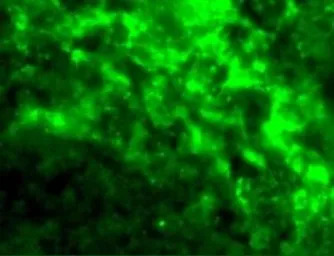
IHC-P analysis of human lymph node tissue using GTX31656 DC-SIGN antibody.
Working concentration : 20 μg/ml
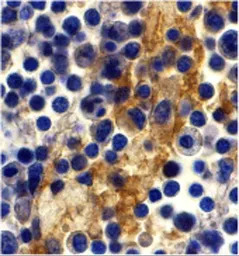
IHC-P analysis of human lymph node tissue using GTX31656 DC-SIGN antibody.
Working concentration : 10 μg/ml
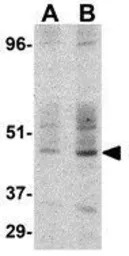
WB analysis of human small intestine tissue lysate using GTX31656 DC-SIGN antibody.
Working concentration : (A) 1 and (B) 2 μg/ml
风险提示:丁香通仅作为第三方平台,为商家信息发布提供平台空间。用户咨询产品时请注意保护个人信息及财产安全,合理判断,谨慎选购商品,商家和用户对交易行为负责。对于医疗器械类产品,请先查证核实企业经营资质和医疗器械产品注册证情况。
 文献和实验
文献和实验Determination of DC-SIGN and DC-SIGNR Repeat Region Variations
DC-SIGN and DC-SIGNR efficiently bind HIV-1 and other viral as well as nonviral pathogens and assist either cis or trans infection. Both are type II transmembrane proteins that consist of an N-terminal cytoplasmic domain, a repeat region
The C Type Lectins DC-SIGN and L-SIGN: Receptors for Viral Glycoproteins
DC-SIGN and L-SIGN are C-type lectins that recognize carbohydrate structures present on viral glycoproteins and function as attachment factors for several enveloped viruses. DC-SIGN and L-SIGN enhance viral entry and facilitate infection
Generation of Antibody Molecules Through Antibody Engineering
been overcome to a large extent using genetic-engineering techniques to produce chimeric mouse/human and completely human antibodies. Such an approach is particularly suitable because of the domain structure of the antibody molecule ( 2 ), where functional
 技术资料
技术资料暂无技术资料 索取技术资料

