

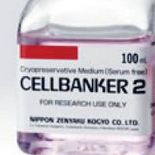
- ¥1800
- ZENOAQ
- CELLBANER-2-100
- 日本 ZENOAQ
- 2026年05月29日


万千商家帮你免费找货
0 人在求购买到急需产品
相关阅读
细胞污染识别与处理全攻略:5 种常见类型+关键误区Cytoscape 教程来了!快速实现顶刊同款通路网络图五大应用案例:Mustang Q 膜层析应用全解析1 个小工具,一次性搞定流程图、质粒图谱和信号通路图- 详细信息
- 询价记录
- 文献和实验
- 技术资料
- 英文名:
CELLBANKER 2
- 供应商:
上海研卉生物科技
- 库存:
大量
- 规格:
100ml
产品描述:无血清细胞冻存液特点:
? 无血清成份,无批次间差异。
? 可直接存放于-80℃冰箱,无需程序降温设备。
? 广受欢迎的产品,被大量的采用并发表文献。
储存方法:
- Application:
-
Cell type Description 293 Sheared human Ad5 DNA-transformed cell line. 293T Human cell line expressing SV40 large T antigen 32D Murine myeloid cell 3LL Murine Lewis lung cancer cell A10 Thoracic aortic smooth muscle of an embryonic rat A2781 Glioblastoma cell Ac2F Rat liver cell AtT20 Murine anterior pituitary cell Ba/F3 Murine Pro-B cell BHK-21 Ba Hamster renal fibroblast cell C2C12 Mouse myoblast cell C3H10T1/2 Murine embryonic fibroblast cell Caco-2 Human colonic adenocarcinoma cell CHL/1U Neonatal Chinese Hamster Lung cell CHO Chinese Hamster Ovary cell CHO-K1 Chinese Hamster Ovary cell Colo203 Human colonic adenocarcinoma cell COS1 African green monkey kidney cell COS7 African green monkey kidney cell CTLL-2 Murine T-cell DLP-1 Human colonic adenocarcinoma cell DT40 Chicken B lymphocyte cell DU145 Human prostate carcinoma cell EBV transformed B cell EJ-1 Human bladder carcinoma ELM-D Murine erythroblastic leukemia cell HeLa cell Human Uterine Cervical Carcinoma Cell Hep3B Human hepatoma cell Hepal-6 Murine hepatoma cell Hepatocyte HepG2 Hepatocellular carcinoma cell HL-60 Human promyelocytic leukemia cell HT-2 Murine cell Huh-7 Human hepatocarcinoma cell Jurkat Human T-cell line K-562 Human Caucasian Chronic myelogenous leukaemia cell Kato-III Human stomach carcinoma Keratinocyte KM12-LX Human Caucasian Chronic myelogenous leukaemia cell L5178Y Murine lymphoma cell L929 Murine fibroblast cell LM Murine fibroblast cell LNCap Human prostate adenocarcinoma cell Lymphocyte MCF-7 Human metastatic mammary carcinoma cell MDCK Madin-Dar canine kidney cell Microvascular Endothelial Cell Molt-4 Human T-cell NB-1/GOTO Human neuroblastoma NCI-H441 Human lung adenocarcinoma epithelial cell NIH3T3 Mouse embryonic fibroblast cell P388 Murine leukimia cell P3/x63-Ag8.U1 Murine myeloma cell PC12 Rat pheochromocytoma cell Periodontal ligament fibroblast cell Periodontal ligament membrane fibroblast cell Raji Human B-cell line RAW264.7 Murine Macrophage cell sf9 Insect cell SK-N-MC Neuroepithelioma cell SN12C Renal carcinoma cell Subclone: PM6,Clone8, MM3 Stem cell Stomach carcinoma cell THle3 Human liver cell T24 Human bladder carcinoma Vero African green monkey kidney epithelial cell WEHI3B Murine myeloid leukemia WiDr Human colon adenocarcinoma cell Typical experimental results
Cells Preservation period
(year)Viability of cells (%)
(preservation temperature -80℃)MOUSE Hybridome 5 90 Myeloma 5 90 L929 5 90 FM3A 5 90 BALB/3T3 5 90 RAT RLC-16 5 90 NKR 3 90 HAMSTER CHO 3 90 V79 3 90 MONKEY COS-1 3 90 Vero 5 90 HUMAN EBV transformed cell 5 90 Fibroblast 5 90 Melanoma 5 90 SK-007 5 90 Jurkat 5 90 K562 5 90 - Protocol:
-
Freezing
For optimum results, cells for cryopreservation should be in log phase of growth. Similar or standard freezing protocols may be substituted.
- Examine and make sure the cell culture free of contamination, in healthy situation and proper confluency, etc.
- Perform a cell count to determine the viability of cells.
- Gently pellet the cells centrifugation (3 - 5 minutes at 1,000~2,000rpm, 4℃). Remove the supernatant using a aspirator.
- Gently suspend the cells with CELLBANKER® cryopreservation medium (1 ml for 5×10⁵ - 5×10⁶ cells.
- Dispense the cell suspension in 1ml aliquots to cryopreservation vials that have been labeled with the cell line name, cell concentration, passage date and other essential information.
- Place the vials directly in a -80℃ for storage. If necessary, transfer the frozen vials to a liquid nitrogen storage tank after the vials have been frozen for at least 24 hours.
- IMPORTANT: Optimum protocol may change with the cell types.
-
Thawing
- Remove the frozen cell from storage and quickly thaw in a 37℃ shaking waterbath.
- Immediately dilute and gently mix each 1ml of cells with 10ml of complete cell culture medium.
- Gently pellet the cells centrifugation (3-5 minutes at 1,000 - 2,000rpm, 4℃). Remove the supernatant aspirator.
- Gently suspend the cells with appropriate volume of complete cell culture medium. And plate in a culture flask.
- Continue the further culture procedures according to standard protocols.
- Storage and Stability
- Store at 2 to 8 or below -20 degrees celisus. The product will be stable for 3 years after the date of manufacture at this storage temperature.
风险提示:丁香通仅作为第三方平台,为商家信息发布提供平台空间。用户咨询产品时请注意保护个人信息及财产安全,合理判断,谨慎选购商品,商家和用户对交易行为负责。对于医疗器械类产品,请先查证核实企业经营资质和医疗器械产品注册证情况。
 询价记录
询价记录 暂无询价记录
 文献和实验
文献和实验对比)。 六、总结 细胞冻存“先-80℃再过液氮”,本质上是“循序渐进保护细胞”的过程——用-80℃实现缓慢降温、减少冰晶损伤、让冻存液发挥作用,再用液氮实现长期封存,守住细胞的活性。 看似简单的一步温度过渡,背后藏着对细胞生理特性的精准把握。掌握这个核心逻辑,再也不用为“细胞冻存失败”发愁啦! 中乔新舟冻存液全线解决方案 冻存液名称 货号 适用细胞 无血清细胞冻存液 CSP042-100 通用于肿瘤细胞和常规细胞 干细胞专用无血清冻存液 CSP083
科幻电影中将冻存若干年的生命体重新解冻复活的情节在生命科学研究过程中每一天都在上演。为了将每一种有生命的细胞较好的保存其原有的细胞特性或者长久的保存种质资源,实验人员往往将细胞用特殊配置的细胞冻存液保存于-196℃ 的液氮,使得细胞暂时脱离生长状态,等到实验需要的时候再从液氮中取出复苏应用。在这一看似神奇的生命存储过程中,我们不禁要问,这是如何实现的呢? 其实,细胞冻存和复苏的教科书和实验手册上面都有。小编不想再重复了。这里,我要谈谈应该注意的一些事项和技巧,大部分都是血泪教训
流式课堂 | 裂红 or 分离液?外周血不同制备方法应用场景
、粒细胞等),需要裂解红细胞;倘若检测的是红细胞,不需要裂解红细胞; ⊙ 如果后续样本不用于流式分析,而是需要培养或者冻存复苏,使用裂红后培养的细胞,活性可能会打折扣。 Ficoll 密度梯度离心法 01 原理 根据细胞的沉降系数差异,借助细胞分离液和离心操作,对细胞进行分离。 02 优点 ⊙ 获得的细胞更纯净,有利于细胞培养后检测胞内因子 ⊙ 可将细胞冻存后再复苏、培养、检测 ⊙ 去除死细胞 03 缺点 ⊙ 步骤复杂,需 30min 以上 ⊙ 取白膜层需要丰富的经验 ⊙ 只能获得淋巴细胞和单核
 技术资料
技术资料暂无技术资料 索取技术资料

