

- ¥780 - 2200
- LMAI Bio
- LM-6558R
- 进口/国产
- 2026年05月12日
- WB=1:500-2000 ELISA=1:500-1000 IF=1:200-800 (石蜡切片需做抗原修复)
- Rabbit
- Human, Mouse, Rat, Dog, Pig, Cow, Rabbit,

企业认证
相关产品推荐更多 >
万千商家帮你免费找货
0 人在求购买到急需产品
相关阅读
细胞污染识别与处理全攻略:5 种常见类型+关键误区Cytoscape 教程来了!快速实现顶刊同款通路网络图五大应用案例:Mustang Q 膜层析应用全解析1 个小工具,一次性搞定流程图、质粒图谱和信号通路图- 详细信息
- 文献和实验
- 技术资料
- 供应商:
上海联迈生物工程有限公司
- 库存:
大量
- 目录编号:
LM-6558R
- 克隆性:
多克隆
- 抗原来源:
Rabbit
- 保质期:
1年
- 抗体英文名:
OLFM4
- 抗体名:
抗细胞凋亡蛋白OLFM44抗体
- 宿主:
Rabbit
- 适应物种:
Human, Mouse, Rat, Dog, Pig, Cow, Rabbit,
- 免疫原:
KLH conjugated synthetic peptide derived from human OLFM4:111-510/510
- 亚型:
IgG
- 形态:
Lyophilized or Liquid
- 应用范围:
WB=1:500-2000 ELISA=1:500-1000 IF=1:200-800 (石蜡切片需做抗原修复)
- 浓度:
1mg/ml
- 保存条件:
Store at -20 °C
- 规格:
50ul 100ul 200ul
| 英文名称 | OLFM4 |
| 中文名称 | 抗细胞凋亡蛋白OLFM44抗体 |
| 别 名 | Antiapoptotic protein GW112; G-CSF-stimulated clone 1 protein; GC1; GW112; hGC 1; hGC-1; hOLfD; olfactomedin 4; Olfactomedin-4; OlfD; OLFM4; OLFM4_HUMAN; OLM4. |
| 规格价格 | 50ul/780元 购买 100ul/1380元 购买 200ul/2200元 购买 大包装/询价 |
| 说 明 书 | 50ul 100ul 200ul |
| 研究领域 | 肿瘤 肿瘤细胞生物标志物 |
| 抗体来源 | Rabbit |
| 克隆类型 | Polyclonal |
| 交叉反应 | Human, Mouse, Rat, Dog, Pig, Cow, Rabbit, |
| 产品应用 | WB=1:500-2000 ELISA=1:500-1000 IF=1:200-800 (石蜡切片需做抗原修复) not yet tested in other applications. optimal dilutions/concentrations should be determined by the end user. |
| 分 子 量 | 55kDa |
| 细胞定位 | 细胞浆 细胞膜 细胞外基质 分泌型蛋白 |
| 性 状 | Lyophilized or Liquid |
| 浓 度 | 1mg/ml |
| 免 疫 原 | KLH conjugated synthetic peptide derived from human OLFM4:111-510/510 |
| 亚 型 | IgG |
| 纯化方法 | affinity purified by Protein A |
| 储 存 液 | 0.01M TBS(pH7.4) with 1% BSA, 0.03% Proclin300 and 50% Glycerol. |
| 保存条件 | Store at -20 °C for one year. Avoid repeated freeze/thaw cycles. The lyophilized antibody is stable at room temperature for at least one month and for greater than a year when kept at -20°C. When reconstituted in sterile pH 7.4 0.01M PBS or diluent of antibody the antibody is stable for at least two weeks at 2-4 °C. |
| PubMed | PubMed |
| 产品介绍 | background: Olfactomedin-4, also known as G-CSF-stimulated clone 1 protein, Antiapoptotic protein GW112, and OLFM4, is a secreted protein which contains one olfactomedin-like domain. OLFM4 is expressed during myeloid lineage development. It is strongly expressed in the prostate, small intestine and colon and moderately expressed in the bone marrow and stomach. OLFM4 is highly expressed in pancreatic cancer tissues and shows an elevated expression level during the early S phase of the cell cycle. It is also expressed at high levels in stomach cancer and colon cancer tissues. Inhibition of ROS or the ERK pathway remarkably decreased G-CSF-induced OLFM4 expression. OLFM4 is an antiapoptotic factor that promotes tumor growth. OLFM4 promotes proliferation of pancreatic cancer cells by favoring the transition from the S to G2/M phase. OLFM4 also facilitates cell adhesion. Induction of OLFM4 in cancer cells was reported to have a novel antiapoptotic action via binding to the potent apoptosis inducer GRIM-19. The human OLFM4 is also thought to be a useful marker for early myeloid development. Function: May promote proliferation of pancreatic cancer cells by favoring the transition from the S to G2/M phase. In myeloid leukemic cell lines, inhibits cell growth and induces cell differentiation and apoptosis. May play a role in the inhibition of EIF4EBP1 phosphorylation/deactivation. Facilitates cell adhesion, most probably through interaction with cell surface lectins and cadherin. Subunit: Homomultimer; disulfide-linked. Interacts with NDUFA13. Interacts with cell surface lectins (locutions ricinus communis agglutinin I, concanavalin-A and wheat germ agglutinin) and cadherin. Subcellular Location: Secreted, extracellular space. Mitochondrion. Note=Subcellular location is not clearly defined: has been shown to be secreted (PubMed:16566923), but also in the mitochondrion (PubMed:15059901 and PubMed:20724538), cytoplasm and plasma membrane (PubMed:20724538) and in the nucleus (PubMed:15059901). Tissue Specificity: Expressed during myeloid lineage development. Much higher expression in bone marrow neutrophils than in peripheral blood neutrophils (at protein level). Strongly expressed in the prostate, small intestine and colon and moderately expressed in the bone marrow and stomach. Overexpressed in some pancreatic cancer tissues. Post-translational modifications: N-glycosylated. Similarity: Contains 1 olfactomedin-like domain. SWISS: Q6UX06 Gene ID: 10562 Database links: Entrez Gene: 467367 Chimpanzee Entrez Gene: 515082 Cow Entrez Gene: 485470 Dog Entrez Gene: 10562 Human Entrez Gene: 380924 Mouse Entrez Gene: 290409 Rat Omim: 614061 Human SwissProt: Q6UX06 Human SwissProt: Q3UZZ4 Mouse Unigene: 508113 Human Unigene: 26456 Mouse Unigene: 156265 Rat Important Note: This product as supplied is intended for research use only, not for use in human, therapeutic or diagnostic applications. |
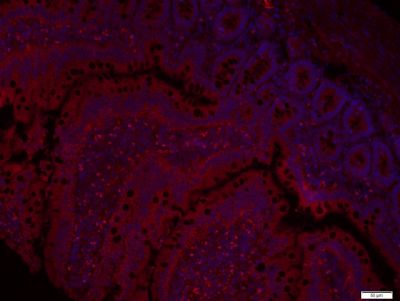
| 产品图片 | 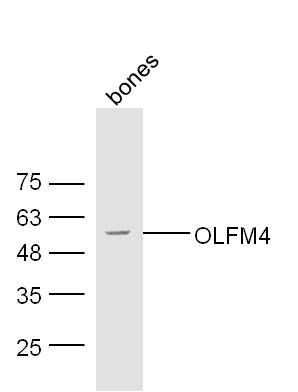 Sample: Bone (Mouse) Lysate at 40 ug Primary: Anti-OLFM4 (bs-6558R) at 1/300 dilution Secondary: IRDye800CW Goat Anti-Rabbit IgG at 1/20000 dilution Predicted band size: 55 kD Observed band size: 55 kD 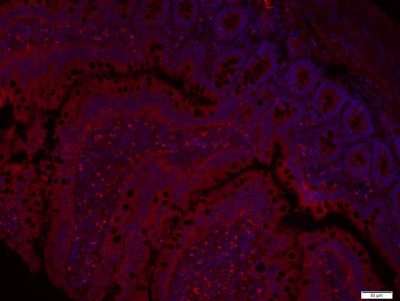 Paraformaldehyde-fixed, paraffin embedded (Rat small intestine); Antigen retrieval by boiling in sodium citrate buffer (pH6.0) for 15min; Block endogenous peroxidase by 3% hydrogen peroxide for 20 minutes; Blocking buffer (normal goat serum) at 37°C for 30min; Incubation: Anti-OLFM4 Antibody, conjugated (bs-6558R-AF594) 1:400, 1.5 hours at 37°C; DAPI (5ug/ml, blue, C-0033) was used to stain the cell nuclei. |
风险提示:丁香通仅作为第三方平台,为商家信息发布提供平台空间。用户咨询产品时请注意保护个人信息及财产安全,合理判断,谨慎选购商品,商家和用户对交易行为负责。对于医疗器械类产品,请先查证核实企业经营资质和医疗器械产品注册证情况。
 文献和实验
文献和实验补充精氨酸能抗癌?Nature:用细菌把「肿瘤克星」送到抗癌前线,免疫治疗效果提高 30%
菌株,单独或合并抗 PD-L1 抗体。结果发现,合并用药降低了肿瘤的生长速率,并且 74% 使用了合并疗法的小鼠甚至根除了肿瘤。与之相对的,单独使用抗 PD-L1 抗体或与野生型菌株合并使用,分别只有 44% 和 39% 的小鼠根除了肿瘤。这增加的 30% 根除肿瘤的治疗效果可归功于生物工程编辑的细菌。综合这些结果可知,L-Arg 菌株增强了 PD-L1 介导的免疫治疗。接下来,研究者试图探究是否该免疫治疗效果是由 T 细胞介导的。他们在 T 细胞缺陷的 cd3e-/-小鼠中重复了上述实验,同样
脑靶向递送|抗体也能“鼻脑递送”?甘油辅助双抗联合增强黑色素瘤脑转移免疫治疗
分别将抗 IL-17 和抗 CD73 抗体的脑内递送提高 19.4 倍和 17.1 倍,同时减少系统暴露。 2. IL-17 会影响 CD73 靶向治疗 研究发现,IL-17 和 CD73 在黑色素瘤中均升高。IL-17 可通过 STAT3 相关通路促进 HIF-1α 和 VEGF-A 表达,进一步影响 CD73 表达和 T 细胞进入肿瘤区域。 3. 抗 IL-17 与抗 CD73 联合有明确分工 抗 IL-17 主要用于降低 HIF-1α/VEGF-A 相关限制,改善肿瘤微环境;抗 CD
。 结构就是辣么简单A. 传统IgG四链抗体;B. 骆驼血液中的重链抗体;C. 纳米抗体 纳米抗体序列优化:纳米抗体 VHH 表面大概只有 10 个氨基酸和人 VH 不同,其中在 FR2 位置有四个特异的氨基酸:普通抗体的 FR2 中 V37、G44、L45 和 W47 这 4 个氨基酸残基是在进化中相当保守的疏水性残基;而在 VHH 中,它们突变为亲水性的氨基酸残基 F37、E44、 R45、G47,增加了 VHH 的溶解性。所以,利用这一特性将人源抗体 VH 结构域 FR2 中的一些氨基酸进行
 技术资料
技术资料暂无技术资料 索取技术资料

