

- ¥780 - 2200
- LMAI Bio
- LM-6544R
- 进口/国产
- 2026年05月14日
- WB=1:500-2000 ELISA=1:500-1000 IHC-P=1:400-800 IHC-F=1:400-800 IF=1:100-500 (石蜡切片需做抗原修复)
- Rabbit
- Human, Mouse, Rat, Chicken, Dog, Pig, Cow, Horse, Rabbit,

企业认证
相关产品推荐更多 >


万千商家帮你免费找货
0 人在求购买到急需产品
相关阅读
源叶生物 十万种现货试剂速发,品质稳、品类全,实验不再等!Takara 秋促来袭,提取+反转录+定量套装仅 1200 元abinScience 体内级抗体 全年锁价 低至 ¥1200阿拉丁 22万+ 科研级产品现货速发,品质严控、科研无忧- 详细信息
- 文献和实验
- 技术资料
- 供应商:
上海联迈生物工程有限公司
- 库存:
大量
- 目录编号:
LM-6544R
- 克隆性:
多克隆
- 抗原来源:
Rabbit
- 保质期:
1年
- 抗体英文名:
LOXL2
- 抗体名:
赖氨酰氧化酶相关蛋白2抗体
- 宿主:
Rabbit
- 适应物种:
Human, Mouse, Rat, Chicken, Dog, Pig, Cow, Horse, Rabbit,
- 免疫原:
KLH conjugated synthetic peptide derived from human LOXL2:621-720/774
- 亚型:
IgG
- 形态:
Lyophilized or Liquid
- 应用范围:
WB=1:500-2000 ELISA=1:500-1000 IHC-P=1:400-800 IHC-F=1:400-800 IF=1:100-500 (石蜡切片需做抗原修复)
- 浓度:
1mg/ml
- 保存条件:
Store at -20 °C
- 规格:
50ul 100ul 200ul
| 英文名称 | LOXL2 |
| 中文名称 | 赖氨酰氧化酶相关蛋白2抗体 |
| 别 名 | LOR 2; LOR2; LOX L2; LOXL 2; LOXL2; LOXL2_HUMAN; Lysyl oxidase homolog 2; Lysyl oxidase like 2; Lysyl oxidase like protein 2; Lysyl oxidase related 2; Lysyl oxidase related protein 2; Lysyl oxidase related protein WS9 14; Lysyl oxidase-like protein 2; Lysyl oxidase-related protein 2; Lysyl oxidase-related protein WS9-14; WS9 14. |
| 规格价格 | 50ul/780元 购买 100ul/1380元 购买 200ul/2200元 购买 大包装/询价 |
| 说 明 书 | 50ul 100ul 200ul |
| 研究领域 | 肿瘤 细胞生物 免疫学 信号转导 细胞骨架 肿瘤细胞生物标志物 |
| 抗体来源 | Rabbit |
| 克隆类型 | Polyclonal |
| 交叉反应 | Human, Mouse, Rat, Chicken, Dog, Pig, Cow, Horse, Rabbit, |
| 产品应用 | WB=1:500-2000 ELISA=1:500-1000 IHC-P=1:400-800 IHC-F=1:400-800 IF=1:100-500 (石蜡切片需做抗原修复) not yet tested in other applications. optimal dilutions/concentrations should be determined by the end user. |
| 分 子 量 | 87kDa |
| 细胞定位 | 细胞外基质 分泌型蛋白 |
| 性 状 | Lyophilized or Liquid |
| 浓 度 | 1mg/ml |
| 免 疫 原 | KLH conjugated synthetic peptide derived from human LOXL2:621-720/774 |
| 亚 型 | IgG |
| 纯化方法 | affinity purified by Protein A |
| 储 存 液 | 0.01M TBS(pH7.4) with 1% BSA, 0.03% Proclin300 and 50% Glycerol. |
| 保存条件 | Store at -20 °C for one year. Avoid repeated freeze/thaw cycles. The lyophilized antibody is stable at room temperature for at least one month and for greater than a year when kept at -20°C. When reconstituted in sterile pH 7.4 0.01M PBS or diluent of antibody the antibody is stable for at least two weeks at 2-4 °C. |
| PubMed | PubMed |
| 产品介绍 | background: This gene encodes a member of the lysyl oxidase gene family. The prototypic member of the family is essential to the biogenesis of connective tissue, encoding an extracellular copper-dependent amine oxidase that catalyses the first step in the formation of crosslinks in collagens and elastin. A highly conserved amino acid sequence at the C-terminus end appears to be sufficient for amine oxidase activity, suggesting that each family member may retain this function. The N-terminus is poorly conserved and may impart additional roles in developmental regulation, senescence, tumor suppression, cell growth control, and chemotaxis to each member of the family. [provided by RefSeq, Jul 2008]. Function: Mediates the post-translational oxidative deamination of lysine residues on target proteins leading to the formation of deaminated lysine (allysine). When secreted in extracellular matrix, promotes cross-linking of extracellular matrix proteins by mediating oxidative deamination of peptidyl lysine residues in precursors to fibrous collagen and elastin. Acts as a regulator of sprouting angiogenesis, probably via collagen IV scaffolding. When nuclear, acts as a transcription corepressor and specifically mediates deamination of trimethylated 'Lys-4' of histone H3 (H3K4me3), a specific tag for epigenetic transcriptional activation. Involved in epithelial to mesenchymal transition (EMT) via interaction with SNAI1 and participates in repression of E-cadherin, probably by mediating deamination of histone H3. Also involved in E-cadherin repression following hypoxia, a hallmark of epithelial to mesenchymal transition believed to amplify tumor aggressiveness, suggesting that it may play a role in tumor progression. Acts as a regulator of chondrocyte differentiation, probably by regulating expression of factors that control chondrocyte differentiation. Subunit: Component of some chromatin repressor complex. Interacts with SNAI1. Subcellular Location: Secreted, extracellular space, extracellular matrix, basement membrane (By similarity). Nucleus. Chromosome. Note=Associated with chromatin. It is unclear how LOXL2 is nuclear: it contains a clear signal sequence and is predicted to localize in the extracellular medium. However, different reports confirmed the intracellular location and its key role in transcription regulation. Tissue Specificity: Expressed in many tissues. Highest expression in reproductive tissues, placenta, uterus and prostate. Post-translational modifications: The lysine tyrosylquinone cross-link (LTQ) is generated by condensation of the epsilon-amino group of a lysine with a topaquinone produced by oxidation of tyrosine. [PTM] N-glycosylated. N-glycosylation on Asn-455 and Asn-644 may be essential for proper folding and secretion; may be composed of a fucosylated carbohydrates attached to a trimannose N-linked glycan core. Similarity: Belongs to the lysyl oxidase family. Contains 4 SRCR domains. SWISS: Q9Y4K0 Gene ID: 4017 Database links: Entrez Gene: 4017 Human Entrez Gene: 94352 Mouse Entrez Gene: 290350 Rat Omim: 606663 Human SwissProt: Q9Y4K0 Human SwissProt: P58022 Mouse SwissProt: B5DF27 Rat Unigene: 626637 Human Unigene: 661130 Human Unigene: 116714 Mouse Important Note: This product as supplied is intended for research use only, not for use in human, therapeutic or diagnostic applications. Post-translational modifications: The lysine tyrosylquinone cross-link (LTQ) is generated by condensation of the epsilon-amino group of a lysine with a topaquinone produced by oxidation of tyrosine. |
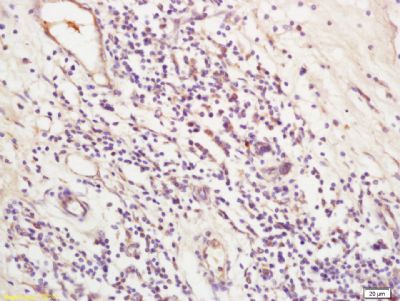
| 产品图片 | 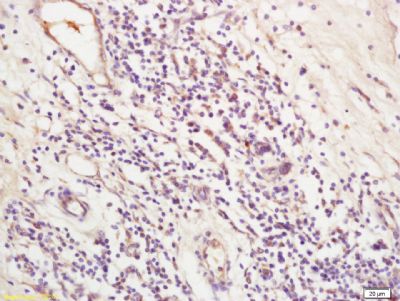 Tissue/cell: human breast carcinoma; 4% Paraformaldehyde-fixed and paraffin-embedded; Antigen retrieval: citrate buffer ( 0.01M, pH 6.0 ), Boiling bathing for 15min; Block endogenous peroxidase by 3% Hydrogen peroxide for 30min; Blocking buffer (normal goat serum,C-0005) at 37℃ for 20 min; Incubation: Anti-LOXL2 Polyclonal Antibody, Unconjugated(bs-6544R) 1:200, overnight at 4°C, followed by conjugation to the secondary antibody(SP-0023) and DAB(C-0010) staining |
风险提示:丁香通仅作为第三方平台,为商家信息发布提供平台空间。用户咨询产品时请注意保护个人信息及财产安全,合理判断,谨慎选购商品,商家和用户对交易行为负责。对于医疗器械类产品,请先查证核实企业经营资质和医疗器械产品注册证情况。
 文献和实验
文献和实验状的DNA分子上。由于每个体细胞中有2套染色体(2n),故所含的DNA是由两个基因组(genome)构成。每个单倍体基因组约含3.2×10⁹bp。人类基因的平均长度为1-1.5kb,所以基因组以足以编码1.5×10⁶蛋白质,但实际上编码蛋白质的结构基因只不过5万-10万个,仅占总基因组的2%-3%。其余的DNA顺序包括基因之间的间隔顺序、基因内插入顺序、重复顺序等。目前,对它们的功能知之甚少,绝大多数重复顺序只不过是过剩的DNA。但是,其中一些则有着特殊的功能,包括:调节基因的表达,增强同源染色体之间
氧化应激分子机制与相关信号通路:解码细胞 “氧化危机” 的底层逻辑
被打破,核心驱动物质为活性氧(ROS),包括超氧阴离子(O₂⁻・)、过氧化氢(H₂O₂)、羟基自由基(・OH)等,其生成与清除的动态平衡决定细胞氧化状态。 1. ROS 生成途径 1) 内源性:线粒体是主要来源,氧化磷酸化时电子传递链复合体 Ⅰ/Ⅲ 会发生电子泄漏,1%-2% 的电子与氧结合生成 O₂⁻・,后续可转化为 H₂O₂,在铁 / 铜等过渡金属参与下还能生成毒性极强的・OH;此外,内质网应激、NADPH 氧化酶异常激活、过氧化物酶体脂肪酸 β- 氧化也会产生 ROS。 2) 外源性:紫外
Adv Healthc Mater(IF=11) | 苹果EV纳米载体+光控水凝胶:骨关节炎的多靶点透皮治疗新策略
可强化凝胶网络结构。 图2. AEV/BBR/PIP NP-HOF@ALG-GO@Dex的材料表征与功能分析 03 体外细胞安全性与生物功能验证 采用梯度浓度大鼠软骨细胞MTT、活死染色完成生物相容性评价,0–5 mg/mL浓度区间细胞活性无下降,NIR处理不产生额外细胞毒性。LPS诱导软骨炎症模型中,Amplex Red荧光定量结果显示单纯凝胶即可下调ROS水平,联合NIR后抗氧化效果进一步增强。RAW巨噬细胞炎症模型通过CD86(M1促炎标记)、CD206(M2抗
 技术资料
技术资料暂无技术资料 索取技术资料

