

- ¥780 - 2200
- LMAI Bio
- LM-2209R
- 进口/国产
- 2026年09月02日
- WB=1:500-2000 Flow-Cyt=0.2μg /test (石蜡切片需做抗原修复)
- Rabbit
- Human, Mouse, Rat, Dog, Pig, Cow, Rabbit, Guinea Pig,

企业认证
相关产品推荐更多 >



万千商家帮你免费找货
0 人在求购买到急需产品
相关阅读
细胞污染识别与处理全攻略:5 种常见类型+关键误区Cytoscape 教程来了!快速实现顶刊同款通路网络图五大应用案例:Mustang Q 膜层析应用全解析1 个小工具,一次性搞定流程图、质粒图谱和信号通路图- 详细信息
- 文献和实验
- 技术资料
- 供应商:
上海联迈生物工程有限公司
- 库存:
大量
- 目录编号:
LM-2209R
- 克隆性:
多克隆
- 抗原来源:
Rabbit
- 保质期:
1年
- 抗体英文名:
CXCR3
- 抗体名:
细胞表面趋化因子受体3抗体
- 宿主:
Rabbit
- 适应物种:
Human, Mouse, Rat, Dog, Pig, Cow, Rabbit, Guinea Pig,
- 免疫原:
KLH conjugated synthetic peptide derived from mouse CXCR3:301-367/367
- 亚型:
IgG
- 形态:
Lyophilized or Liquid
- 应用范围:
WB=1:500-2000 Flow-Cyt=0.2μg /test (石蜡切片需做抗原修复)
- 浓度:
1mg/ml
- 保存条件:
Store at -20 °C
- 规格:
50ul 100ul 200ul
| 英文名称 | CXCR3 |
| 中文名称 | 细胞表面趋化因子受体3抗体 |
| 别 名 | CXC-R3; Interferon-inducible protein 10 receptor; IP-10 receptor; CKR-L2; CD183 antigen; G protein-coupled receptor 9; C-X-C Chemokine receptor; CD183; CXC Motif Receptor 3; CKRL2; CMKAR3; G Protein Coupled Receptor 9; GPR9; IP10; IP10R; MIGR; CXCR3_HUMAN. |
 |
Specific References (6) | bs-2209R has been referenced in 6 publications. [IF=3.06] Zhang, Wen, et al. "The role of CXCR3 in the induction of primary biliary cirrhosis." Clinical and Developmental Immunology 2011 (2011). IHC-P ; Mouse. PubMed:21647407 [IF=2.00] Wang, Jun, et al. "Anti‐inflammatory and retinal protective effects of capsaicin on ischemia‐induced injuries through the release of endogenous somatostatin." Clinical and Experimental Pharmacology and Physiology (2017). IHC-P ; Mouse. PubMed:28429852 [IF=2.00] Wang, Jun, et al. "Anti‐inflammatory and retinal protective effects of capsaicin on ischemia‐induced injuries through the release of endogenous somatostatin." Clinical and Experimental Pharmacology and Physiology (2017). IHC-P ; Mouse. PubMed:28429852 [IF=5.94] Saxena, Amit, et al. "CXCR3-independent actions of the CXC chemokine CXCL10 in the infarcted myocardium and in isolated cardiac fibroblasts are mediated through proteoglycans." Cardiovascular Research (2014): cvu138. Mouse. PubMed:24891401 [IF=4.20] Ge, L. P., et al. "Integration of nondegradable polystyrene and degradable gelatin in a core–sheath nanofibrous patch for pelvic reconstruction." International Journal of Nanomedicine 2015:10 3193–3201 IHC-P ; Rat. PubMed:25995629 [IF=4.88] Massafra, Vittoria, et al. "Splenic dendritic cell involvement in FXR-mediated amelioration of DSS colitis." Biochimica et Biophysica Acta (BBA)-Molecular Basis of Disease (2015). IHC-P ; Mouse. PubMed:2655460 |
| 规格价格 | 50ul/780元 购买 100ul/1380元 购买 200ul/2200元 购买 大包装/询价 |
| 说 明 书 | 50ul 100ul 200ul |
| 研究领域 | 细胞生物 免疫学 信号转导 细胞周期蛋白 细胞膜受体 G蛋白偶联受体 细胞分化 |
| 抗体来源 | Rabbit |
| 克隆类型 | Polyclonal |
| 交叉反应 | Human, Mouse, Rat, Dog, Pig, Cow, Rabbit, Guinea Pig, |
| 产品应用 | WB=1:500-2000 Flow-Cyt=0.2μg /test (石蜡切片需做抗原修复) not yet tested in other applications. optimal dilutions/concentrations should be determined by the end user. |
| 分 子 量 | 40kDa |
| 细胞定位 | 细胞膜 |
| 性 状 | Lyophilized or Liquid |
| 浓 度 | 1mg/ml |
| 免 疫 原 | KLH conjugated synthetic peptide derived from mouse CXCR3:301-367/367 |
| 亚 型 | IgG |
| 纯化方法 | affinity purified by Protein A |
| 储 存 液 | 0.01M TBS(pH7.4) with 1% BSA, 0.03% Proclin300 and 50% Glycerol. |
| 保存条件 | Store at -20 °C for one year. Avoid repeated freeze/thaw cycles. The lyophilized antibody is stable at room temperature for at least one month and for greater than a year when kept at -20°C. When reconstituted in sterile pH 7.4 0.01M PBS or diluent of antibody the antibody is stable for at least two weeks at 2-4 °C. |
| PubMed | PubMed |
| 产品介绍 | background: This gene encodes a G protein-coupled receptor with selectivity for three chemokines, termed CXCL9/Mig (monokine induced by interferon-g), CXCL10/IP10 (interferon-g-inducible 10 kDa protein) and CXCL11/I-TAC (interferon-inducible T cell a-chemoattractant). Binding of chemokines to this protein induces cellular responses that are involved in leukocyte traffic, most notably integrin activation, cytoskeletal changes and chemotactic migration. Alternatively spliced transcript variants encoding different isoforms have been found for this gene. One of the isoforms (CXCR3-B) shows high affinity binding to chemokine, CXCL4/PF4 (PMID:12782716). [provided by RefSeq, Jun 2011]. Function: Receptor for CXCL9, CXCL10 and CXCL11 and mediates the proliferation of human mesangial cells (HMC). Isoform 2 is a receptor for CXCL4 and also mediates the inhibitory activities of CXCL9, CXCL10 and CXCL11 on the growth of human microvascular endothelial cells (HMVEC). Interaction with CXCL4 or CXCL10 leads to activation of the p38MAPK pathway and contributes to inhibition of angiogenesis. Overexpression in renal cancer cells down-regulates expression of the anti-apoptotic protein HMOX1 and promotes apoptosis. Isoform 3 mediates the activity of CXCL11. Subcellular Location: Cell membrane; Multi-pass membrane protein. Tissue Specificity: Isoform 1 and isoform 2 are mainly expressed in heart, kidney, liver and skeletal muscle. Isoform 1 is also expressed in placenta. Post-translational modifications: Sulfation on Tyr-27 and Tyr-29 is essential for CXCL10 binding and subsequent signal transduction induction. N-glycosylated. Similarity: Belongs to the G-protein coupled receptor 1 family. SWISS: O88410 Gene ID: 12766 Database links: Entrez Gene: 12766 Mouse SwissProt: O88410 Mouse Unigene: 12876 Mouse Important Note: This product as supplied is intended for research use only, not for use in human, therapeutic or diagnostic applications. |
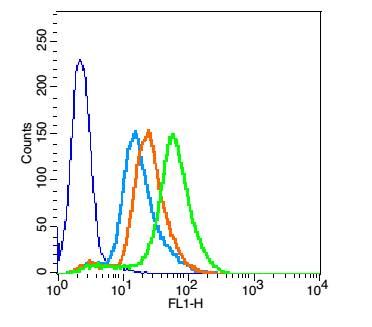
| 产品图片 | 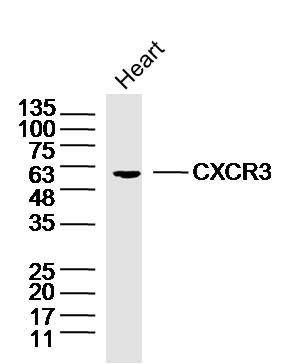 Sample: heart(mouse) Lysate at 40 ug Primary: Anti-CXCR3 (bs-2209R)at 1/300 dilution Secondary: IRDye800CW Goat Anti-Rabbit IgG at 1/20000 dilution Predicted band size: 41kD Observed band size: 51kD 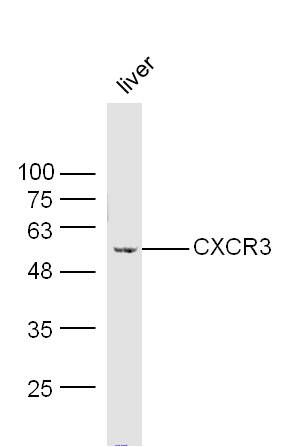 Sample: liver(mouse) Lysate at 40 ug Primary: Anti-CXCR3 (bs-2209R)at 1/300 dilution Secondary: IRDye800CW Goat Anti-Rabbit IgG at 1/20000 dilution Predicted band size: 41kD Observed band size: 51kD 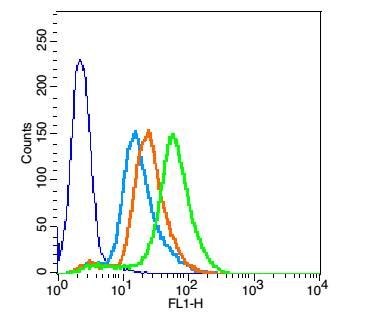 Blank control: HCCLM3(blue) Isotype Control Antibody: Rabbit IgG(orange) ; Secondary Antibody: Goat anti-rabbit IgG-FITC(white blue), Dilution: 1:100 in 1 X PBS containing 0.5% BSA ; Primary Antibody Dilution: 5ul in 100 uL1X PBS containing 0.5% BSA(green). |
风险提示:丁香通仅作为第三方平台,为商家信息发布提供平台空间。用户咨询产品时请注意保护个人信息及财产安全,合理判断,谨慎选购商品,商家和用户对交易行为负责。对于医疗器械类产品,请先查证核实企业经营资质和医疗器械产品注册证情况。
 文献和实验
文献和实验让肿瘤变「热」!宋尔卫院士团队Nat Immunol发文报道肿瘤免疫治疗新策略
1 和/或 CTL 细胞计数患者的效应 T 细胞 RGS1 表达上调。此外,Th1 和/或 CTL 细胞中 RGS1 高表达的患者预后更差。图片来源:Nature ImmunologyRGS1 如何影响 T 细胞向肿瘤迁移?为了确定 RGS1 在效应 T 细胞迁移中的作用,作者敲低 RGS1 表达后发现,CTL 和 Th1 细胞向 CXCR3、CCR4 和 CXCR4 的配体迁移的能力增强。图片来源:Nature Immunology先前的研究表明 RGS 蛋白通过增强 GTP 酶活性来抑制趋化因子受体的细胞
的治疗效果。 研究团队在建立的皮下胰腺癌肿瘤小鼠模型、原位胰腺癌肿瘤小鼠模型和患者来源的异种移植瘤小鼠中进行实验,可以发现共表达CXCR-6的T细胞相比较而言会表现出增强的瘤内积累,具有更持久的抗肿瘤活性,进而延长动物的生存时间。最后研究团队提出:通过在特异性CAR T细胞上共表达肿瘤特异性的趋化因子受体,是增强获得性免疫疗法治疗实体瘤的一种新策略。 研究团队为了确定胰腺癌小鼠模型中合适的趋化因子靶点,使用QPCR的方法定量不同趋化因子的RNA水平。实时荧光定量PCR(Quantitative Real
今天让我们跟着教程,以趋化因子基因家族为背景来获取序列进行多序列比对后绘制系统发育树。趋化因子背景知识趋化因子被分为四个主要的亚家族:CXC,CC,CX3C 和 XC。所有这些蛋白质都通过与 G 蛋白质连接的跨膜受体(称为趋化因子受体)相互作用而发挥其生物学作用,该受体在其靶细胞表面被选择性地发现。维基百科关于趋化因子介绍:https://zh.wikipedia.org/wiki/参考文章:Charo IF, Ransohoff RM. The many roles
 技术资料
技术资料暂无技术资料 索取技术资料

