

- ¥780 - 2200
- LMAI Bio
- LM-4119R
- 进口/国产
- 2026年04月21日
- WB=1:500-2000 ELISA=1:500-1000 (石蜡切片需做抗原修复)
- Rabbit
- Human, Mouse, Rat, Pig, Cow, Horse, Rabbit,

企业认证
相关产品推荐更多 >

万千商家帮你免费找货
0 人在求购买到急需产品
- 详细信息
- 文献和实验
- 技术资料
- 供应商:
上海联迈生物工程有限公司
- 库存:
大量
- 目录编号:
LM-4119R
- 克隆性:
多克隆
- 抗原来源:
Rabbit
- 保质期:
1年
- 抗体英文名:
ASGPR1
- 抗体名:
唾液酸糖蛋白受体1抗体
- 宿主:
Rabbit
- 适应物种:
Human, Mouse, Rat, Pig, Cow, Horse, Rabbit,
- 免疫原:
KLH conjugated synthetic peptide derived from human ASGPR1:201-291/291 <Extracellular>
- 亚型:
IgG
- 形态:
Lyophilized or Liquid
- 应用范围:
WB=1:500-2000 ELISA=1:500-1000 (石蜡切片需做抗原修复)
- 浓度:
1mg/ml
- 保存条件:
Store at -20 °C
- 规格:
50ul 100ul 200ul
| 英文名称 | ASGPR1 |
| 中文名称 | 唾液酸糖蛋白受体1抗体 |
| 别 名 | ASGR; Asgr1; ASGPR1; Asgr; Asgr-1: MGC108731; RATRHL1; RHL1; ASGR1_HUMAN; Asialoglycoprotein receptor 1; ASGP-R 1; ASGPR 1; C-type lectin domain family 4 member H1; Hepatic lectin H1; HL-1. |
| 规格价格 | 50ul/780元 购买 100ul/1380元 购买 200ul/2200元 购买 大包装/询价 |
| 说 明 书 | 50ul 100ul 200ul |
| 研究领域 | 免疫学 结合蛋白 糖蛋白 |
| 抗体来源 | Rabbit |
| 克隆类型 | Polyclonal |
| 交叉反应 | Human, Mouse, Rat, Pig, Cow, Horse, Rabbit, |
| 产品应用 | WB=1:500-2000 ELISA=1:500-1000 (石蜡切片需做抗原修复) not yet tested in other applications. optimal dilutions/concentrations should be determined by the end user. |
| 分 子 量 | 32kDa |
| 细胞定位 | 细胞膜 |
| 性 状 | Lyophilized or Liquid |
| 浓 度 | 1mg/ml |
| 免 疫 原 | KLH conjugated synthetic peptide derived from human ASGPR1:201-291/291 <Extracellular> |
| 亚 型 | IgG |
| 纯化方法 | affinity purified by Protein A |
| 储 存 液 | 0.01M TBS(pH7.4) with 1% BSA, 0.03% Proclin300 and 50% Glycerol. |
| 保存条件 | Store at -20 °C for one year. Avoid repeated freeze/thaw cycles. The lyophilized antibody is stable at room temperature for at least one month and for greater than a year when kept at -20°C. When reconstituted in sterile pH 7.4 0.01M PBS or diluent of antibody the antibody is stable for at least two weeks at 2-4 °C. |
| PubMed | PubMed |
| 产品介绍 | background: ASGR is a heterooligomeric receptor that is abundantly expressed on the sinusoidal surface of the hepatic plasma membrane. It is an endocytic receptor that rapidly binds and internalizes galactose-terminated glycoproteins (asialoglycoproteins or ASGP) from the circulation. The mouse ASGPR belongs to the long-form subfamily of the C-type/Ca2+ dependent lectin family. It is a complex of two noncovalently-linked and highly homologous subunits, a major 42 kDa glycoprotein ASGPR1(MHL-1) and a minor 51 kDa glycoprotein ASGR2 (MHL-2). ASGPR1 is synthesized as a type II transmembrane protein that contains a cytosolic N-terminal domain, a single transmembrane segment, and an extracellular domain which contains two important structural regions. The first is a stalk domain that contributes to noncovalent oligomerization, and the second is a Ca2+-dependent carbohydrate binding domain at the very C-terminus that is unusually stabilized by three ions. The aa sequence of mouse ASGPR1 ECD is 89% and 79% identical to the ASGPR1 ECD of rat and human, respectively. Function: Mediates the endocytosis of plasma glycoproteins to which the terminal sialic acid residue on their complex carbohydrate moieties has been removed. The receptor recognizes terminal galactose and N-acetylgalactosamine units. After ligand binding to the receptor, the resulting complex is internalized and transported to a sorting organelle, where receptor and ligand are disassociated. The receptor then returns to the cell membrane surface. Subunit: Interacts with LASS2. Subcellular Location: Membrane; Single-pass type II membrane protein. Tissue Specificity: Expressed exclusively in hepatic parenchymal cells. Post-translational modifications: Phosphorylated on a cytoplasmic Ser residue. Similarity: Contains 1 C-type lectin domain. SWISS: P07306 Gene ID: 432 Database links: Entrez Gene: 509121 Cow Entrez Gene: 432 Human Entrez Gene: 11889 Mouse Entrez Gene: 24210 Rat Omim: 108360 Human SwissProt: P07306 Human SwissProt: P34927 Mouse SwissProt: P02706 Rat Unigene: 12056 Human Unigene: 6559 Mouse Unigene: 44300 Rat Important Note: This product as supplied is intended for research use only, not for use in human, therapeutic or diagnostic applications. |
| 产品图片 |
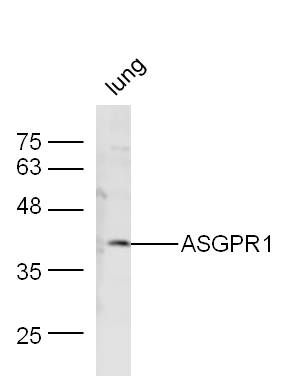
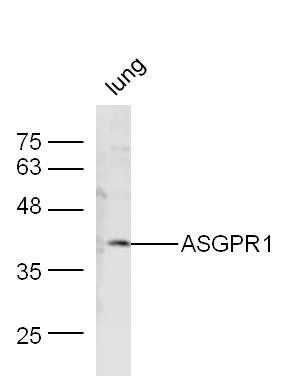
Sample: Lung (Mouse) Lysate at 40 ug
Primary: Anti-ASGPR1 (bs-4119R) at 1/300 dilution Secondary: IRDye800CW Goat Anti-Rabbit IgG at 1/20000 dilution Predicted band size: 32 kD Observed band size: 40 kD |
风险提示:丁香通仅作为第三方平台,为商家信息发布提供平台空间。用户咨询产品时请注意保护个人信息及财产安全,合理判断,谨慎选购商品,商家和用户对交易行为负责。对于医疗器械类产品,请先查证核实企业经营资质和医疗器械产品注册证情况。
 文献和实验
文献和实验受体介导的基因转移法 受体 介导的基因转移(receptor rmediated gene transfer)是利用细胞表面存在的特异性受体介导与配体结合的DNA内吞作用实现的。配体与受体的结合具有选择性,将DNA分子偶联在特异的配体上,借助配体与受体的选择性结合,可以实现靶基因的定向转移与表达。基于这种新的基因转移策略,目前已发展出了多种受体―配体系统,如脱唾液酸糖蛋白已被用于将目的基因靶向导人具有特异的脱唾液酸糖蛋白受体的肝细胞。脱唾液酸糖蛋白受体
人流感病毒对α 2-6结合型糖链有高亲和性,鸡禽流感病毒对α 2-3结合型唾液酸糖链有高亲和性5-7)。能选择性识别这个特征性的唾液酸糖链结构的探针,不仅能够分析流感病毒受体的组织分布,也很可能用于分析受体的分子生物学性质和功能。 之后我们尝试研发识别α 2-3结合型唾液酸糖链的单抗。结果成功研制出产α 2-3结合型唾液酸糖链单抗的杂交瘤细胞克隆体1H/3H11/B4(以下简称HYB4)。本文阐述了我们成功建立的HYB4单抗的性质和糖链识别性及使用HYB4抗体的免疫检测法。 2 建立
红细胞沉降速率(erythrocyte sedimentation rate)
来的红细胞,与血浆接触的总面积减小,而单位面积上的重量增加,即逐渐下沉。决定红细胞悬浮稳定性的因素在血浆,同一个体的红细胞悬浮于不同的血浆里,其沉降率不同。红细胞悬浮稳定性的原理,可能是红细胞表面有带负电荷的唾液酸糖蛋白,同性电荷相斥,故红细胞不易聚集,而保持悬浮稳定性,如果血浆中带正电荷的蛋白质(球蛋白、纤维蛋白原等)增加,被红细胞吸附后,使其表面的负电荷量减少而易于叠连。正常人之间的血沉差异很小,某些疾病使血沉改变,如风湿热、结核病等患者,血沉增快。有些疾病引起血沉减慢,如哮喘、荨麻疹等过
 技术资料
技术资料暂无技术资料 索取技术资料

