- ¥1380 - 2200
- LMAI Bio
- LM-17493R
- 进口/国产
- 2025年07月13日
- WB=1:500-2000 ELISA=1:500-1000 IHC-P=1:400-800 IHC-F=1:400-800 ICC=1:100-500 IF=1:100-500 (石蜡切片需做抗原修复)
- Rabbit
- Human, Mouse, Rat, Dog, Pig, Horse,

企业认证
相关产品推荐更多 >


万千商家帮你免费找货
0 人在求购买到急需产品
- 详细信息
- 文献和实验
- 技术资料
- 供应商:
上海联迈生物工程有限公司
- 库存:
大量
- 目录编号:
LM-17493R
- 克隆性:
多克隆
- 抗原来源:
Rabbit
- 保质期:
1年
- 抗体英文名:
SIL1
- 抗体名:
内质网分子伴侣SIL1抗体
- 宿主:
Rabbit
- 适应物种:
Human, Mouse, Rat, Dog, Pig, Horse,
- 免疫原:
KLH conjugated synthetic peptide derived from human SIL1:101-200/461
- 亚型:
IgG
- 形态:
Lyophilized or Liquid
- 应用范围:
WB=1:500-2000 ELISA=1:500-1000 IHC-P=1:400-800 IHC-F=1:400-800 ICC=1:100-500 IF=1:100-500 (石蜡切片需做抗原修复)
- 浓度:
1mg/ml
- 保存条件:
Store at -20 °C
- 规格:
100ul 200ul
| 英文名称 | SIL1 |
| 中文名称 | 内质网分子伴侣SIL1抗体 |
| 别 名 | BAP; BiP associated protein; BiP-associated protein; Endoplasmic reticulum chaperone SIL 1; Endoplasmic reticulum chaperone SIL1; MSS; Nucleotide exchange factor SIL 1; Nucleotide exchange factor SIL1; SIL 1; sil1; SIL1 homolog; SIL1 homolog endoplasmic reticulum chaperone (S. cerevisiae); SIL1 homolog endoplasmic reticulum chaperone; SIL1_HUMAN; UGL 5; ULG5. |
| 规格价格 | 100ul/1380元 购买 200ul/2200元 购买 大包装/询价 |
| 说 明 书 | 100ul 200ul |
| 研究领域 | 细胞生物 神经生物学 信号转导 细胞凋亡 |
| 抗体来源 | Rabbit |
| 克隆类型 | Polyclonal |
| 交叉反应 | Human, Mouse, Rat, Dog, Pig, Horse, |
| 产品应用 | WB=1:500-2000 ELISA=1:500-1000 IHC-P=1:400-800 IHC-F=1:400-800 ICC=1:100-500 IF=1:100-500 (石蜡切片需做抗原修复) not yet tested in other applications. optimal dilutions/concentrations should be determined by the end user. |
| 分 子 量 | 49kDa |
| 细胞定位 | 细胞浆 |
| 性 状 | Lyophilized or Liquid |
| 浓 度 | 1mg/ml |
| 免 疫 原 | KLH conjugated synthetic peptide derived from human SIL1:101-200/461 |
| 亚 型 | IgG |
| 纯化方法 | affinity purified by Protein A |
| 储 存 液 | 0.01M TBS(pH7.4) with 1% BSA, 0.03% Proclin300 and 50% Glycerol. |
| 保存条件 | Store at -20 °C for one year. Avoid repeated freeze/thaw cycles. The lyophilized antibody is stable at room temperature for at least one month and for greater than a year when kept at -20°C. When reconstituted in sterile pH 7.4 0.01M PBS or diluent of antibody the antibody is stable for at least two weeks at 2-4 °C. |
| PubMed | PubMed |
| 产品介绍 | background: SIKE interacts with IKK-epsilon (IKBKE; MIM 605048) and TBK1 (MIM 604834) and acts as a suppressor of TLR3 (MIM 603029) and virus-triggered interferon activation pathways (Huang et al., 2005 [PubMed 16281057]).[supplied by OMIM, Mar 2008] Function: Required for protein translocation and folding in the endoplasmic reticulum (ER). Functions as a nucleotide exchange factor for the ER lumenal chaperone HSPA5. Subcellular Location: Endoplasmic reticulum lumen. Tissue Specificity: Highly expressed in tissues which produce large amounts of secreted proteins such as kidney, liver and placenta. Also expressed in colon, heart, lung, ovary, pancreas, peripheral leukocyte, prostate, spleen and thymus. Expressed at low levels throughout the brain. Post-translational modifications: N-glycosylated. DISEASE: Defects in SIL1 are a cause of Marinesco-Sjoegren syndrome (MSS) [MIM:248800]. MSS is an autosomal recessive multisystem disorder which is characterized by cerebellar ataxia due to cerebellar atrophy, with Purkinje and granule cell loss and myopathy featuring marked muscle replacement with fat and connective tissue. Other cardinal features include bilateral cataracts, hypergonadotrophic hypogonadism and mild to severe mental retardation. Skeletal abnormalities, short stature, dysarthria, strabismus and nystagmus are also frequent findings. Mutational inactivation of this protein may result in ER stress-induced cell death signaling or malfunctioning chaperone machineries that mishandle client proteins which are critical for the organs targeted in MSS. Similarity: Belongs to the SIL1 family. SWISS: Q9H173 Gene ID: 64374 Database links: Entrez Gene: 64374 Human Entrez Gene: 81500 Mouse Entrez Gene: 291673 Rat Omim: 608005 Human SwissProt: Q9H173 Human SwissProt: Q9EPK6 Mouse SwissProt: Q6P6S4 Rat Unigene: 483521 Human Unigene: 291482 Mouse Unigene: 103851 Rat Important Note: This product as supplied is intended for research use only, not for use in human, therapeutic or diagnostic applications. |
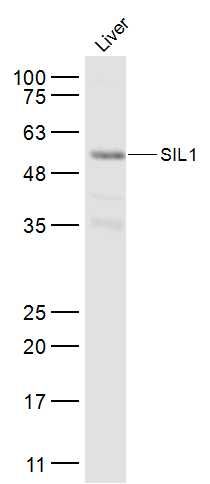
| 产品图片 | 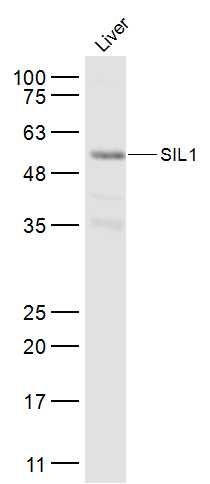 Sample: Liver (Mouse) Lysate at 40 ug Primary: Anti-SIL1 (bs-17493R) at 1/300 dilution Secondary: IRDye800CW Goat Anti-Rabbit IgG at 1/20000 dilution Predicted band size: 49 kD Observed band size: 59 kD |
风险提示:丁香通仅作为第三方平台,为商家信息发布提供平台空间。用户咨询产品时请注意保护个人信息及财产安全,合理判断,谨慎选购商品,商家和用户对交易行为负责。对于医疗器械类产品,请先查证核实企业经营资质和医疗器械产品注册证情况。
 文献和实验
文献和实验重链结合蛋白(heavy-chain binding protein, Bip)
Bip是重链结合蛋白的简称,因为它能够同IgG抗体的重链结合而得名。Bip是一类分子伴侣,属于Hsp70家族,在内质网中有两个作用。 第一,Bip同进入内质网的未折叠蛋白质的疏水氨基酸结合,防止多肽链不正确地折叠和聚合。然后Bip同ATP结合并通过ATP的水解释放出结合的多肽。在多数情况下,释放出的多肽很快折叠,或者同别的亚基共同组装成完整的蛋白质。正确折叠和装配的蛋白质不会同Bip再结合,但是,如果蛋白质进行了不正确的折叠或错误的装配,Bip会马上同这种
Phagophore,是自噬发生的铁证之一。步骤2:Phagophore不断延伸,将胞浆中的任何成分,包括细胞器,全部揽入“碗”中,然后“收口”,成为密闭的球状的autophagosome,我把它翻译为“自噬体”。电镜下观察到自噬体是自噬发生的铁证之二。有2个特征:一是双层膜,二是内含胞浆成分,如线粒体、内质网碎片等。步骤3:自噬体形成后,可与细胞内吞的吞噬泡、吞饮泡和内体融合(加了个“可”字,意思是这种情况不是必然要发生的)。步骤4:自噬体与溶酶体融合形成autolysosome,期间自噬体的内膜被溶酶
70是一种分子伴侣,能够与新翻译的多肽结合,抑制前体肽的凝聚使前体肽顺利到达内质网进行加工,从而提高蛋白的分泌水平。 最近,人们又构建了杆状病毒-S2表达系统,该系统能将重组杆状病毒转染果蝇S2细胞,以前人们认为杆状病毒仅能在鳞翅目昆虫细胞(如 sf9、sf21)中复制,不能在其他昆虫细胞(如果蝇细胞)中复制,然而目前研究表明在一定条件下,杆状病毒也能感染果蝇细胞。在果蝇细胞中,杆状病毒的多角体基因启动子几乎不发生作用。杆状病毒-S2表达系统的表达载体利用的是果蝇启动子如Hsp70启动子、肌动蛋白5C
 技术资料
技术资料暂无技术资料 索取技术资料