

- ¥780 - 2200
- 康朗生物
- kl-2962R
- 中国/美国/德国
- 2025年07月16日
- WB=1:500-2000 ELISA=1:500-1000
- Rabbit
- Human, Mouse,

企业认证
相关产品推荐更多 >



万千商家帮你免费找货
0 人在求购买到急需产品
相关阅读
AJE 润色服务限时 8 折起,权威机构信任 15+ 年Cytoscape 教程来了!快速实现顶刊同款通路网络图五大应用案例:Mustang Q 膜层析应用全解析1 个小工具,一次性搞定流程图、质粒图谱和信号通路图- 详细信息
- 技术资料
- 供应商:
上海康朗生物科技有限公司
- 库存:
大量
- 目录编号:
kl-2962R
- 克隆性:
多克隆
- 抗原来源:
Rabbit
- 保质期:
12个月
- 抗体英文名:
Syncytin 1 antibody
- 抗体名:
合胞素1抗体
- 宿主:
Rabbit
- 适应物种:
Human, Mouse,
- 免疫原:
KLH conjugated synthetic peptide derived from human Syncytin 1:451-550/538 <Cytoplasmic>
- 亚型:
IgG
- 形态:
冻干粉或液体
- 应用范围:
WB=1:500-2000 ELISA=1:500-1000
- 浓度:
1mg/ml
- 保存条件:
-20 °C
- 规格:
50ul 100ul 200ul
| 中文名称 | 合胞素1抗体 |
| 别 名 | HERV-W_7q21.2 provirus ancestral Env polyprotein; Endogenous retrovirus group W member 1; env; Env-W; Envelope polyprotein gPr73; Enverin; ENW1_HUMAN; ERVW; ERVW-1; Gp24; Gp50; HERV-7q Envelope protein; HERV-W envelope protein; HERVW; SU; Syncytin 1; Syncytin; Syncytin-1; TM; Transmembrane protein; Surface protein. |
 |
Specific References (1) | bs-2962R has been referenced in 1 publications. [IF=4.43] Díaz-Carballo, David, et al. "Therapeutic potential of antiviral drugs targeting chemorefractory colorectal adenocarcinoma cells overexpressing endogenous retroviral elements." Journal of Experimental & Clinical Cancer Research 34.1 (2015): 81. WB ; Human. PubMed:26260344 |
| 规格价格 | 50ul/780元 购买 100ul/1380元 购买 200ul/2200元 购买 大包装/询价 |
| 说 明 书 | 50ul 100ul 200ul |
| 研究领域 | 细胞生物 微生物学 细菌及病毒 |
| 抗体来源 | Rabbit |
| 克隆类型 | Polyclonal |
| 交叉反应 | Human, Mouse, |
| 产品应用 | WB=1:500-2000 ELISA=1:500-1000 (石蜡切片需做抗原修复) not yet tested in other applications. optimal dilutions/concentrations should be determined by the end user. |
| 分 子 量 | 33/58kDa |
| 细胞定位 | 细胞膜 细胞外基质 |
| 性 状 | Lyophilized or Liquid |
| 浓 度 | 1mg/ml |
| 免 疫 原 | KLH conjugated synthetic peptide derived from human Syncytin 1:451-550/538 <Cytoplasmic> |
| 亚 型 | IgG |
| 纯化方法 | affinity purified by Protein A |
| 储 存 液 | 0.01M TBS(pH7.4) with 1% BSA, 0.03% Proclin300 and 50% Glycerol. |
| 保存条件 | Store at -20 °C for one year. Avoid repeated freeze/thaw cycles. The lyophilized antibody is stable at room temperature for at least one month and for greater than a year when kept at -20°C. When reconstituted in sterile pH 7.4 0.01M PBS or diluent of antibody the antibody is stable for at least two weeks at 2-4 °C. |
| PubMed | PubMed |
| 产品介绍 | background: Retroviral envelope proteins mediate receptor recognition and membrane fusion during early infection. Endogenous envelope proteins may have kept, lost or modified their original function during evolution. This endogenous envelope protein has retained its original fusogenic properties and participates in trophoblast fusion during placenta morphogenesis. SU mediates receptor recognition. This interaction triggers the refolding of the transmembrane protein (TM) and is thought to activate its fusogenic potential by unmasking its fusion peptide (By similarity). Seems to recognize the type D mammalian retrovirus receptors SLC1A4 and SLC1A5, as it induces fusion of cells expressing these receptors in vitro. The transmembrane protein (TM) acts as a class I viral fusion protein. Under the current model, the protein has at least 3 conformational states: pre-fusion native state, pre-hairpin intermediate state, and post-fusion hairpin state. During viral and target cell membrane fusion, the coiled coil regions (heptad repeats) assume a trimer-of-hairpins structure, positioning the fusion peptide in close proximity to the C-terminal region of the ectodomain. The formation of this structure appears to drive apposition and subsequent fusion of membranes. Function: Retroviral envelope proteins mediate receptor recognition and membrane fusion during early infection. Endogenous envelope proteins may have kept, lost or modified their original function during evolution. This endogenous envelope protein has retained its original fusogenic properties and participates in trophoblast fusion during placenta morphogenesis. SU mediates receptor recognition. This interaction triggers the refolding of the transmembrane protein (TM) and is thought to activate its fusogenic potential by unmasking its fusion peptide (By similarity). Seems to recognize the type D mammalian retrovirus receptors SLC1A4 and SLC1A5, as it induces fusion of cells expressing these receptors in vitro. The transmembrane protein (TM) acts as a class I viral fusion protein. Under the current model, the protein has at least 3 conformational states: pre-fusion native state, pre-hairpin intermediate state, and post-fusion hairpin state. During viral and target cell membrane fusion, the coiled coil regions (heptad repeats) assume a trimer-of-hairpins structure, positioning the fusion peptide in close proximity to the C-terminal region of the ectodomain. The formation of this structure appears to drive apposition and subsequent fusion of membranes (By similarity). Subunit: The mature envelope protein (Env) consists of a trimer of SU-TM heterodimers attached probably by a labile interchain disulfide bond. Interacts with the C-type lectin CD209/DC-SIGN. Subcellular Location: Transmembrane protein: Cell membrane; Single-pass type I membrane protein (By similarity). Surface protein: Cell membrane; Peripheral membrane protein (By similarity). Note=The surface protein is not anchored to the membrane, but localizes to the extracellular surface through its binding to TM (By similarity). HERV-W_7q21.2 provirus ancestral Env polyprotein: Virion (By similarity). Tissue Specificity: Expressed at higher level in placental syncytiotrophoblast. Expressed at intermediate level in testis. Seems also to be found at low level in adrenal tissue, bone marrow, breast, colon, kidney, ovary, prostate, skin, spleen, thymus, thyroid, brain and trachea. Both mRNA and protein levels are significantly increased in the brain of individuals with multiple sclerosis, particularly in astrocytes and microglia. Post-translational modifications: Specific enzymatic cleavages in vivo yield mature proteins. Envelope glycoproteins are synthesized as a inactive precursor that is heavily N-glycosylated and processed likely by furin in the Golgi to yield the mature SU and TM proteins. The cleavage site between SU and TM requires the minimal sequence [KR]-X-[KR]-R. The intracytoplasmic tail cleavage by the viral protease that is required for the fusiogenic activity of some retroviruses envelope proteins seems to have been lost during evolution. The CXXC motif is highly conserved across a broad range of retroviral envelope proteins. It is thought to participate in the formation of a labile disulfide bond possibly with the CX6CC motif present in the transmembrane protein. Isomerization of the intersubunit disulfide bond to an SU intrachain disulfide bond is thought to occur upon receptor recognition in order to allow membrane fusion (By similarity). Similarity: Belongs to the gamma type-C retroviral envelope protein family. HERV class-I W env subfamily. SWISS: Q9UQF0 Gene ID: 30816 Database links: Entrez Gene: 2086 Human Entrez Gene: 30816 Human Entrez Gene: 405754 Human Omim: 604659 Human SwissProt: O42043 Human SwissProt: O71037 Human SwissProt: P10267 Human SwissProt: P60507 Human SwissProt: P60508 Human SwissProt: P61550 Human SwissProt: P61565 Human SwissProt: P61566 Human SwissProt: P61567 Human SwissProt: P61570 Human SwissProt: Q14264 Human SwissProt: Q69384 Human SwissProt: Q902F8 Human SwissProt: Q902F9 Human SwissProt: Q96L62 Human SwissProt: Q9N2J8 Human SwissProt: Q9N2J9 Human SwissProt: Q9N2K0 Human SwissProt: Q9NX77 Human SwissProt: Q9UKH3 Human SwissProt: Q9UQF0 Human Unigene: 250693 Human Unigene: 631996 Human Important Note: This product as supplied is intended for research use only, not for use in human, therapeutic or diagnostic applications. 合胞素(Syncytin)是一类由人俘获的逆转录病毒囊膜蛋白,与胎盘的形态发生中细胞滋养层到合胞滋养层的分化过程相关。Syncytin与人免疫缺陷病毒I型(HIV-1)囊膜蛋白(Env)在结构上具有相似的特点,二者可能具有相似的膜融合机制。 |
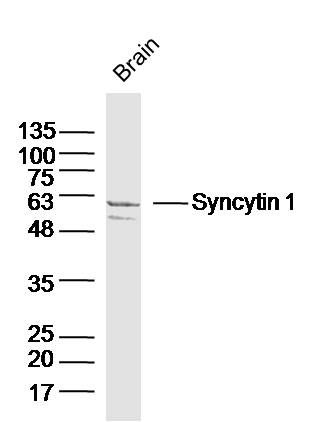
| 产品图片 | 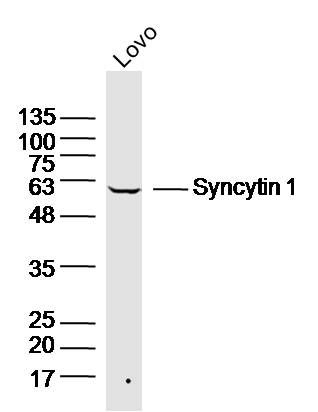 Sample: Lovo(Human) Cell Lysate at 30 ug Primary: Anti-Syncytin 1 (bs-2962R) at 1/300 dilution Secondary: IRDye800CW Goat Anti-Rabbit IgG at 1/20000 dilution Predicted band size: 33/58 kD Observed band size: 58kD 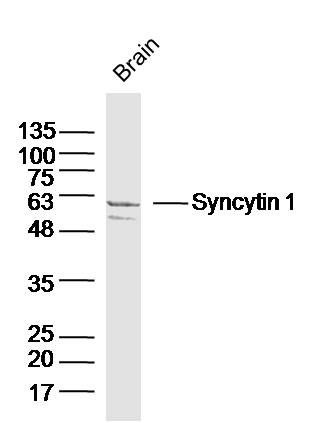 Sample: Brain (Mouse) Lysate at 40 ug Primary: Anti-Syncytin 1 (bs-2962R) at 1/300 dilution Secondary: IRDye800CW Goat Anti-Rabbit IgG at 1/20000 dilution Predicted band size: 33/58 kD Observed band size: 58kD |
风险提示:丁香通仅作为第三方平台,为商家信息发布提供平台空间。用户咨询产品时请注意保护个人信息及财产安全,合理判断,谨慎选购商品,商家和用户对交易行为负责。对于医疗器械类产品,请先查证核实企业经营资质和医疗器械产品注册证情况。
 技术资料
技术资料暂无技术资料 索取技术资料

