

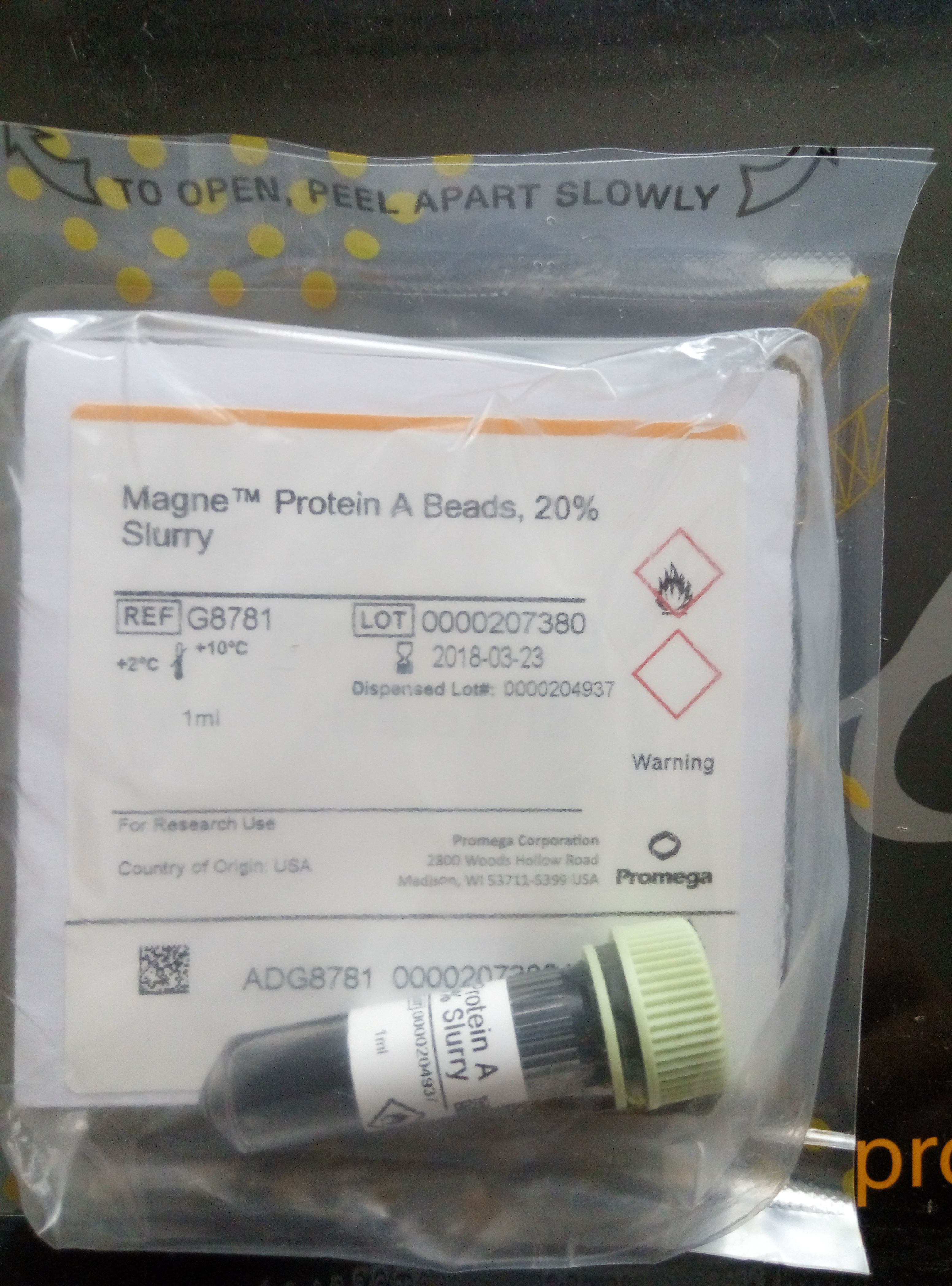
- ¥1075
- promega

- 美国
- G8781
- 2025年07月12日


相关产品推荐更多 >
万千商家帮你免费找货
0 人在求购买到急需产品
相关阅读
细胞污染识别与处理全攻略:5 种常见类型+关键误区Cytoscape 教程来了!快速实现顶刊同款通路网络图五大应用案例:Mustang Q 膜层析应用全解析1 个小工具,一次性搞定流程图、质粒图谱和信号通路图- 详细信息
- 文献和实验
- 技术资料
- 保存条件:
4度
- 保质期:
2018.3.23
- 库存:
1
- 规格:
1ml
Magne™ Protein A Beads and Protein G Beads beads use a novel attachment chemistry based on the HaloTag® technology to immobilize Protein A or Protein G. The HaloTag® protein is a multi-functional protein tag that forms a covalent bond with its ligand and is used for protein expression and purification, cell imaging, protein immobilization and protein-interaction analysis. Magne™ Protein A Beads and Magne™ Protein G Beads use recombinant Protein A from Staphylococcus and Protein G from Streptococci, respectively, fused with the HaloTag® protein. The Protein A-HaloTag® (M.Wt 71kDa) or Protein G-HaloTag® (M.Wt 58kDa) fusion protein is covalently attached in an oriented fashion to a magnetic cellulose bead that is activated using a HaloTag® ligand.
The Magne™ Protein A and Protein G Beads are not recommended for use in immunoprecipitation (IP) or co-IP applications.
风险提示:丁香通仅作为第三方平台,为商家信息发布提供平台空间。用户咨询产品时请注意保护个人信息及财产安全,合理判断,谨慎选购商品,商家和用户对交易行为负责。对于医疗器械类产品,请先查证核实企业经营资质和医疗器械产品注册证情况。
 文献和实验
文献和实验PREPARATION OF PROTEIN A SEPHAROSE CL 4B BEADS
Swelling and Storage1.Resuspend .2 gm of beads (= 1.0 ml swelled bead volume)in 40 ml of distilled water.Let swell for at least 2 hours.2.Wash beads twice in (10 ml each wash).Spin in clinical or table top fuge.Do not exceed 2K rpm.3.Resuspend
Encapsulation of Cells in Agarose Beads
For the analysis of large DNA fragments using pulsed-field gel electrophoresis (PFGE), it is necessary to first embed the cells in agarose to prevent shearing of the DNA during protein extraction and restriction enzyme digestion. The speed
of 10 intensity levels and six colors could theoretically code 1 million nucleic acid or protein sequences. Imaging and spectroscopic measurements indicate that the quantum dot-tagged beads are highly uniform and reproducible, yielding bead


