

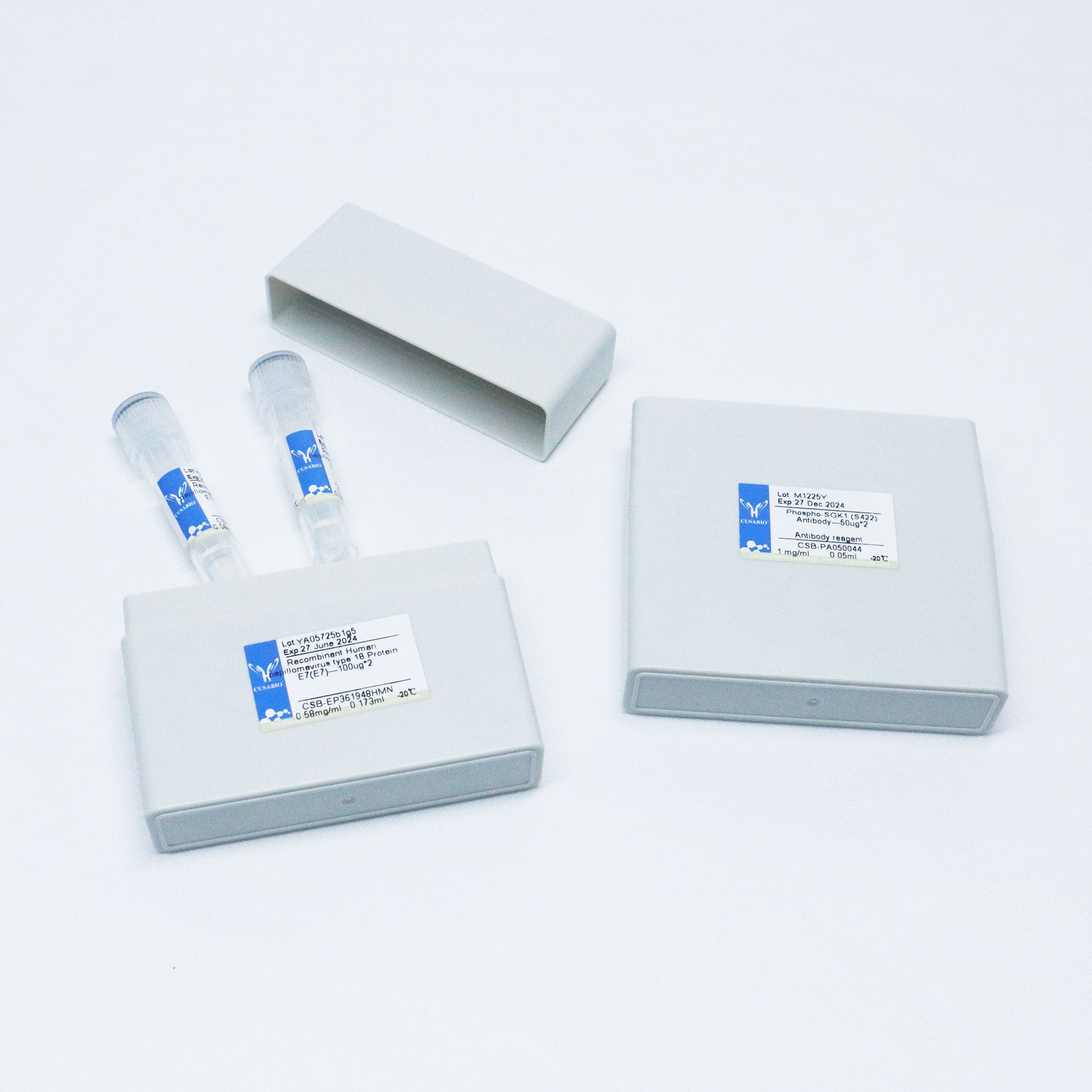
- ¥1344
- CUSABIO

- CN
- CSB-EP365854HML
- 2026年01月20日

企业认证
相关产品推荐更多 >
Recombinant-Organic-solute-transporter-alpha-like-protein-W01D25W01D25Organic solute transporter alpha-like protein W01D2.5
¥11872
小鼠Rasd1重组蛋白/Mouse Dexamethasone-induced Ras-related protein 1(Rasd1)蛋白
¥3168
Recombinant-Escherichia-coli-O6:K15:H31-Protein-CysZcysZProtein CysZ
¥11032/CUT1重组蛋白(Cutin hydrolase)Magnaporthe oryzae Cutinase(CUT1)蛋白
¥2616
Recombinant-Glycine-max-Chlorophyll-a-b-binding-protein-2-chloroplasticCAB2Chlorophyll a-b binding protein 2, chloroplastic Alternative name(s): LHCII type I CAB-2; LHCP
¥10752
万千商家帮你免费找货
0 人在求购买到急需产品
相关阅读
AJE 润色服务限时 8 折起,权威机构信任 15+ 年Cytoscape 教程来了!快速实现顶刊同款通路网络图五大应用案例:Mustang Q 膜层析应用全解析1 个小工具,一次性搞定流程图、质粒图谱和信号通路图- 详细信息
- 文献和实验
- 技术资料
- 保存条件:
We recommend to add 5-50% of glycerol (final concentration) and aliquot for long-term storage at -20℃/-80℃.
- 保质期:
Generally, the shelf life of liquid form is 6 months at -20℃/-80℃. The shelf life of lyophilized form is 12 months at -20℃/-80℃.
- 英文名:
Recombinant Human papillomavirus type 16 Protein E6 (E6)
- 库存:
200
- 供应商:
武汉华美生物工程有限公司
- 规格:
20μg
英文名称:
Recombinant Human papillomavirus type 16 Protein E6 (E6)品名简称:
Recombinant Human papillomavirus type 16 E6 protein货号:
CSB-EP365854HML规格:
20μg价格:
1344LC-MS/Western Blot:
/SDS-PAGE:
(Tris-Glycine gel) Discontinuous SDS-PAGE (reduced) with 5% enrichment gel and 15% separation gel.纯度:
Greater than 90% as determined by SDS-PAGE.内毒素:
Not test生物活性:
/基因名:
E6Uniprot No.:
P03126别名:
E6; Protein E6种属:
Human papillomavirus type 16蛋白长度:
Full Length来源:
E.coli分子量:
23.2 kDa表达区域:
1-158aa氨基酸序列:
MHQKRTAMFQDPQERPRKLPQLCTELQTTIHDIILECVYCKQQLLRREVYDFAFRDLCIVYRDGNPYAVCDKCLKFYSKISEYRHYCYSLYGTTLEQQYNKPLCDLLIRCINCQKPLCPEEKQRHLDKKQRFHNIRGRWTGRCMSCCRSSRTRRETQL蛋白标签:
N-terminal 6xHis-tagged产品提供形式:
Liquid or Lyophilized powder缓冲液:
If the delivery form is liquid, the default storage buffer is Tris/PBS-based buffer, 5%-50% glycerol. If the delivery form is lyophilized powder, the buffer before lyophilization is Tris/PBS-based buffer, 6% Trehalose, pH 8.0.储存条件:
We recommend that this vial be briefly centrifuged prior to opening to bring the contents to the bottom. Please reconstitute protein in deionized sterile water to a concentration of 0.1-1.0 mg/mL.We recommend to add 5-50% of glycerol (final concentration) and aliquot for long-term storage at -20℃/-80℃. Our default final concentration of glycerol is 50%. Customers could use it as reference.保质期:
The shelf life is related to many factors, storage state, buffer ingredients, storage temperature and the stability of the protein itself. Generally, the shelf life of liquid form is 6 months at -20℃/-80℃. The shelf life of lyophilized form is 12 months at -20℃/-80℃.货期:
3-7 business days注意事项:
Repeated freezing and thawing is not recommended. Store working aliquots at 4℃ for up to one week.功能1:
Plays a major role in the induction and maintenance of cellular transformation. Acts mainly as an oncoprotein by stimulating the destruction of many host cell key regulatory proteins. E6 associates with host E6-AP ubiquitin-protein ligase, and inactivates tumor suppressors TP53 and TP73 by targeting th to the 26S proteasome for degradation. In turn, DNA damage and chromosomal instabilities increase and lead to cell proliferation and cancer development. The complex E6/E6P targets several other substrates to degradation via the proteasome including host NFX1-91, a repressor of human telomerase reverse transcriptase (hTERT). The resulting increased expression of hTERT prevents the shortening of telomere length leading to cell immortalization. Other cellular targets including Bak, Fas-associated death domain-containing protein (FADD) and procaspase 8, are degraded by E6/E6AP causing inhibition of apoptosis. E6 also inhibits immune response by interacting with host IRF3 and TYK2. These interactions prevent IRF3 transcriptional activities and inhibit TYK2-mediated JAK-STAT activation by interferon alpha resulting in inhibition of the interferon signaling pathway.功能2:
Plays a major role in the induction and maintenance of cellular transformation. Acts mainly as an oncoprotein by stimulating the destruction of many host cell key regulatory proteins. E6 associates with host UBE3A/E6-AP ubiquitin-protein ligase, and inactivates tumor suppressors TP53 and TP73 by targeting them to the 26S proteasome for degradation. In turn, DNA damage and chromosomal instabilities increase and lead to cell proliferation and cancer development. The complex E6/E6AP targets several other substrates to degradation via the proteasome including host DLG1 or NFX1, a repressor of human telomerase reverse transcriptase (hTERT). The resulting increased expression of hTERT prevents the shortening of telomere length leading to cell immortalization. Other cellular targets including BAK1, Fas-associated death domain-containing protein (FADD) and procaspase 8, are degraded by E6/E6AP causing inhibition of apoptosis. E6 also inhibits immune response by interacting with host IRF3 and TYK2. These interactions prevent IRF3 transcriptional activities and inhibit TYK2-mediated JAK-STAT activation by interferon alpha resulting in inhibition of the interferon signaling pathway.文献:
Cellular and molecular biological aspects of cervical intraepithelial neoplasia.Kisseljov F., Sakharova O., Kondratjeva T.Int. Rev. Cytol. 271:35-95(2008)研究领域:
Epigenetics and Nuclear Signaling请点击“在线询价”找客服索取产品说明书及引用文献目录,产品实时更新参数、价格信息、更多文献信息可以查看cusabio官网
风险提示:丁香通仅作为第三方平台,为商家信息发布提供平台空间。用户咨询产品时请注意保护个人信息及财产安全,合理判断,谨慎选购商品,商家和用户对交易行为负责。对于医疗器械类产品,请先查证核实企业经营资质和医疗器械产品注册证情况。
 文献和实验
文献和实验Immortalization of Human Prostate Cells With the Human Papillomavirus Type 16 E6 Gene
. With the addition of DU145 the list of human experimental prostate cell systems is almost exhausted, although recently new sets of cell lines, immortalized by viral and nonviral genes, have begun to appear to augment the list (1 –5 ).
In Vitro Assays of Substrate Degradation Induced by High-Risk HPV E6 Oncoproteins
The high-risk mucosal human papillomavirus E6 proteins were the first viral proteins that were shown to use the ubiquitin proteasome pathway for the inactivation of their cellular target proteins. The first substrate to be identified
cancer cells as a model, we demonstrate RNAi for viral oncogenes Cervical cancer is the second most common cancer in women worldwide and is caused by human papillomavirus (HPV). Silencing of HPV E6 and E7 gene expression was achieved using siRNAs
 技术资料
技术资料暂无技术资料 索取技术资料

