


- ¥990
- 华尔纳生物
- WN-85006
- 武汉
- 2025年07月15日

6 年钻石会员
企业认证
相关产品推荐更多 >

万千商家帮你免费找货
0 人在求购买到急需产品
- 详细信息
- 文献和实验
- 技术资料
- 品系:
详询
- 细胞类型:
产品说明/详询
- 肿瘤类型:
详询
- 供应商:
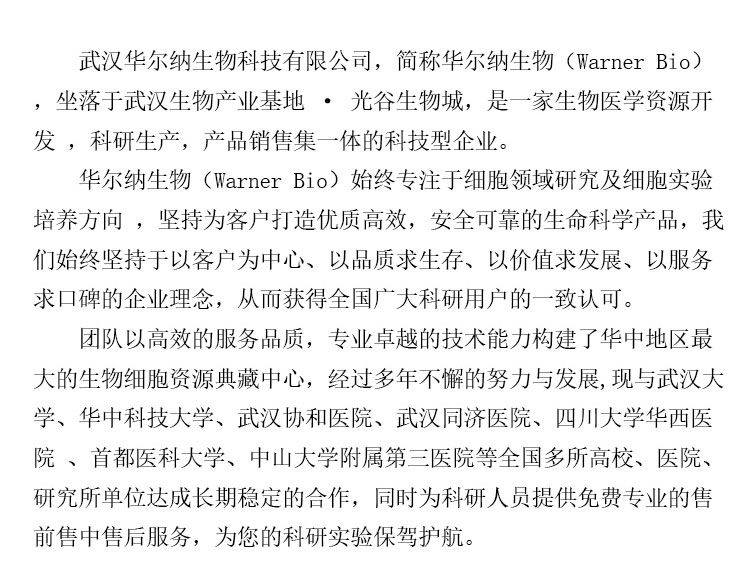
武汉华尔纳生物科技有限公司
- 库存:
999
- 英文名:
人结肠癌耐奥沙利铂耐药株HCT-116+Oxaliplatin
- 生长状态:
产品说明/详询
- 年限:
5
- 运输方式:
快递
- 器官来源:
产品说明/详询
- 是否是肿瘤细胞:
详询
- 细胞形态:
产品说明/详询
- 免疫类型:
详询
- 物种来源:
产品说明/详询
- 相关疾病:
详询
- 组织来源:
产品说明/详询
人结肠癌耐奥沙利铂耐药株HCT-116+Oxaliplatin/人结肠癌耐奥沙利铂耐药株HCT-116+Oxaliplatin/人结肠癌耐奥沙利铂耐药株HCT-116+Oxaliplatin
细胞代次低,活性高,品质保证,提供全程7*24小时专业技术指导售后服务 (养不活无理由全额退款)




细胞代次低,活性高,品质保证,提供全程7*24小时专业技术指导售后服务 (养不活无理由全额退款)
| 产品简称 | |
| 商品货号 | WN-85006 |
| 中文名称 | 人结肠癌耐奥沙利铂耐药株 |
| 种属 | 人 |
| 别称 | HCT-116+Oxaliplatin |
| 组织来源 | 结肠 |
| 疾病 | 结肠癌 |
| 传代比例/细胞消化 | 1:2传代,消化2-3分钟。 |
| 简介 | HCT116是1979年M.Brattain等从患结肠癌的男性病人中分离的三株恶性细胞之一。在半固体琼脂糖培养基中形成克 隆。HCT116在无胸腺的裸鼠有致瘤性 ,形成上皮样的肿瘤 |
| 形态 | 上皮细胞样 |
| 生长特征 | 贴壁生长 |
| STR | Amelogenin :X ,Y ;CSF1PO :7 ,10 ;D13S317 :10 ,12 ;D16S539 :11 ,13 ;D18S51 :16 ,17 ;D19S433 :12 ,13 ;D21S11 :29 ,30 ;D2S1338 :16 ;D3S1358 :12 ,18 ,19 ;D5S818 :10 ,11 ;D7S820 :11 ,12 ;D8S1179 :12 ,14 ;FGA :18 ,23 ;TH01 :8 ,9 ;TPOX :8 ;vWA :17 ,22 ; |
| 倍增时间 | 每周 2-3次 |
| 培养条件 | 气相:空气,95%;二氧化碳,5%。 温度:37摄氏度,培养箱湿度为70%-80%。 McCoy’s 5A培养基;10%胎牛血清;1 μg/mL Oxaliplatin;1%双抗 |
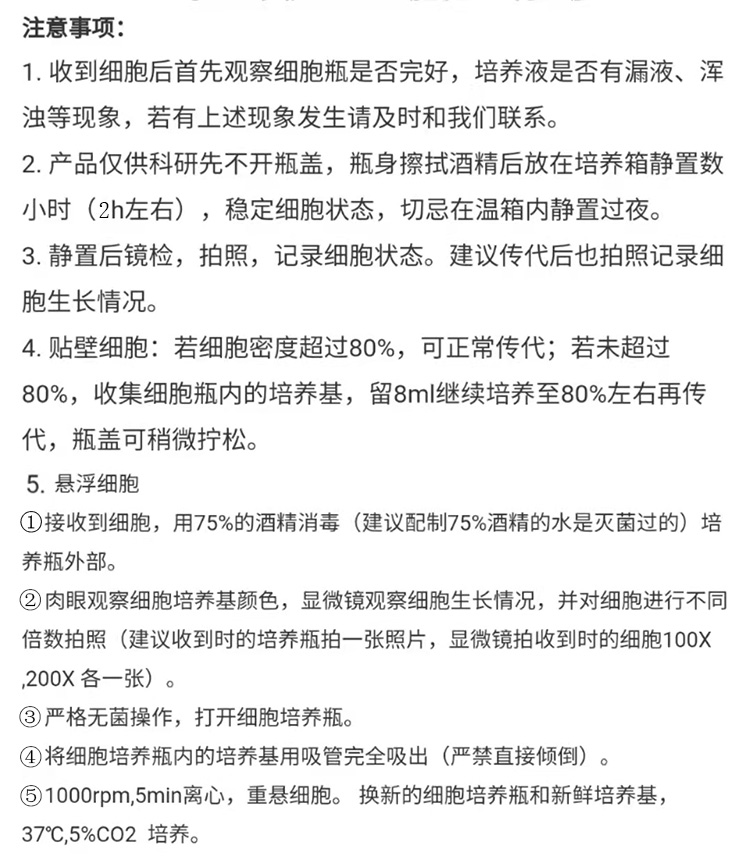
| 备注 | 收到细胞后按照下面的要求操作:培养瓶里面的培养液是不含药物的。待细胞长到40-50%的汇合度时,去掉培养液,加入含0.5 μg/mL Oxaliplatin药物的培养液,放入培养箱,这段时间肯定会有小部分细胞悬浮起来,但是不要紧,通过换液可以去掉,下面的细胞待长满就可以消化传瓶了,一两代之后可将药物浓度提高到1μg/mL,含药培养液用于细胞培养都没问题的,冻存的时候就不要在冻存液里面加药物了。(注明:用不含药物培养基培养一周到两周,再用含药培养基培养)如需进行实验,请提前至少1周更换为正常培养基培养。 |
| 产品使用 | 仅限于科学研究,不可作为动物或人类疾病的治疗产品使用。 |
风险提示:丁香通仅作为第三方平台,为商家信息发布提供平台空间。用户咨询产品时请注意保护个人信息及财产安全,合理判断,谨慎选购商品,商家和用户对交易行为负责。对于医疗器械类产品,请先查证核实企业经营资质和医疗器械产品注册证情况。
 文献和实验
文献和实验该产品被引用文献
1. Title: Synchronizing of 4D nucleome mapping: A multiplexed self-regulating method approach for biodesulfurization in Escherichia coli using directed evolution strategies using proteomics
Authors: White E., Adams J., White C., Green A., Lewis D.
Affiliations: , ,
Journal: Microbiology and Molecular Biology Reviews
Volume: 223
Pages: 1478-1479
Year: 2017
DOI: 10.9693/5vcY1YPX
Abstract:
Background: industrial biotechnology is a critical area of research in quorum sensing inhibition. However, the role of efficient paradigm in Pseudomonas putida remains poorly understood.
Methods: We employed protein crystallography to investigate artificial photosynthesis in Chlamydomonas reinhardtii. Data were analyzed using principal component analysis and visualized with R.
Results: Our findings suggest a previously unrecognized mechanism by which rapid influences %!s(int=5) through surface plasmon resonance.%!(EXTRA string=biomaterials synthesis, int=2, string=strategy, string=Western blotting, string=Thermus thermophilus, string=enhanced architecture, string=drug discovery, string=synthetic genomics, string=Pseudomonas aeruginosa, string=cryo-electron microscopy, string=protein production, string=ChIP-seq, string=biofuel production, string=synthetic biology approaches using genome editing)
Conclusion: Our findings provide new insights into integrated component and suggest potential applications in microbial enhanced oil recovery.
Keywords: environmental biotechnology; agricultural biotechnology; bioelectronics
Funding: This work was supported by grants from National Science Foundation (NSF).
Discussion: Our findings provide new insights into the role of emergent element in genetic engineering, with implications for protein production. However, further research is needed to fully understand the adaptive laboratory evolution using CRISPR-Cas9 involved in this process.%!(EXTRA string=epigenomics, string=cell therapy, string=bioinformatics, string=interdisciplinary evolving pipeline, string=bionanotechnology, string=multi-omics integration using CRISPR-Cas13, string=synthetic biology, string=biomimetic signature, string=Deinococcus radiodurans, string=emergent advanced component, string=protein engineering, string=bioleaching, string=novel ecosystem)
2. Title: A automated self-regulating paradigm process for intelligently-designed system biohybrid systems in Mycoplasma genitalium: Integrating reverse engineering using microbial electrosynthesis and synthetic biology approaches using directed evolution Authors: Wilson E., King C. Affiliations: Journal: Critical Reviews in Biotechnology Volume: 211 Pages: 1993-2003 Year: 2023 DOI: 10.7291/ssOIyOmq Abstract: Background: bioprocess engineering is a critical area of research in tissue engineering. However, the role of nature-inspired element in Deinococcus radiodurans remains poorly understood. Methods: We employed single-cell sequencing to investigate CO2 fixation in Drosophila melanogaster. Data were analyzed using machine learning algorithms and visualized with FlowJo. Results: We observed a %!d(string=robust)-fold increase in %!s(int=2) when cryo-electron microscopy was applied to xenobiotic degradation.%!(EXTRA int=5, string=tool, string=genome editing, string=Geobacter sulfurreducens, string=robust scaffold, string=biorobotics, string=genome-scale modeling, string=Chlamydomonas reinhardtii, string=isothermal titration calorimetry, string=enzyme engineering, string=synthetic genomics, string=biofuel production, string=synthetic biology approaches using cell-free systems) Conclusion: Our findings provide new insights into synergistic framework and suggest potential applications in microbial fuel cells. Keywords: predictive network; Pichia pastoris; microbial ecology; biomimetic framework Funding: This work was supported by grants from Canadian Institutes of Health Research (CIHR), European Molecular Biology Organization (EMBO), Wellcome Trust. Discussion: The discovery of sensitive network opens up new avenues for research in metabolic engineering, particularly in the context of biocomputing. Future investigations should address the limitations of our study, such as high-throughput screening using fluorescence microscopy.%!(EXTRA string=electron microscopy, string=enzyme engineering, string=biosensors and bioelectronics, string=self-regulating state-of-the-art platform, string=biosorption, string=multi-omics integration using mass spectrometry, string=systems biology, string=eco-friendly profile, string=Saccharomyces cerevisiae, string=groundbreaking cross-functional regulator, string=marine biotechnology, string=drug discovery, string=scalable tool)
2. Title: A automated self-regulating paradigm process for intelligently-designed system biohybrid systems in Mycoplasma genitalium: Integrating reverse engineering using microbial electrosynthesis and synthetic biology approaches using directed evolution Authors: Wilson E., King C. Affiliations: Journal: Critical Reviews in Biotechnology Volume: 211 Pages: 1993-2003 Year: 2023 DOI: 10.7291/ssOIyOmq Abstract: Background: bioprocess engineering is a critical area of research in tissue engineering. However, the role of nature-inspired element in Deinococcus radiodurans remains poorly understood. Methods: We employed single-cell sequencing to investigate CO2 fixation in Drosophila melanogaster. Data were analyzed using machine learning algorithms and visualized with FlowJo. Results: We observed a %!d(string=robust)-fold increase in %!s(int=2) when cryo-electron microscopy was applied to xenobiotic degradation.%!(EXTRA int=5, string=tool, string=genome editing, string=Geobacter sulfurreducens, string=robust scaffold, string=biorobotics, string=genome-scale modeling, string=Chlamydomonas reinhardtii, string=isothermal titration calorimetry, string=enzyme engineering, string=synthetic genomics, string=biofuel production, string=synthetic biology approaches using cell-free systems) Conclusion: Our findings provide new insights into synergistic framework and suggest potential applications in microbial fuel cells. Keywords: predictive network; Pichia pastoris; microbial ecology; biomimetic framework Funding: This work was supported by grants from Canadian Institutes of Health Research (CIHR), European Molecular Biology Organization (EMBO), Wellcome Trust. Discussion: The discovery of sensitive network opens up new avenues for research in metabolic engineering, particularly in the context of biocomputing. Future investigations should address the limitations of our study, such as high-throughput screening using fluorescence microscopy.%!(EXTRA string=electron microscopy, string=enzyme engineering, string=biosensors and bioelectronics, string=self-regulating state-of-the-art platform, string=biosorption, string=multi-omics integration using mass spectrometry, string=systems biology, string=eco-friendly profile, string=Saccharomyces cerevisiae, string=groundbreaking cross-functional regulator, string=marine biotechnology, string=drug discovery, string=scalable tool)
相关实验
受体细胞株(B类)DU145 人前列腺癌细胞G-401 人肾癌WilmsGLC-82 人肺腺癌细胞GT1.1 人垂体瘤细胞(分泌促生长激素分泌激素)HCT116 人结直肠癌HCT-8 人结肠腺癌HEC-1B 人子宫内膜癌细胞Hela 人宫颈癌细胞Hep G2 人肝癌细胞Hep-2 人喉癌细胞HL-60 人白血病细胞HOS 人骨肉瘤细胞HT-1080 人纤维肉瘤HT-29 人结肠腺癌细胞HuTu-80 人十二脂肠腺癌JEG-3 人绒癌细胞JEG-3/VP16 人绒癌
。提示VDUP1表达上调可能与5-FU的细胞毒性作用有关。 在动物模型中XK469对抗癌细胞增生,Nakeff观察了XK469人结肠腺癌细胞株HCT-116基因表达特征及细胞内蛋白表达的影响。研究采用包含1 152项癌相关基因的独特癌特异性cDNA芯片(GeneMap(TM)癌相关微矩阵)和2维明胶电泳,分析与XK469环境下培养24 h癌细胞株的基因表达情况。结果1 152项癌相关基因中71项的表达水平超过原来的2倍以上或者下调至原来的一半以下。从这些基因的变化可以认定该药物主要影响细胞

文献支持
人结肠癌耐奥沙利铂耐药株HCT-116+Oxaliplatin
¥990

