

- ¥270
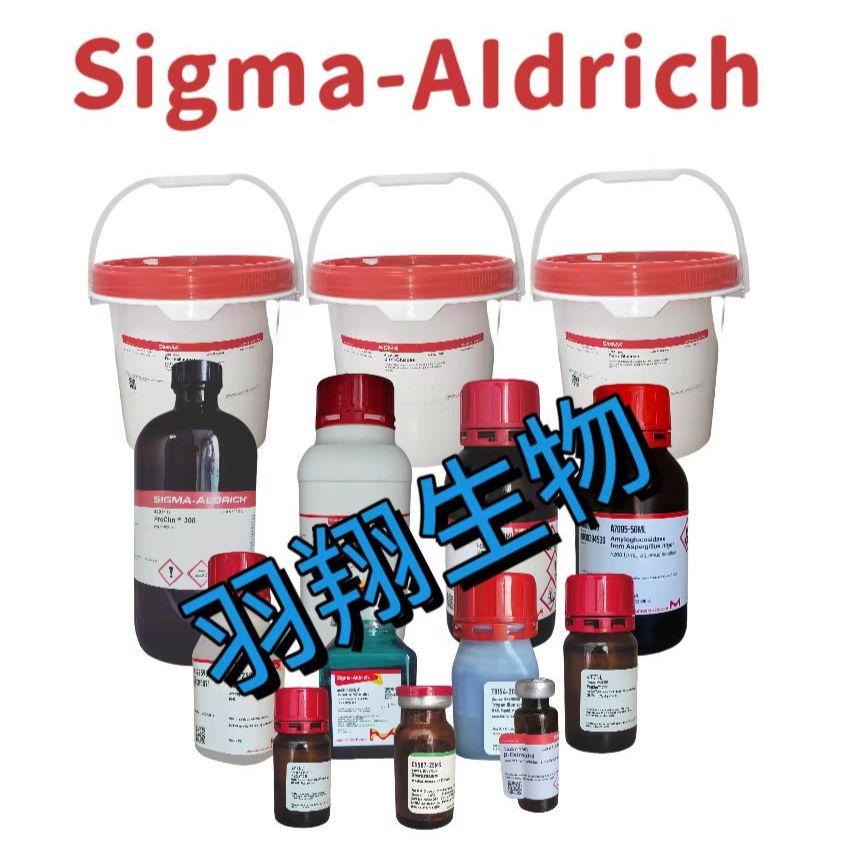
- Sigma-Aldrich
- 进口
- E4378-10G
- 2026年01月13日

企业认证
相关产品推荐更多 >


万千商家帮你免费找货
0 人在求购买到急需产品
- 详细信息
- 文献和实验
- 技术资料
- 保存条件:
常温
- 保质期:
根据瓶身LOT号查询
- 英文名:
Ethylene glycol-bis(2-aminoethylether)-N,N,N′,N′-tetraacetic acid
- 库存:
有现货
- 供应商:
浙江羽翔生物科技有限公司
- CAS号:
67-42-5
- 规格:
10G
属性
生物来源
synthetic (organic)
质量水平
400
检测方案
≥97.0%
形式
powder
reaction suitability
reagent type: chelator
缺失
≤1.0% loss on drying
mp
241 °C (dec.) (lit.)
溶解性
1 M NaOH: 1.1 g/10 mL, clear, colorless
储存温度
room temp
SMILES string
OC(=O)CN(CCOCCOCCN(CC(O)=O)CC(O)=O)CC(O)=O
InChI
1S/C14H24N2O10/c17-11(18)7-15(8-12(19)20)1-3-25-5-6-26-4-2-16(9-13(21)22)10-14(23)24/h1-10H2,(H,17,18)(H,19,20)(H,21,22)(H,23,24)
InChI key
DEFVIWRASFVYLL-UHFFFAOYSA-N
应用
乙二醇双(EGTA)可用于:
- 作为大鼠主动脉弓缩窄术(TAC)用低温心脏停跳液的组分
- 作为冰冷裂解缓冲液组分,用于蛋白提取和全细胞提取
- 作为HEK293F细胞线粒体提取用缓冲液A、B和C的组分
一种螯合剂,可在镁存在的情况下对钙进行测定。
生化/生理作用
乙二醇双((EGTA)A是一种螯合剂,可在镁存在的情况下对钙进行测定。
物理属性
在水中的溶解性随 pH 值增加而增加
风险提示:丁香通仅作为第三方平台,为商家信息发布提供平台空间。用户咨询产品时请注意保护个人信息及财产安全,合理判断,谨慎选购商品,商家和用户对交易行为负责。对于医疗器械类产品,请先查证核实企业经营资质和医疗器械产品注册证情况。
 文献和实验
文献和实验Flux through mitochondrial redox circuits linked to nicotinamide nucleotide transhydrogenase generates counterbalance changes in energy expenditure.
Compensatory changes in energy expenditure occur in response to positive and negative energy balance, but the underlying mechanism remains unclear. Under low energy demand, the mitochondrial electron transport system is particularly sensitive to added energy supply (i.e. reductive stress), which exponentially increases the rate of H2O2 (JH2O2) production. H2O2 is reduced to H2O by electrons supplied by NADPH. NADP+ is reduced back to NADPH by activation of mitochondrial membrane potential-dependent nicotinamide nucleotide transhydrogenase (NNT). The coupling of reductive stress-induced JH2O2 production to NNT-linked redox buffering circuits provides a potential means of integrating energy balance with energy expenditure. To test this hypothesis, energy supply was manipulated by varying flux rate through β-oxidation in muscle mitochondria minus/plus pharmacological or genetic inhibition of redox buffering circuits. Here we show during both non-ADP- and low-ADP-stimulated respiration that accelerating flux through β-oxidation generates a corresponding increase in mitochondrial JH2O2 production, that the majority (∼70-80%) of H2O2 produced is reduced to H2O by electrons drawn from redox buffering circuits supplied by NADPH, and that the rate of electron flux through redox buffering circuits is directly linked to changes in oxygen consumption mediated by NNT. These findings provide evidence that redox reactions within β-oxidation and the electron transport system serve as a barometer of substrate flux relative to demand, continuously adjusting JH2O2 production and, in turn, the rate at which energy is expended via NNT-mediated proton conductance. This variable flux through redox circuits provides a potential compensatory mechanism for fine-tuning energy expenditure to energy balance in real time.
【求助】最近在做hsv tk,所用前药为粉末状GCV(购自sigma),但不知道怎么溶解
qulinyd 最近在做hsv tk,所用前药为粉末状GCV(购自sigma),但不知道怎么溶解合适,还请各位帮帮忙哦 freecell 你从sigma买来的东西,应该有个datasheet吧: Preparation Instructions Soluble at 10 mg/ml in 0.1 N HCl. Storage/Stability Store desiccated
:Formerly listed as Type III 溶解性:溶于水,参考浓度2mg/ml 储存条件:2-8℃ From Sigma D1626 Salmon DNA 的配制: 组份浓度10 mg/ml Salmon DNA ;配制量约100 ml 配制方法: 1. 称取鲑鱼精DNA 2 g置于500 ml烧杯中,加入约200 ml的TE Buffer。 2. 用磁力搅拌器室温搅拌2~4小时
疗法虽以改进使用满意,现予以报道。 1 对象和方法 1.1 对象 本组病例均为门诊经胃镜证实无并发症的活动性消化性溃疡共67例。其中 胃溃疡 (GU)13例,十二指肠球部溃疡(DU)54例,女8例,男59例,的龄16岁~65岁,平均40.5岁,20岁~60岁者60例(90%)。 1.2 方法 每日3餐饭前40min空腹时将甲硝唑(Met)片剂0.2g,研末化成10ml水溶液口服,令患者向右侧卧10min
 技术资料
技术资料暂无技术资料 索取技术资料

