


- 询价
- gelatins
- JC122827
- 进口/国产
- 2025年07月11日
- ELISA, WB
- Rabbit
- 人/动物/植物

企业认证
相关产品推荐更多 >




万千商家帮你免费找货
0 人在求购买到急需产品
相关阅读
细胞污染识别与处理全攻略:5 种常见类型+关键误区Cytoscape 教程来了!快速实现顶刊同款通路网络图五大应用案例:Mustang Q 膜层析应用全解析1 个小工具,一次性搞定流程图、质粒图谱和信号通路图- 详细信息
- 文献和实验
- 技术资料
- 供应商:
上海机纯实业有限公司
- 库存:
大量
- 克隆性:
多克隆
- 保质期:
12个月
- 抗体英文名:
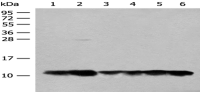
Anti-ZMAT3 antibody
- 宿主:
Rabbit
- 适应物种:
人/动物/植物
- 应用范围:
ELISA, WB
- 浓度:
0.2 mg/ml
- 保存条件:
-20°C
- 规格:
25 μl/100 μl/200 μl
Cat. No. JC122827
Package 25 μl/100 μl/200 μl
Storage -20°C, pH7.4 PBS, 0.05% NaN3, 40% Glycerol
Product overview
Description Anti-ZMAT3 rabbit polyclonal antibody
Applications ELISA, IHC
Immunogen Fusion protein of human ZMAT3
Reactivity Human, Mouse, Rat
Content 0.2 mg/ml
Host species Rabbit
Ig class Immunogen-specific rabbit IgG
Purification Antigen affinity purification
Anti-ZMAT3 antibody
Target information
Symbol ZMAT3
Full name zinc finger, matrin-type 3
Synonyms WIG1; WIG-1; PAG608
Swissprot Q9HA38
Target Background
This gene encodes a protein containing three zinc finger domains and a nuclear localization signal. The mRNA and the protein of this gene are upregulated by wildtype p53 and overexpression of this gene inhibits tumor cell growth, suggesting that this gene may have a role in the p53-dependent growth regulatory pathway. Alternative splicing of this gene results in two transcript variants encoding two isoforms differing in only one amino acid.
Anti-ZMAT3 antibody
Applications
Immunohistochemistry
Predicted cell location: Nucleus
Positive control: Human colon cancer
Recommended dilution: 25-100 Predicted cell location: Nucleus
Positive control: Human breast cancer
Recommended dilution: 25-100
风险提示:丁香通仅作为第三方平台,为商家信息发布提供平台空间。用户咨询产品时请注意保护个人信息及财产安全,合理判断,谨慎选购商品,商家和用户对交易行为负责。对于医疗器械类产品,请先查证核实企业经营资质和医疗器械产品注册证情况。
 文献和实验
文献和实验a simple ELISA method to detect human anti-antibody response.
Purification Of Anti Peptide Antibody
antibody that could contribute to staining background. The proportion in each pool varies with the peptide immunogen. The quality of the anti-peptide serum seems to increase with multiple boosts - the first bleed may be feeble.
Anticardiolipin Antibody and Anti-beta 2 Glycoprotein I Antibody Assays
standard” laboratory test to diagnose or classify a patient as having APS. This chapter discusses the clinical and laboratory theoretical and technical aspects of aCL and anti-β2GPI antibody assays.
 技术资料
技术资料需要更多技术资料 索取更多技术资料

