


- ¥3684
- BD
- 564405
- USA
- 2025年07月14日

企业认证
相关产品推荐更多 >


万千商家帮你免费找货
0 人在求购买到急需产品
- 详细信息
- 询价记录
- 文献和实验
- 技术资料
- 英文名:
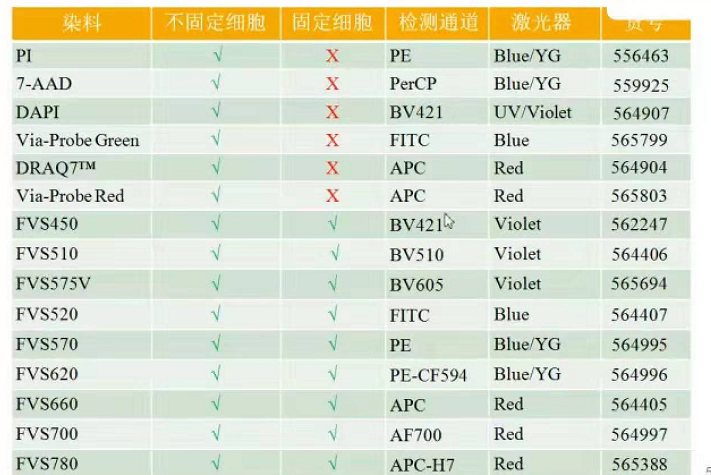
Fixable Viability Stain 660
- 保存条件:
低温
- 规格:
100 µg
Description
BD Horizon™ Fixable Viability Stain 660 (FVS660) is useful for discrimination of viable from non-viable mammalian cells in multicolor flow cytometric applications. This dye reacts with and covalently binds to cell-surface and intracellular amines. Permeable plasma cell membranes, such as those present in necrotic cells, allow for the intracellular diffusion of the dye and covalent binding to higher overall concentrations of amines than in non-permeable live cells. Therefore, necrotic cells present in a typical in vitro assay label with higher levels of dye increasing their fluorescence intensity 10-20 fold over that of viable cells. The labeled cells can be fixed with formaldehyde for downstream decontamination, freezing and/or permeabilization and subsequent intracellular staining while maintaining stable viability stain fluorescence.
BD Horizon™ Fixable Viability Stain 660 is excited by the Red laser (with an excitation maximum of 649 nm) and has a fluorescence emission maximum of 660 nm.
Suggested Companion Products
| Cat No. | Description | Size | |
|---|---|---|---|
| 554656 | Stain Buffer (FBS) RUO | 500 mL |
|
| 554655 | Fixation Buffer RUO | 100 mL |
|
| 557885 | Perm/Wash Buffer I RUO | 125 mL |
|
| 558050 | Perm Buffer III RUO | 125 mL |
|
| 562574 | Transcription Factor Buffer Set RUO | 100 Tests |
|
| 562725 | Transcription Factor Buffer Set RUO | 25 Tests |
|
| 554714 | Fixation/Permeabilization Solution Kit RUO | 250 |
|
| 554657 | Stain Buffer (BSA) RUO | 500 mL |
Preparation
Bring FVS660 dye powder and 190 μl of fresh cell culture-grade Dimethyl Sulfoxide (DMSO; e.g., Sigma D2650) to room temperature. Add 190 μl of DMSO and vortex solution well. Inspect the solution and repeat vortex until the stock dye has fully dissolved. This is the Stock Solution.
Storage
Upon arrival, store the dry dye desiccated and protected from light at -80°C until use. After reconstitution with DMSO, store the Stock Solution at -20°C in small aliquots. Do not use reconstituted dye after 90 days of storage. Please discard the dye solution after 90 days post reconstitution with DMSO.
Cytometry Requirements
Red laser-equipped Flow Cytometers (e.g., BD FACSCanto™ II, BD LSRFortessa™, BD™ LSR II, or BD Accuri™ C6) can be used. This dye can be read out of filters commonly used for APC or Alexa Fluor® 647 (e.g., 660/20 or 670/30). Fluorescence compensation is best achieved using a sample of the cells of interest.
Procedure
Fixable Viability Stain 660 labeling of cells
1. Prepare cells for flow cytometric staining using sodium azide-free buffers.
2. Wash cells one time in sodium azide- and protein-free Dulbecco's Phosphate Buffered Saline (1X DPBS).
3. Resuspend cells at 1-10x10^6 cells/ml in sodium azide- and protein-free 1X DPBS.
4. Add 1 ìl of the BD Horizon™ Fixable Viability Stain 660 Stock Solution for each 1 ml of cell suspension (1:1000) and vortex immediately.
a. Note: We recommend titrating the dye for optimal performance, as different cell types and different applications can result in a wide degree of variability in staining. Please read Note 1 below for guidance on recommended ranges.
5. Incubate the mixture for 10-15 minutes at room temperature or 2-8°C protected from light.
a. Optional: Alternatively, incubate mixtures at 37°C for 5-7 minutes.
6. Wash cells twice with 2 ml of BD Pharmingen™ Stain Buffer (FBS) (Cat. No. 554656) or the equivalent.
7. Decant the supernatant and gently mix to disrupt the cell pellet.
8. Resuspend the cells in Stain Buffer (FBS) or equivalent.
9. Stain, fix and permeabilize cells as desired for downstream applications.
Notes:
1. Each user should determine the optimal concentrations of reagents, cells, and conditions for the assay of interest. We recommend titrating the reagent in early experiments to obtain optimal results. The following are ranges that we have found to work for various cell systems:
a. Lysed Whole Blood: 1:1,000 from the Stock Solution.
b. Primary Cells: 1:1,000 - 1:4,000 from the Stock Solution.
c. Cell Lines: 1:4,000 - 1:10,000 from the Stock Solution.
2. The reactivity of the free dye is quenched by washing with buffer containing protein (e.g., FBS or BSA).
3. Cells may be stained in bulk prior to freezing or staining with fluorescent antibodies.
4. BD Horizon™ Fixable Viability Stain 660 can be used in intracellular staining assays that require fixation with formaldehyde and permeabilization with methanol and detergents such as those used for BD Phosflow™ staining (e.g., Cat. No. 558050, BD Phosflow™ Perm Buffer III), intracellular cytokine staining (e.g., Cat. No. 554714, BD Cytofix/Cytoperm™ Fixation/Permeablization Kit), or transcription factor staining (e.g., Cat. No. 562574/562725, BD Pharmingen™ Transcription Factor Buffer Set).
5. Apoptotic cells can show variable staining. We recommend co-staining with, e.g., Annexin V FITC (Cat. No. 556419) if further analysis is desired for the apoptotic cells.
-
Perfetto SP, Chattopadhyay PK, Lamoreaux L, et al. Amine-reactive dyes for dead cell discrimination in fixed samples. Curr Protoc Cytom. 2010; 9(9.34). View reference
风险提示:丁香通仅作为第三方平台,为商家信息发布提供平台空间。用户咨询产品时请注意保护个人信息及财产安全,合理判断,谨慎选购商品,商家和用户对交易行为负责。对于医疗器械类产品,请先查证核实企业经营资质和医疗器械产品注册证情况。
- 作者
- 内容
- 询问日期
 文献和实验
文献和实验Exercise 12.7 - Viability Cell Count Materials Suspension culture of cells Sterile transfer pipettes Stock 0.2% (w/v) Trypan blue Hemacytometer and microscope Procedure Gently
Trypan blue will stain dead or dying cells. Viable cells are able to repell the dye and do not stain. Note: Trypan blue has a greater affinity for serum proteins than for cellular protein. If the background is too dark, cells should be pelleted
Vybrant® DyeCycle Violet Stain
Stability Vybrant® DyeCycle™ Violet stain 200 μL 5 mM solution in deionized water 2-6?C
 技术资料
技术资料暂无技术资料 索取技术资料

