

- ¥780 - 2200
- LMAI Bio
- LM-8536R
- 进口/国产
- 2026年05月07日
- ELISA=1:500-1000 IHC-P=1:400-800 IHC-F=1:400-800 Flow-Cyt=1μg/Test IF=1:50-200 (石蜡切片需做抗原修复)
- Rabbit
- Human, Mouse, Rat, Dog, Pig, Cow, Horse,

企业认证
相关产品推荐更多 >


万千商家帮你免费找货
0 人在求购买到急需产品
相关阅读
AJE 润色服务限时 8 折起,权威机构信任 15+ 年Cytoscape 教程来了!快速实现顶刊同款通路网络图五大应用案例:Mustang Q 膜层析应用全解析1 个小工具,一次性搞定流程图、质粒图谱和信号通路图- 详细信息
- 文献和实验
- 技术资料
- 供应商:
上海联迈生物工程有限公司
- 库存:
大量
- 目录编号:
LM-8536R
- 克隆性:
多克隆
- 抗原来源:
Rabbit
- 保质期:
1年
- 抗体英文名:
Nucleolin/C23
- 抗体名:
核仁蛋白C23抗体
- 宿主:
Rabbit
- 适应物种:
Human, Mouse, Rat, Dog, Pig, Cow, Horse,
- 免疫原:
KLH conjugated synthetic peptide derived from human Nucleolin:601-710/710
- 亚型:
IgG
- 形态:
Lyophilized or Liquid
- 应用范围:
ELISA=1:500-1000 IHC-P=1:400-800 IHC-F=1:400-800 Flow-Cyt=1μg/Test IF=1:50-200 (石蜡切片需做抗原修复)
- 浓度:
1mg/ml
- 保存条件:
Store at -20 °C
- 规格:
50ul 100ul 200ul
| 英文名称 | Nucleolin/C23 |
| 中文名称 | 核仁蛋白C23抗体 |
| 别 名 | C23; NCL; Nucl; NUCL_HUMAN; Nucleolin; Protein C23. |
| 规格价格 | 50ul/780元 购买 100ul/1380元 购买 200ul/2200元 购买 大包装/询价 |
| 说 明 书 | 50ul 100ul 200ul |
| 研究领域 | 细胞生物 染色质和核信号 表观遗传学 |
| 抗体来源 | Rabbit |
| 克隆类型 | Polyclonal |
| 交叉反应 | Human, Mouse, Rat, Dog, Pig, Cow, Horse, |
| 产品应用 | ELISA=1:500-1000 IHC-P=1:400-800 IHC-F=1:400-800 Flow-Cyt=1μg/Test IF=1:50-200 (石蜡切片需做抗原修复) not yet tested in other applications. optimal dilutions/concentrations should be determined by the end user. |
| 分 子 量 | 76kDa |
| 细胞定位 | 细胞核 细胞浆 |
| 性 状 | Lyophilized or Liquid |
| 浓 度 | 1mg/ml |
| 免 疫 原 | KLH conjugated synthetic peptide derived from human Nucleolin:601-710/710 |
| 亚 型 | IgG |
| 纯化方法 | affinity purified by Protein A |
| 储 存 液 | 0.01M TBS(pH7.4) with 1% BSA, 0.03% Proclin300 and 50% Glycerol. |
| 保存条件 | Store at -20 °C for one year. Avoid repeated freeze/thaw cycles. The lyophilized antibody is stable at room temperature for at least one month and for greater than a year when kept at -20°C. When reconstituted in sterile pH 7.4 0.01M PBS or diluent of antibody the antibody is stable for at least two weeks at 2-4 °C. |
| PubMed | PubMed |
| 产品介绍 | background: Nucleolin is the major nucleolar protein of growing eukaryotic cells. C23 (nucleolin, NCL) is a eukaryotic nucleolar phosphoprotein that influences synthesis and maturation of ribosomes. C23 localizes to dense fibrillar regions of the nucleolus. It contains four RNA binding domains that interact with pre-rRNA during synthesis. C23 can influence RNA processing, ribosomal gene transcription and nucleolar targeting of ribosomal components. It is known to associate with a variety of proteins, including the nucleolar protein B23. Phosphorylation by Cdc2 and casein kinase II causes translocation of C23 from the nucleolus to the cytoplasm. Mitotic phosphorylated forms of Bcl-2 are present in nuclear structures in prophase Hela cells together with C23 and Ki-67. Retinoic acid-induced apoptosis leads to C23 down-regulation and Bcl-2 mRNA instability. C23 binds the human telomerase reverse transcriptase subunit (TERT) through interactions with its RNA binding domain 4 and carboxyl-terminal RGG domain, and this interaction is critical for the nucleolar localization of human TERT. Function: Nucleolin is the major nucleolar protein of growing eukaryotic cells. It is found associated with intranucleolar chromatin and pre-ribosomal particles. It induces chromatin decondensation by binding to histone H1. It is thought to play a role in pre-rRNA transcription and ribosome assembly. May play a role in the process of transcriptional elongation. Binds RNA oligonucleotides with 5'-UUAGGG-3' repeats more tightly than the telomeric single-stranded DNA 5'-TTAGGG-3' repeats. Subunit: Identified in a mRNP granule complex, at least composed of ACTB, ACTN4, DHX9, ERG, HNRNPA1, HNRNPA2B1, HNRNPAB, HNRNPD, HNRNPL, HNRNPR, HNRNPU, HSPA1, HSPA8, IGF2BP1, ILF2, ILF3, NCBP1, NCL, PABPC1, PABPC4, PABPN1, RPLP0, RPS3, RPS3A, RPS4X, RPS8, RPS9, SYNCRIP, TROVE2, YBX1 and untranslated mRNAs. Interacts with APTX and NSUN2. Component of the SWAP complex that consists of NPM1, NCL/nucleolin, PARP1 and SWAP70. Component of a complex which is at least composed of HTATSF1/Tat-SF1, the P-TEFb complex components CDK9 and CCNT1, RNA polymerase II, SUPT5H, and NCL/nucleolin. Interacts (via RRM1 and C-terminal RRM4/Arg/Gly-rich domains) with TERT; the interaction is important for nucleolar localization of TERT. Interacts with ERBB4. Interacts with GZF1; this interaction is important for nucleolar localization of GZF1. Interacts with NVL. Subcellular Location: Nucleus, nucleolus. Cytoplasm. Note=Localized in cytoplasmic mRNP granules containing untranslated mRNAs. Post-translational modifications: Some glutamate residues are glycylated by TTLL8. This modification occurs exclusively on glutamate residues and results in a glycine chain on the gamma-carboxyl group (By similarity). Similarity: Contains 4 RRM (RNA recognition motif) domains. SWISS: P19338 Gene ID: 4691 Database links: Entrez Gene: 4691 Human Entrez Gene: 17975 Mouse Entrez Gene: 25135 Rat Omim: 164035 Human SwissProt: P19338 Human SwissProt: P09405 Mouse SwissProt: P13383 Rat Unigene: 79110 Human Unigene: 154378 Mouse Unigene: 474153 Mouse Unigene: 144561 Rat Important Note: This product as supplied is intended for research use only, not for use in human, therapeutic or diagnostic applications. |
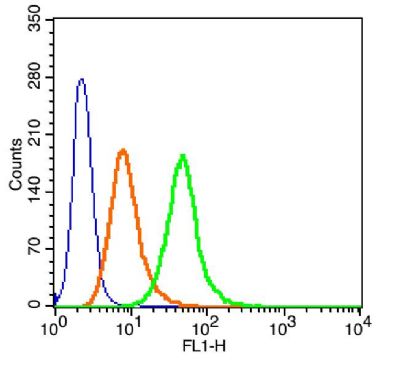
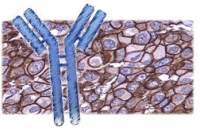
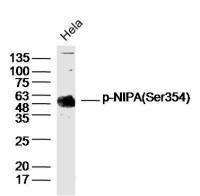
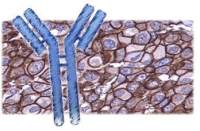
| 产品图片 | 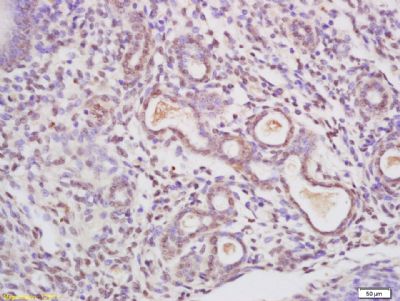 Tissue/cell: rat uterus tissue; 4% Paraformaldehyde-fixed and paraffin-embedded; Antigen retrieval: citrate buffer ( 0.01M, pH 6.0 ), Boiling bathing for 15min; Block endogenous peroxidase by 3% Hydrogen peroxide for 30min; Blocking buffer (normal goat serum,C-0005) at 37℃ for 20 min; Incubation: Anti-Nucleolin/C23 Polyclonal Antibody, Unconjugated(bs-8536R) 1:200, overnight at 4°C, followed by conjugation to the secondary antibody(SP-0023) and DAB(C-0010) staining 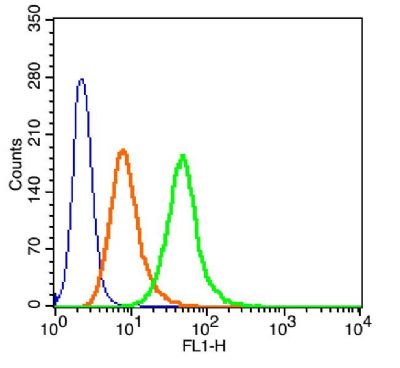 Blank control(blue): Hela(fixed with 2% paraformaldehyde (10 min) and then permeabilized with ice-cold 90% methanol for 30 min on ice). Primary Antibody: Rabbit Anti- Phospho-c-Fos (Ser32) /AF488 antibody(bs-8536R-AF488), Dilution: 1μg in 100 μL 1X PBS containing 0.5% BSA; Isotype Control Antibody: Rabbit IgG/AF488(orange) ,used under the same conditions. 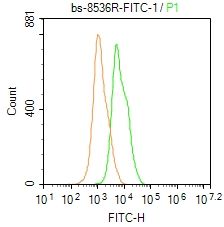 Blank control: Molt4. Primary Antibody (green line): Rabbit Anti- Nucleolin/C23/FITC Conjugated antibody (bs-8536R-FITC) Dilution: 1μg /10^6 cells; Isotype Control Antibody (orange line): Rabbit IgG-FITC . Protocol The cells were fixed with 4% PFA (10min at room temperature)and then permeabilized with 0.1% PBST for 20 min at-20℃. The cells were then incubated in 5% BSA to block non-specific protein-protein interactions for 30 min at room temperature. The cells were stained with Primary Antibody for 30 min at room temperature. Acquisition of 20,000 events was performed. |
风险提示:丁香通仅作为第三方平台,为商家信息发布提供平台空间。用户咨询产品时请注意保护个人信息及财产安全,合理判断,谨慎选购商品,商家和用户对交易行为负责。对于医疗器械类产品,请先查证核实企业经营资质和医疗器械产品注册证情况。
 文献和实验
文献和实验(3)同上。两个磷酸化位点都要做,但是可能在不同的病理条件下,侧重点有所不同,这主要体现在你的论文的讨论中。因此建议实验前多做论文研究,查阅一下别人的发表文章,看看与你的病理模型更相关的是哪个位点。 真爱满行囊 非常感谢你 的回复,现在我遇到的问题是我做出来蛋白总量还有216位点是有变化的,9位因为买的是santa curz的抗体,现在死活做不出来,很头痛,我要说明的问题是他的活性降低,我也看到216位点磷酸化水平降低了,可是现在没有第九位的结果(就是没有办法得到第九
异硫氰基与蛋白中氨基酸(主要是赖氨酸)的氨基结合。一个IgG分子有86个氨基酸残基,一般最多能标记16~20个荧光素分子。 (2)丽丝胺罗丹明:为褐色粉末,不溶于水、易溶于酒精和丙酮。荧光为桔红色。性质稳定,可长期保存。分子式C23H29O7NaS2,分子量为580,最大吸收波长570 nm,最大发射波长为600 nm。由于丽丝胺罗丹明荧光效能较低,一般不单独使用,多用于与FITC标记抗体的反衬染色或双标记配合使用。此染料不能直接与蛋白质结合,必须先用五氯化磷(PCl5)处理,使染料
扫描仪中,都采用机械式的二维X,Y线性扫描技术实现,即X,Y方向都采用直线驱动器和直线导轨实现往复运动。此类装置,由于驱动系统的频率限制,驱动器的扫描惯性大,使得扫描效率低,分析时间相当长;并且往复行程长,对直线导轨的精度要求相当高。二、光机结合的二维扫描系统为同样实现生物芯片的二维扫描,我们的实验装置设计如图2,采用了振镜和大数值孔径的远心f-è物镜相结合实现X方向扫描,Y方向的运动仍采用直线驱动器和直线导轨实现。 系统中,对于f-è物镜,满足x=2fè(è为振镜的摆动角度,f为物镜焦距)的线性
 技术资料
技术资料暂无技术资料 索取技术资料

