

- ¥1380 - 2200
- LMAI Bio
- LM-7678R
- 进口/国产
- 2026年04月27日
- WB=1:500-2000 ELISA=1:500-1000 IHC-P=1:400-800 IHC-F=1:400-800 ICC=1:100-500 IF=1:100-500 (石蜡切片需做抗原修复)
- Rabbit
- Human, Mouse, Rat, Chicken, Dog, Cow, Horse, Rabbit,

企业认证
相关产品推荐更多 >

万千商家帮你免费找货
0 人在求购买到急需产品
相关阅读
香烟烟雾如何加速声带纤维化?CD44-透明质酸轴是关键通路Takara 秋促来袭,提取+反转录+定量套装仅 1200 元abinScience 体内级抗体 全年锁价 低至 ¥1200阿拉丁 22万+ 科研级产品现货速发,品质严控、科研无忧- 详细信息
- 文献和实验
- 技术资料
- 供应商:
上海联迈生物工程有限公司
- 库存:
大量
- 目录编号:
LM-7678R
- 克隆性:
多克隆
- 抗原来源:
Rabbit
- 保质期:
1年
- 抗体英文名:
DR6
- 抗体名:
肿瘤细胞调亡素/肿瘤坏死因子受体死亡受体6抗体
- 宿主:
Rabbit
- 适应物种:
Human, Mouse, Rat, Chicken, Dog, Cow, Horse, Rabbit,
- 免疫原:
KLH conjugated synthetic peptide derived from human DR6/CD358:101-200/655 <Extracellular>
- 亚型:
IgG
- 形态:
Lyophilized or Liquid
- 应用范围:
WB=1:500-2000 ELISA=1:500-1000 IHC-P=1:400-800 IHC-F=1:400-800 ICC=1:100-500 IF=1:100-500 (石蜡切片需做抗原修复)
- 浓度:
1mg/ml
- 保存条件:
Store at -20 °C
- 规格:
100ul 200ul
| 英文名称 | DR6 |
| 中文名称 | 肿瘤细胞调亡素/肿瘤坏死因子受体死亡受体6抗体 |
| 别 名 | TNFRSF 21; BM 018; BM018; CD358; Death receptor 6; DR 6; MGC31965; TNFR related death receptor 6; TNFRSF21; TNFRSF21 protein; TNR21_HUMAN; Tumor necrosis factor receptor superfamily member 21; Tumor necrosis factor receptor superfamily member 21 precursor. |
| 规格价格 | 100ul/1380元 购买 200ul/2200元 购买 大包装/询价 |
| 说 明 书 | 100ul 200ul |
| 研究领域 | 细胞生物 细胞凋亡 |
| 抗体来源 | Rabbit |
| 克隆类型 | Polyclonal |
| 交叉反应 | Human, Mouse, Rat, Chicken, Dog, Cow, Horse, Rabbit, |
| 产品应用 | WB=1:500-2000 ELISA=1:500-1000 IHC-P=1:400-800 IHC-F=1:400-800 ICC=1:100-500 IF=1:100-500 (石蜡切片需做抗原修复) not yet tested in other applications. optimal dilutions/concentrations should be determined by the end user. |
| 分 子 量 | 52/68kDa |
| 细胞定位 | 细胞膜 |
| 性 状 | Lyophilized or Liquid |
| 浓 度 | 1mg/ml |
| 免 疫 原 | KLH conjugated synthetic peptide derived from human DR6/CD358:101-200/655 <Extracellular> |
| 亚 型 | IgG |
| 纯化方法 | affinity purified by Protein A |
| 储 存 液 | 0.01M TBS(pH7.4) with 1% BSA, 0.03% Proclin300 and 50% Glycerol. |
| 保存条件 | Store at -20 °C for one year. Avoid repeated freeze/thaw cycles. The lyophilized antibody is stable at room temperature for at least one month and for greater than a year when kept at -20°C. When reconstituted in sterile pH 7.4 0.01M PBS or diluent of antibody the antibody is stable for at least two weeks at 2-4 °C. |
| PubMed | PubMed |
| 产品介绍 | background: May activate NF-kappa-B and promote apoptosis. May activate JNK and be involved in T-cell differentiation. Required for both normal cell body death and axonal pruning. Trophic-factor deprivation triggers the cleavage of surface APP by beta-secretase to release sAPP-beta which is further cleaved to release an N-terminal fragment of APP (N-APP). N-APP binds TNFRSF21 triggering caspase activation and degeneration of both neuronal cell bodies (via caspase-3) and axons (via caspase-6). Tissue specificity: Highly expressed in heart, brain, placenta, pancreas, lymph node, thymus and prostate. Detected at lower levels in lung, skeletal muscle, kidney, testis, uterus, small intestine, colon, spleen, bone marrow and fetal liver. Very low levels were found in adult liver and peripheral blood leukocytes. Function: May activate NF-kappa-B and promote apoptosis. May activate JNK and be involved in T-cell differentiation. Required for both normal cell body death and axonal pruning. Trophic-factor deprivation triggers the cleavage of surface APP by beta-secretase to release sAPP-beta which is further cleaved to release an N-terminal fragment of APP (N-APP). N-APP binds TNFRSF21 triggering caspase activation and degeneration of both neuronal cell bodies (via caspase-3) and axons (via caspase-6). Subunit: Associates with TRADD. Interacts with N-APP (By similarity). Subcellular Location: Membrane; Single-pass type I membrane protein (Probable). Tissue Specificity: Highly expressed in heart, brain, placenta, pancreas, lymph node, thymus and prostate. Detected at lower levels in lung, skeletal muscle, kidney, testis, uterus, small intestine, colon, spleen, bone marrow and fetal liver. Very low levels were found in adult liver and peripheral blood leukocytes. Similarity: Contains 1 death domain. Contains 4 TNFR-Cys repeats. SWISS: O75509 Gene ID: 27242 Database links: Entrez Gene: 27242 Human Omim: 605732 Human SwissProt: O75509 Human Unigene: 443577 Human Important Note: This product as supplied is intended for research use only, not for use in human, therapeutic or diagnostic applications. |
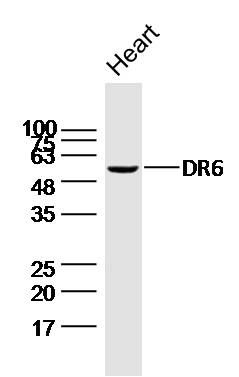
| 产品图片 | 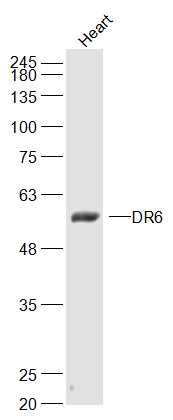 Sample: Heart (Mouse) Lysate at 40 ug Primary: Anti-DR6 (bs-7678R) at 1/300 dilution Secondary: IRDye800CW Goat Anti-Rabbit IgG at 1/20000 dilution Predicted band size: 52/68 kD Observed band size: 52 kD 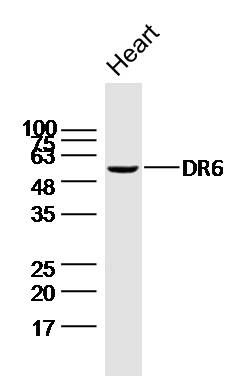 Sample: Heart (Mouse) Lysate at 40 ug Primary: Anti-DR6 (bs-7678R) at 1/300 dilution Secondary: IRDye800CW Goat Anti-Rabbit IgG at 1/20000 dilution Predicted band size: 52/68 kD Observed band size: 52 kD |
风险提示:丁香通仅作为第三方平台,为商家信息发布提供平台空间。用户咨询产品时请注意保护个人信息及财产安全,合理判断,谨慎选购商品,商家和用户对交易行为负责。对于医疗器械类产品,请先查证核实企业经营资质和医疗器械产品注册证情况。
 文献和实验
文献和实验单链抗体可变区基因片段五聚体作用于凋亡诱导配体受体-2来增强其对癌症的治疗作用
单链抗体可变区基因片段(scFvs) 已被看做是一类有前景的药物。然而,它们的低亲和力和快速的血浆清除率限制了其广泛的临床应用。在本研究中,我们旨在通过多聚scFv提高scFv的抗体表达,再通过与人软骨寡聚基质蛋白(COMP)48的螺旋结构域结合以抵抗死亡受体5(DR5,肿瘤坏死因子10B)。通过合成一种五聚体,我们称其为共同体,在体外和体内实验中,scFv的活性增加了10倍,并且共同体比它的单体配对物在抗肿瘤活性方面更有效。标准的抗体类药物正被成功地用于临床治疗癌症。然而,由于标准抗体的低产
) 3、染色质浓缩 4、DNA裂解:核小体DNA ladder 5、磷脂酰丝氨酸由质膜内侧翻转至外侧 6、凋亡小体的释放 第二节 凋亡的分子机制 一、细胞表面死亡受体 细胞死亡受体家族的成员是一类跨膜蛋白,它们均含有一个与配基结合的胞外结构域;一个跨膜域和一个转导胞外信号进入胞内的胞内结构域(死亡结构域)。这此受体(如Fas、TNF受体)同它们的配基结合后被激活并导致细胞凋亡。 二、Bcl-2家族 对B细胞淋巴瘤的研究发现bcl-2是一种抗凋亡基因,进一步研究证明它与ced-9基因
factor receptor 1-mediated signaling is required for skin cancer development induced by NF-κB inhibition NF-κB受抑制诱导的皮肤癌发展受肿瘤坏死因子受体1(TNFR1)介导 NF-κB信号通路在皮肤发展和表皮的生长控制中起着重要的作用。在表皮角质细胞NF-κB信号通路受到抑制时,会导致炎症反应,包括嗜中性粒细胞浸润、表皮增生。甚至导致快速发展的鳞状上皮细胞癌。但是在TNFR1缺陷的小鼠中,NF
 技术资料
技术资料暂无技术资料 索取技术资料

