


- ¥9149.61
- 美天旎Miltenyi Biotec
- 130-117-043
- Made in Germany
- 2026年01月13日

企业认证
相关产品推荐更多 >

Miltenyi货号130-045-201人CD8磁珠(human CD8 MicroBeads)上海睿安生物13611631389
¥8030.91
Miltenyi货号130-045-101现货CD4 MicroBeads(human)(人CD4磁珠)13611631389上海睿安生物
¥8030.91![美天旎Miltenyi货号130-045-801人CD45磁珠[CD45 MicroBeads(human)]上海睿安生物13611631389](https://img1.dxycdn.com/p/s14/2025/0607/218/8670886672060431391.jpg!wh200)
美天旎Miltenyi货号130-045-801人CD45磁珠[CD45 MicroBeads(human)]上海睿安生物13611631389
¥8578.96
美天旎Miltenyi货号130-097-043人-冻干CD3磁珠(human CD3 MicroBeads)上海睿安生物13611631389
¥8030.91
美天旎Miltenyi货号130-117-044小鼠CD8a(Ly-2)磁珠19121878899上海睿安生物Miltenyi官方正式授权
¥9149.61
万千商家帮你免费找货
0 人在求购买到急需产品
- 详细信息
- 文献和实验
- 技术资料
- 英文名:
mouse CD4(L3T4) MicroBeads
- 保质期:
1年
- 保存条件:
2-8°C
- 库存:
100⁺盒
- 供应商:
上海睿安生物13611631389
- 规格:
2╳10⁹ total cells/盒
美天旎Miltenyi货号130-117-043小鼠CD4(L3T4)磁珠[mouse CD4(L3T4) MicroBeads]上海睿安生物13611631389
该试剂盒用于从小鼠淋巴或者非淋巴组织的单细胞悬液以及外周血中分离或者去除CD4+T细胞。
CD4抗原在大多数胸腺细胞和成熟的T辅助细胞上,在NKT细胞的亚群上以及在树突状细胞的亚群中以较低的水平表达。在通过CD4 + T辅助细胞上的TCR异二聚体识别MHC II类/肽复合物时,CD4充当辅助分子。 CD4抗原在大约90%的胸腺细胞,25%的脾细胞和55%的淋巴结细胞上表达。
下游应用
CD4(L3T4)磁珠,设计用于从小鼠各种组织(例如脾脏和淋巴结,外周血,脑,骨髓或支气管肺泡灌洗液)中分离出小鼠CD4 + T细胞,以便随后进行T helper 细胞的体内外功能和表型分析。
此外,CD4(L3T4)磁珠,也可以通过去除CD4 +细胞来分离小鼠CD4–CD8 +胸腺细胞。
下游应用的示例包括:
CD4 + T细胞的体外活化和扩增(例如,使用T细胞活化/扩增试剂盒,小鼠)抗原特异性刺激CD4 + T细胞(例如使用PepTivator 肽库)分析细胞因子的分泌和表面标志物的表达(例如,使用REAfinity™重组抗体)CD4 + T细胞向T +细胞亚型(例如,使用T + 1,T + 2或T + 17 CytoBox的T + 1,T + 2和T + 17细胞)极化。过继性T细胞转移实验(例如,在EAE小鼠模型中转移至免疫缺陷,基因敲除,寄生虫感染和荷瘤小鼠中,或通过自身抗原刺激的CD4 + T细胞被动转移疾病)。检查细胞因子在自身免疫性疾病和感染中的调节作用。研究共刺激分子的功能(例如OX40-OX40配体相互作用)。从MHV感染小鼠的CNS悬液中分离CD4 + T细胞,以评估其趋化因子表达模式。
优点: |
- 简单、快速;- 高效;- 分离分到的细胞未经磁珠标记。 |
数据: |
|
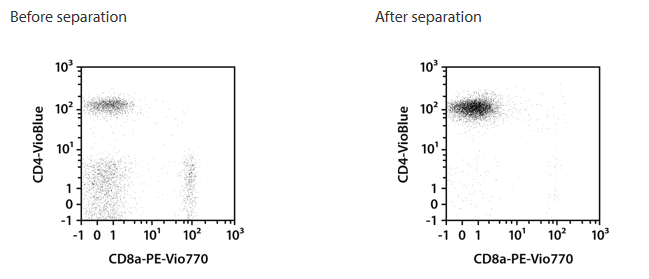
图1.使用gentleMACS™Dissociator制备了来自小鼠脾脏的单细胞悬液。 使用CD4(L3T4)磁珠,LS分选柱和QuadroMACS™分离器从该单细胞悬液中分离出CD4 + T细胞。 用REAfinity™抗体CD45-VioGreen™,CD4-VioBlue,CD8a-PE-Vio770对细胞进行荧光染色,并使用MACSQuant进行流式细胞分析。 根据散射信号,7-AAD染色液荧光和CD45表达,对活的白细胞进行门控分析。 |
| 组成成分: |
▪ 小鼠CD4(L3T4)磁珠:与抗小鼠CD4单克隆抗体(L3T4;同型:大鼠IgG2b)偶联的磁珠,2ml |
|
相关产品: |
▪ MS分选柱(美天旎Miltenyi货号130-042-201)▪ LS分选柱(美天旎Miltenyi货号130-042-401)▪ 磁力架(美天旎Miltenyi货号130-042-303)▪ MS分选磁极(美天旎Miltenyi货号130-042-102)▪ Rinsing solution(美天旎Miltenyi货号130-091-222)▪ Running buffer(美天旎Miltenyi货号130-091-221) |
Specifications for CD4 (L3T4) MicroBeads, mouse
Overview
Mouse CD4 (L3T4) MicroBeads have been developed for positive selection or depletion of mouse CD4+ T cells from single-cell suspensions of lymphoid and non-lymphoid tissues or from peripheral blood.
Detailed product information
Background information
The CD4 antigen is expressed on most thymocytes and mature T helper cells, on a subset of NKT cells and at lower levels on a subpopulation of dendritic cells. CD4 acts as an accessory molecule in the recognition of MHC class II/peptide complexes by the TCR heterodimer on CD4+ T helper cells. The CD4 antigen is expressed on approximately 90% of thymocytes, 25% of splenocytes, and 55% of lymph node cells.
Downstream applications
CD4 (L3T4) MicroBeads, mouse have been designed for the isolation of mouse CD4+ T cells from various tissue, such as spleen and lymph nodes, peripheral blood, brain, bone marrow, or bronchoalveolar lavage for the subsequent functional and phenotypical analysis of T helper cells in vitro and in vivo.
Furthermore, CD4 (L3T4) MicroBeads, mouse can also be used for the isolation of CD4–CD8+ thymocytes by depleting CD4+ cells.
Examples for downstream applications include:
In vitro activation and expansion of CD4+ T cells (e.g. with the T Cell Activation/Expansion Kit, mouse)
Antigen-specific stimulation of CD4+ T cells (e.g. with PepTivator® Peptide Pools)
Analysis of cytokine secretion and surface marker expression (e.g. with REAfinity™ Recombinant Antibodies)
CD4+ T cell polarization towards Tʜ cell subtypes (e.g. Tʜ1, Tʜ2, and Tʜ17 cells using the Tʜ1, Tʜ2, or Tʜ17 CytoBox).
Adoptive T cell transfer experiments (e.g. for transfer into immunodeficient, knock-out, parasite infected, and tumor-bearing mice or to passively transfer a disease with auto-antigen-stimulated CD4+ T cells in an EAE mouse model).
Examination of the regulatory role of cytokines in autoimmune disease and infection.
Studies on the function of costimulatory molecules (e.g. OX40-OX40 ligand interactions).
CD4+ T cell isolation from CNS suspensions of MHV-infected mice for evaluation of their chemokine expression pattern.
Columns
For positive selection: MS, LS, or autoMACS® Columns. For depletion: LD or autoMACS Columns.

风险提示:丁香通仅作为第三方平台,为商家信息发布提供平台空间。用户咨询产品时请注意保护个人信息及财产安全,合理判断,谨慎选购商品,商家和用户对交易行为负责。对于医疗器械类产品,请先查证核实企业经营资质和医疗器械产品注册证情况。
 文献和实验
文献和实验美天旎Miltenyi货号130-117-043小鼠CD4(L3T4)磁珠[mouse CD4(L3T4) MicroBeads]上海睿安生物13611631389
该试剂盒用于从小鼠淋巴或者非淋巴组织的单细胞悬液以及外周血中分离或者去除CD4+T细胞。
CD4抗原在大多数胸腺细胞和成熟的T辅助细胞上,在NKT细胞的亚群上以及在树突状细胞的亚群中以较低的水平表达。在通过CD4 + T辅助细胞上的TCR异二聚体识别MHC II类/肽复合物时,CD4充当辅助分子。 CD4抗原在大约90%的胸腺细胞,25%的脾细胞和55%的淋巴结细胞上表达。
下游应用
CD4(L3T4)磁珠,设计用于从小鼠各种组织(例如脾脏和淋巴结,外周血,脑,骨髓或支气管肺泡灌洗液)中分离出小鼠CD4 + T细胞,以便随后进行T helper 细胞的体内外功能和表型分析。
此外,CD4(L3T4)磁珠,也可以通过去除CD4 +细胞来分离小鼠CD4–CD8 +胸腺细胞。
下游应用的示例包括:
CD4 + T细胞的体外活化和扩增(例如,使用T细胞活化/扩增试剂盒,小鼠)抗原特异性刺激CD4 + T细胞(例如使用PepTivator 肽库)分析细胞因子的分泌和表面标志物的表达(例如,使用REAfinity™重组抗体)CD4 + T细胞向T +细胞亚型(例如,使用T + 1,T + 2或T + 17 CytoBox的T + 1,T + 2和T + 17细胞)极化。过继性T细胞转移实验(例如,在EAE小鼠模型中转移至免疫缺陷,基因敲除,寄生虫感染和荷瘤小鼠中,或通过自身抗原刺激的CD4 + T细胞被动转移疾病)。检查细胞因子在自身免疫性疾病和感染中的调节作用。研究共刺激分子的功能(例如OX40-OX40配体相互作用)。从MHV感染小鼠的CNS悬液中分离CD4 + T细胞,以评估其趋化因子表达模式。
优点: |
- 简单、快速;- 高效;- 分离分到的细胞未经磁珠标记。 |
数据: |
|
图1.使用gentleMACS™Dissociator制备了来自小鼠脾脏的单细胞悬液。 使用CD4(L3T4)磁珠,LS分选柱和QuadroMACS™分离器从该单细胞悬液中分离出CD4 + T细胞。 用REAfinity™抗体CD45-VioGreen™,CD4-VioBlue,CD8a-PE-Vio770对细胞进行荧光染色,并使用MACSQuant进行流式细胞分析。 根据散射信号,7-AAD染色液荧光和CD45表达,对活的白细胞进行门控分析。 |
| 组成成分: |
▪ 小鼠CD4(L3T4)磁珠:与抗小鼠CD4单克隆抗体(L3T4;同型:大鼠IgG2b)偶联的磁珠,2ml |
|
相关产品: |
▪ MS分选柱(美天旎Miltenyi货号130-042-201)▪ LS分选柱(美天旎Miltenyi货号130-042-401)▪ 磁力架(美天旎Miltenyi货号130-042-303)▪ MS分选磁极(美天旎Miltenyi货号130-042-102)▪ Rinsing solution(美天旎Miltenyi货号130-091-222)▪ Running buffer(美天旎Miltenyi货号130-091-221) |
Specifications for CD4 (L3T4) MicroBeads, mouse
Overview
Mouse CD4 (L3T4) MicroBeads have been developed for positive selection or depletion of mouse CD4+ T cells from single-cell suspensions of lymphoid and non-lymphoid tissues or from peripheral blood.
Detailed product information
Background information
The CD4 antigen is expressed on most thymocytes and mature T helper cells, on a subset of NKT cells and at lower levels on a subpopulation of dendritic cells. CD4 acts as an accessory molecule in the recognition of MHC class II/peptide complexes by the TCR heterodimer on CD4+ T helper cells. The CD4 antigen is expressed on approximately 90% of thymocytes, 25% of splenocytes, and 55% of lymph node cells.
Downstream applications
CD4 (L3T4) MicroBeads, mouse have been designed for the isolation of mouse CD4+ T cells from various tissue, such as spleen and lymph nodes, peripheral blood, brain, bone marrow, or bronchoalveolar lavage for the subsequent functional and phenotypical analysis of T helper cells in vitro and in vivo.
Furthermore, CD4 (L3T4) MicroBeads, mouse can also be used for the isolation of CD4–CD8+ thymocytes by depleting CD4+ cells.
Examples for downstream applications include:
In vitro activation and expansion of CD4+ T cells (e.g. with the T Cell Activation/Expansion Kit, mouse)
Antigen-specific stimulation of CD4+ T cells (e.g. with PepTivator® Peptide Pools)
Analysis of cytokine secretion and surface marker expression (e.g. with REAfinity™ Recombinant Antibodies)
CD4+ T cell polarization towards Tʜ cell subtypes (e.g. Tʜ1, Tʜ2, and Tʜ17 cells using the Tʜ1, Tʜ2, or Tʜ17 CytoBox).
Adoptive T cell transfer experiments (e.g. for transfer into immunodeficient, knock-out, parasite infected, and tumor-bearing mice or to passively transfer a disease with auto-antigen-stimulated CD4+ T cells in an EAE mouse model).
Examination of the regulatory role of cytokines in autoimmune disease and infection.
Studies on the function of costimulatory molecules (e.g. OX40-OX40 ligand interactions).
CD4+ T cell isolation from CNS suspensions of MHV-infected mice for evaluation of their chemokine expression pattern.
Columns
For positive selection: MS, LS, or autoMACS® Columns. For depletion: LD or autoMACS Columns.


