

- ¥780 - 2200
- LMAI Bio
- LM-5117R
- 进口/国产
- 2026年05月21日
- ELISA=1:500-1000 IHC-P=1:400-800 IHC-F=1:400-800 Flow-Cyt=1ug/test IF=1:100-500 (石蜡切片需做抗原修复)
- Rabbit
- Human, Mouse, Rat, Chicken, Pig, Cow, Rabbit,

企业认证
相关产品推荐更多 >
万千商家帮你免费找货
0 人在求购买到急需产品
相关阅读
细胞污染识别与处理全攻略:5 种常见类型+关键误区Cytoscape 教程来了!快速实现顶刊同款通路网络图五大应用案例:Mustang Q 膜层析应用全解析1 个小工具,一次性搞定流程图、质粒图谱和信号通路图- 详细信息
- 文献和实验
- 技术资料
- 供应商:
上海联迈生物工程有限公司
- 库存:
大量
- 目录编号:
LM-5117R
- 克隆性:
多克隆
- 抗原来源:
Rabbit
- 保质期:
1年
- 抗体英文名:
Hsc70
- 抗体名:
热休克蛋白71抗体
- 宿主:
Rabbit
- 适应物种:
Human, Mouse, Rat, Chicken, Pig, Cow, Rabbit,
- 免疫原:
KLH conjugated synthetic peptide derived from human HSP71:501-600/646
- 亚型:
IgG
- 形态:
Lyophilized or Liquid
- 应用范围:
ELISA=1:500-1000 IHC-P=1:400-800 IHC-F=1:400-800 Flow-Cyt=1ug/test IF=1:100-500 (石蜡切片需做抗原修复)
- 浓度:
1mg/ml
- 保存条件:
Store at -20 °C
- 规格:
50ul 100ul 200ul
| 英文名称 | Hsc70 |
| 中文名称 | 热休克蛋白71抗体 |
| 别 名 | 2410008N15Rik; Constitutive heat shock protein 70; Heat shock 70 kDa protein 8; Heat shock 70kD protein 10; Heat shock 70kD protein 8; Heat shock 70kDa protein 8; Heat shock cognate 71 kDa protein; Heat shock cognate protein 54; Heat shock cognate protein 71 kDa; Heat shock protein 8; Heat shock protein A8; Heat-shock70-KD protein 10, formerly; HSC54; HSC71; Hsc73; HSP71; HSP73; HSP7C_HUMAN; HSPA10; HSPA8; LAP1; Lipopolysaccharide associated protein 1; LPS associated protein 1; LPS associated protein; MGC102007; MGC106514; MGC114311; MGC118485; MGC131511; MGC29929; N-myristoyltransferase inhibitor protein 71; NIP71; HSC 70; HSC-70. |
| 规格价格 | 50ul/780元 购买 100ul/1380元 购买 200ul/2200元 购买 大包装/询价 |
| 说 明 书 | 50ul 100ul 200ul |
| 研究领域 | 肿瘤 细胞生物 免疫学 信号转导 转录调节因子 |
| 抗体来源 | Rabbit |
| 克隆类型 | Polyclonal |
| 交叉反应 | Human, Mouse, Rat, Chicken, Pig, Cow, Rabbit, |
| 产品应用 | ELISA=1:500-1000 IHC-P=1:400-800 IHC-F=1:400-800 Flow-Cyt=1ug/test IF=1:100-500 (石蜡切片需做抗原修复) not yet tested in other applications. optimal dilutions/concentrations should be determined by the end user. |
| 分 子 量 | 71kDa |
| 细胞定位 | 细胞浆 |
| 性 状 | Lyophilized or Liquid |
| 浓 度 | 1mg/ml |
| 免 疫 原 | KLH conjugated synthetic peptide derived from human HSP71:501-600/646 |
| 亚 型 | IgG |
| 纯化方法 | affinity purified by Protein A |
| 储 存 液 | 0.01M TBS(pH7.4) with 1% BSA, 0.03% Proclin300 and 50% Glycerol. |
| 保存条件 | Store at -20 °C for one year. Avoid repeated freeze/thaw cycles. The lyophilized antibody is stable at room temperature for at least one month and for greater than a year when kept at -20°C. When reconstituted in sterile pH 7.4 0.01M PBS or diluent of antibody the antibody is stable for at least two weeks at 2-4 °C. |
| PubMed | PubMed |
| 产品介绍 | background: This gene encodes a member of the heat shock protein 70 family, which contains both heat-inducible and constitutively expressed members. This protein belongs to the latter group, which are also referred to as heat-shock cognate proteins. It functions as a chaperone, and binds to nascent polypeptides to facilitate correct folding. It also functions as an ATPase in the disassembly of clathrin-coated vesicles during transport of membrane components through the cell. Alternatively spliced transcript variants encoding different isoforms have been found for this gene. [provided by RefSeq, Aug 2011] Function: Acts as a repressor of transcriptional activation. Inhibits the transcriptional coactivator activity of CITED1 on Smad-mediated transcription. Chaperone. Isoform 2 may function as an endogenous inhibitory regulator of HSC70 by competing the co-chaperones. Subunit: Interacts with HSPH1/HSP105. Interacts with IRAK1BP1 (By similarity). Identified in a mRNP granule complex, at least composed of ACTB, ACTN4, DHX9, ERG, HNRNPA1, HNRNPA2B1, HNRNPAB, HNRNPD, HNRNPL, HNRNPR, HNRNPU, HSPA1, HSPA8, IGF2BP1, ILF2, ILF3, NCBP1, NCL, PABPC1, PABPC4, PABPN1, RPLP0, RPS3, RPS3A, RPS4X, RPS8, RPS9, SYNCRIP, TROVE2, YBX1 and untranslated mRNAs. Interacts with PACRG and TSC2. Interacts with BAG1. Interacts with SV40 VP1. Interacts with DNAJC7 (By similarity). Interacts with HERC5. Interacts with CITED1 (via N-terminus); the interaction suppresses the association of CITED1 to p300/CBP and Smad-mediated transcription transactivation. Subcellular Location: Cytoplasm. Melanosome. Tissue Specificity: Ubiquitous. Post-translational modifications: Phosphorylated upon DNA damage, probably by ATM or ATR. ISGylated. Similarity: Belongs to the heat shock protein 70 family. SWISS: P11142 Gene ID: 3312 Database links: Entrez Gene: 3312 Human Entrez Gene: 15481 Mouse Entrez Gene: 24468 Rat Omim: 600816 Human SwissProt: P11142 Human SwissProt: P63017 Mouse SwissProt: P63018 Rat Unigene: 180414 Human Unigene: 290774 Mouse Unigene: 336743 Mouse Unigene: 351377 Mouse Unigene: 412745 Mouse Unigene: 120392 Rat Unigene: 201298 Rat Important Note: This product as supplied is intended for research use only, not for use in human, therapeutic or diagnostic applications. |
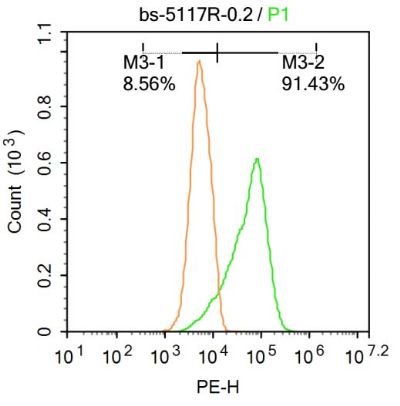
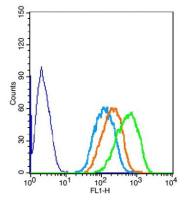
| 产品图片 | 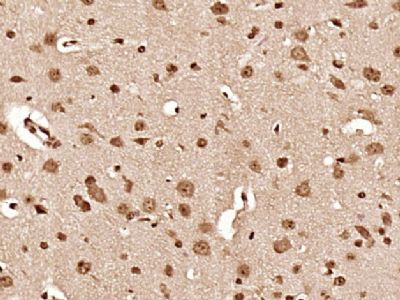 Paraformaldehyde-fixed, paraffin embedded (Mouse brain); Antigen retrieval by boiling in sodium citrate buffer (pH6.0) for 15min; Block endogenous peroxidase by 3% hydrogen peroxide for 20 minutes; Blocking buffer (normal goat serum) at 37°C for 30min; Antibody incubation with (Hsc70) Polyclonal Antibody, Unconjugated (bs-5117R) at 1:400 overnight at 4°C, followed by a conjugated secondary antibody (sp-0023) for 20 minutes and DAB staining. 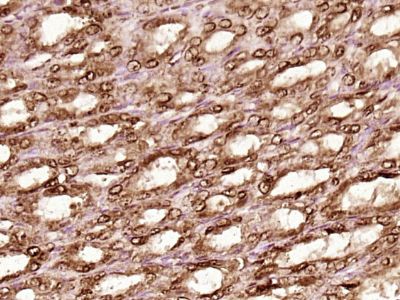 Paraformaldehyde-fixed, paraffin embedded (Rat stomach); Antigen retrieval by boiling in sodium citrate buffer (pH6.0) for 15min; Block endogenous peroxidase by 3% hydrogen peroxide for 20 minutes; Blocking buffer (normal goat serum) at 37°C for 30min; Antibody incubation with (Hsc70) Polyclonal Antibody, Unconjugated (bs-5117R) at 1:400 overnight at 4°C, followed by a conjugated secondary antibody (sp-0023) for 20 minutes and DAB staining. 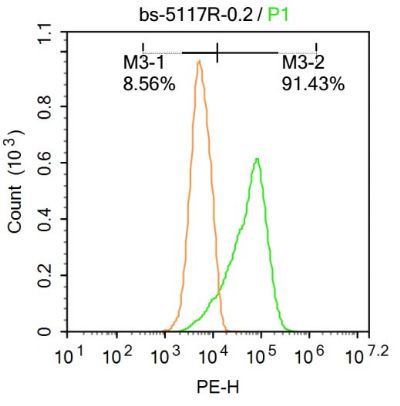 Blank control:U-2OS. Primary Antibody (green line): Rabbit Anti-Hsc70 antibody (bs-5117R) Dilution: 1μg /10^6 cells; Isotype Control Antibody (orange line): Rabbit IgG . Secondary Antibody : Goat anti-rabbit IgG-PE Dilution: 1μg /test. Protocol The cells were fixed with 4% PFA (10min at room temperature)and then permeabilized with PBST for 20 min at room temperature. The cells were then incubated in 5%BSA to block non-specific protein-protein interactions for 30 min at at room temperature .Cells stained with Primary Antibody for 30 min at room temperature. The secondary antibody used for 40 min at room temperature. Acquisition of 20,000 events was performed. |
风险提示:丁香通仅作为第三方平台,为商家信息发布提供平台空间。用户咨询产品时请注意保护个人信息及财产安全,合理判断,谨慎选购商品,商家和用户对交易行为负责。对于医疗器械类产品,请先查证核实企业经营资质和医疗器械产品注册证情况。
 文献和实验
文献和实验agents. Interestingly hsp90 have much thing to do with the evolutionary. Keywords: 热休克蛋白90(hsp90) ,分子伴侣 ,癌症,生物进化,格尔德霉素 1.简介 分 子伴侣(chaperon) 是最近十几年才发现的一类非常保守的蛋白家族。它与酶的作用方式类似,能和某些不同的多肽链非特异性结合,催化介导蛋白质特定构象的形成,参与体内蛋白质的折叠、装配和转运,但又不构成其结构的一部分。这类保守的蛋白家族大致
1987 年 Lasky 首先提出了分子伴侣的概念。他将细胞核内能与组蛋白结合并能介导核小体有序组装的核质素( nucleoplasmin )称为分子伴侣。根据 Ellis 的定义,这一概念延伸为“一类在序列上没有相关性但有共同功能的蛋白质,它们在细胞内帮助其他含多肽的结构完成正确的组装,而且在组装完毕后与之分离,不构成这些蛋白质结构执行功能时的组份”。热休克蛋白就是一大类分子伴侣。 1987 年, Ikemura 发现枯草杆菌素( subtilisin
STM:傅阳心、侯玉柱等发现放疗与免疫治疗的交汇点,兵家必争之地竟是这群细胞
背景介绍 近期,癌症神经科学以及神经营养配体促进肿瘤恶性进展的相关研究越来越多,也逐渐成为领域内的热点之一。其中,一种神经营养因子 —— Artemin (ARTN),被发现能够促进肿瘤进展,而 ARTN 主要是由肿瘤诱导产生的 CD45−Ter119+CD71+ 红系祖细胞分泌的,CD45−Ter119+CD71+ 细胞又被称为「Ter 细胞」,为晚期实体瘤动物脾细胞的主要组成部分。 放射治疗,简称放疗,广泛应用于各种癌症的治疗,最近的研究表明,免疫系统在介导放疗的抗肿瘤作用中扮演
 技术资料
技术资料暂无技术资料 索取技术资料

