

- ¥1380 - 2200
- LMAI Bio
- LM-3757R
- 进口/国产
- 2025年06月23日
- WB=1:500-2000 ELISA=1:500-1000 IHC-P=1:400-800 IHC-F=1:400-800 IF=1:100-500 (石蜡切片需做抗原修复)
- Rabbit
- Human, Mouse, Rat, Dog, Pig, Cow, Rabbit,

企业认证
相关产品推荐更多 >

万千商家帮你免费找货
0 人在求购买到急需产品
- 详细信息
- 文献和实验
- 技术资料
- 供应商:
上海联迈生物工程有限公司
- 库存:
大量
- 目录编号:
LM-3757R
- 克隆性:
多克隆
- 抗原来源:
Rabbit
- 保质期:
1年
- 抗体英文名:
HSF1
- 抗体名:
热休克因子1抗体
- 宿主:
Rabbit
- 适应物种:
Human, Mouse, Rat, Dog, Pig, Cow, Rabbit,
- 免疫原:
KLH conjugated synthetic peptide derived from human HSF1:351-450/529
- 亚型:
IgG
- 形态:
Lyophilized or Liquid
- 应用范围:
WB=1:500-2000 ELISA=1:500-1000 IHC-P=1:400-800 IHC-F=1:400-800 IF=1:100-500 (石蜡切片需做抗原修复)
- 浓度:
1mg/ml
- 保存条件:
Store at -20 °C
- 规格:
100ul 200ul
| 英文名称 | HSF1 |
| 中文名称 | 热休克因子1抗体 |
| 别 名 | Heat shock factor 1; Heat shock factor protein 1; Heat shock transcription factor 1; HSF 1; hsf1; HSTF 1; HSTF1; HSF1_HUMAN. |
 |
Specific References (1) | bs-3757R has been referenced in 1 publications. [IF=2.38] Zhang, Beiru, et al. "HSF1 Relieves Amyloid-β-Induced Cardiomyocytes Apoptosis." Cell Biochemistry and Biophysics (2015): 1-9. WB ; Rat. PubMed:25631374 |
| 规格价格 | 100ul/1380元 购买 200ul/2200元 购买 大包装/询价 |
| 说 明 书 | 100ul 200ul |
| 研究领域 | 肿瘤 细胞生物 免疫学 信号转导 细胞凋亡 转录调节因子 |
| 抗体来源 | Rabbit |
| 克隆类型 | Polyclonal |
| 交叉反应 | Human, Mouse, Rat, Dog, Pig, Cow, Rabbit, |
| 产品应用 | WB=1:500-2000 ELISA=1:500-1000 IHC-P=1:400-800 IHC-F=1:400-800 IF=1:100-500 (石蜡切片需做抗原修复) not yet tested in other applications. optimal dilutions/concentrations should be determined by the end user. |
| 分 子 量 | 57kDa |
| 细胞定位 | 细胞核 细胞浆 |
| 性 状 | Lyophilized or Liquid |
| 浓 度 | 1mg/ml |
| 免 疫 原 | KLH conjugated synthetic peptide derived from human HSF1:351-450/529 |
| 亚 型 | IgG |
| 纯化方法 | affinity purified by Protein A |
| 储 存 液 | 0.01M TBS(pH7.4) with 1% BSA, 0.03% Proclin300 and 50% Glycerol. |
| 保存条件 | Store at -20 °C for one year. Avoid repeated freeze/thaw cycles. The lyophilized antibody is stable at room temperature for at least one month and for greater than a year when kept at -20°C. When reconstituted in sterile pH 7.4 0.01M PBS or diluent of antibody the antibody is stable for at least two weeks at 2-4 °C. |
| PubMed | PubMed |
| 产品介绍 | background: The product of this gene is a heat-shock transcription factor. Transcription of heat-shock genes is rapidly induced after temperature stress. Hsp90, by itself and/or associated with multichaperone complexes, is a major repressor of this gene. [provided by RefSeq, Jul 2008]. Function: DNA-binding protein that specifically binds heat shockpromoter elements (HSE) and activates transcription. In highereukaryotes, HSF is unable to bind to the HSE unless the cells areheat shocked. Subunit: Monomer. Under normal conditions, interacts with HSP90AA1in the HSP90 multichaperone complex; the interaction preventstrimerization and activation of HSF1. On activation by heat-stressor by other factors such as metal ions, HSF1 is released from thecomplex, homotrimerizes, is hyperphosphorylated and translocated tothe nucleus where, subsequently, it can activate transcription.Binds the complex through the regulatory domain. Interacts withSYMPK and CSTF2 in heat-stressed cells. Interacts with FKBP4 in theHSP90 multichaperone complex; the interaction is independent of thephosphorylation state of HSF1. Interacts with MAPKAPK2. Subcellular Location: Cytoplasm. Nucleus. Note=Cytoplasmic duringnormal growth. On activation, translocates to nuclear stressgranules. Colocalizes with SUMO1 in nuclear stress granules. Tissue Specificity: Phosphorylated on multiple serine residues, a subset of whichare involved in stress-related regulation of transcriptionactivation. Constitutive phosphorylation represses transcriptionalactivity at normal temperatures. Levels increase on specificresidues heat-shock and enhance HSF1 transactivation activity.Phosphorylation on Ser-307 derepresses activation on heat-stressand in combination with Ser-303 phosphorylation appears to beinvolved in recovery after heat-stress. Phosphorylated on Ser-230by CAMK2, in vitro. Cadmium also enhances phosphorylation at thissite. Phosphorylation on Ser-303 is a prerequisite for HSF1sumoylation. Phosphorylation on Ser-121 inhibits transactivationand promotes HSP90 binding. Phosphorylation on Thr-142 alsomediates transcriptional activity induced by heat. Sumoylated with SUMO1 and SUMO2 on heat-shock. Heat-induciblesumoylation occurs after 15 min of heat-shock, after which levelsdecrease and at 4 hours, levels return to control levels.Sumoylation has no effect on HSE binding nor on transcriptionalactivity. Phosphorylation on Ser-303 is a prerequisite forsumoylation. Similarity: Belongs to the HSF family. SWISS: Q00613 Gene ID: 3297 Database links: Entrez Gene: 3297 Human Entrez Gene: 15499 Mouse Entrez Gene: 79245 Rat Omim: 140580 Human SwissProt: Q00613 Human SwissProt: P38532 Mouse Unigene: 530227 Human Unigene: 347444 Mouse Important Note: This product as supplied is intended for research use only, not for use in human, therapeutic or diagnostic applications. |
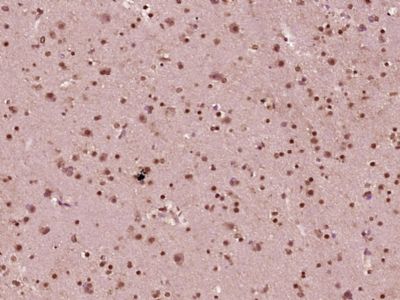
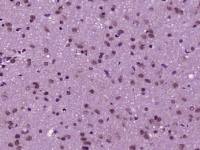
| 产品图片 | 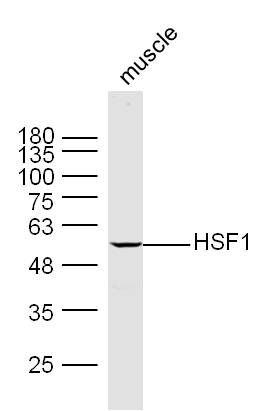 Sample: Muscle (Mouse) Lysate at 40 ug Primary: Anti- HSF1 (bs-3757R) at 1/300 dilution Secondary: IRDye800CW Goat Anti-Rabbit IgG at 1/10000 dilution Predicted band size: 57 kD Observed band size: 57 kD 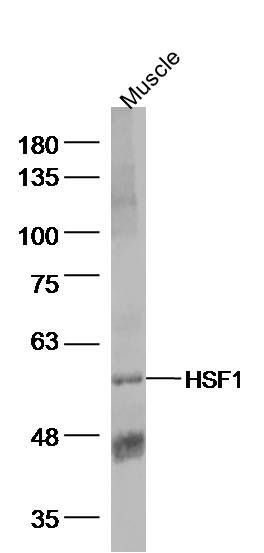 Sample: muscle(mouse) Lysate at 40 ug Primary: Anti-HSF1 (bs-3757R) at 1/300 dilution Secondary: IRDye800CW Goat Anti-Rabbit IgG at 1/20000 dilution Predicted band size: 57kD Observed band size: 57 kD 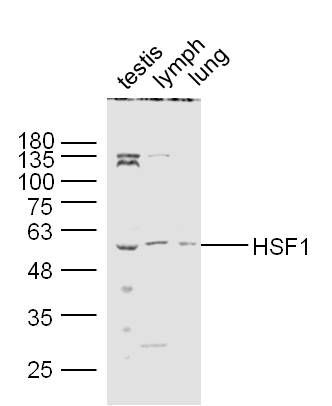 Sample: Testis (Mouse) Lysate at 30 ug Lymph (Mouse) Lysate at 30 ug Lung (Mouse) Lysate at 30 ug Primary: Anti- HSF1 (bs-3757R) at 1/300 dilution Secondary: IRDye800CW Goat Anti-Rabbit IgG at 1/20000 dilution Predicted band size: 57 kD Observed band size: 57 kD 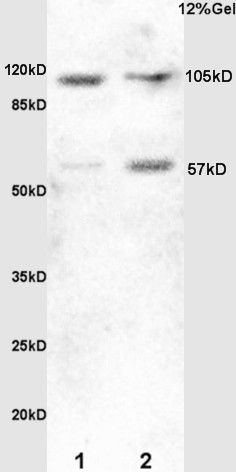 Sample: Lane1: Embryo(Mouse) Lysate at 30 ug Lane2: Brain(Rat) Lysate at 30 ug Primary: Anti-HSF1 (bs-3757R) at 1:200 dilution; Secondary: HRP conjugated Goat Anti-Rabbit IgG(bs-0295G-HRP) at 1: 3000 dilution; Predicted band size : 57kD Observed band size : 57kD 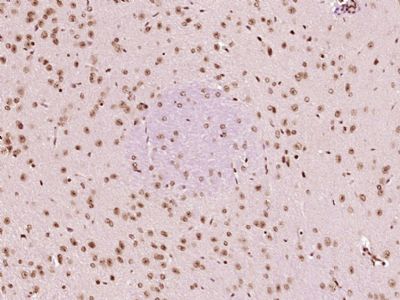 Paraformaldehyde-fixed, paraffin embedded (Mouse brain); Antigen retrieval by boiling in sodium citrate buffer (pH6.0) for 15min; Block endogenous peroxidase by 3% hydrogen peroxide for 20 minutes; Blocking buffer (normal goat serum) at 37°C for 30min; Antibody incubation with (HSF1) Polyclonal Antibody, Unconjugated (bs-3757R) at 1:400 overnight at 4°C, followed by operating according to SP Kit(Rabbit) (sp-0023) instructionsand DAB staining. 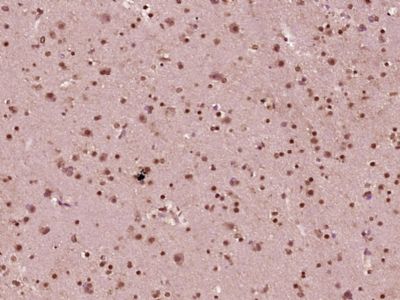 Paraformaldehyde-fixed, paraffin embedded (Human brain glioma); Antigen retrieval by boiling in sodium citrate buffer (pH6.0) for 15min; Block endogenous peroxidase by 3% hydrogen peroxide for 20 minutes; Blocking buffer (normal goat serum) at 37°C for 30min; Antibody incubation with (HSF1) Polyclonal Antibody, Unconjugated (bs-3757R) at 1:400 overnight at 4°C, followed by operating according to SP Kit(Rabbit) (sp-0023) instructionsand DAB staining. |
风险提示:丁香通仅作为第三方平台,为商家信息发布提供平台空间。用户咨询产品时请注意保护个人信息及财产安全,合理判断,谨慎选购商品,商家和用户对交易行为负责。对于医疗器械类产品,请先查证核实企业经营资质和医疗器械产品注册证情况。
 文献和实验
文献和实验别再颠倒作息了!昼夜节律紊乱增加癌症风险,科学家发现这可能与体温调节有关
机制仍然知之甚少。 2022 年 9 月 28 日,来自美国斯克里普斯研究所的研究团队在 Science Advances 发表了题为 Circadian disruption enhances HSF1 signaling and tumorigenesis in Kras-driven lung cancer 的文章。该研究表明昼夜节律紊乱改变了小鼠肝脏和肺部的基因表达,并使小鼠生长的肿瘤更多,并发现热休克因子 1(HSF1)信号的慢性升高可能是昼夜节律紊乱和癌症风险增加之间的关键分子桥梁
强度,是目前应用最广的一种分离模式。适用于蛋白质、氨基酸、多肽类和离子的分析。毛细管中除电解液外,无需填充任何物质,操作容易,自动化程度高。2、毛细管凝胶电泳(Capillary Gel Electrophoresis,CGE)分离原理:凝胶电泳是凝胶移到毛细管中用为支撑物进行分离的区带电泳。凝胶是一种固态的分散的体系。具有多孔性,类似于分子筛的作用,被分离物在通过装入毛细管内的凝胶力,按照各自分子的体积大小逐一分离。分子体积大的首先被分离出来,适用于生物大分子的分析,可纯粹按分子体种大小进行分离(SDS
、胰脏、膀胱和生殖器官等。胃壁非常薄,粘膜呈襞状。胃容量约为20~30ml。肠管较长,约为体长的10倍,其中盲肠发达约占整个腹部的三分之一。肝脏呈暗黄褐色,分为内侧左右叶、外侧左右叶和后叶。胆囊位于内侧左右叶之间。胰脏为一长而扁平的叶状腺体,粉红色,横位于腹腔前半部胃的背面。分头、体和尾叶。6、大脑在胚胎期42~45天脑发育成熟,大脑半球没有明显的回纹,只有原始的深沟,属于平滑脑组织,较其它同类动物发达。7、淋巴系统淋巴系统较为发达。脾脏呈扁平板状,位于胃大弯部。肺部淋巴结具有高度的反应性,在少量
 技术资料
技术资料暂无技术资料 索取技术资料

