- ¥780 - 2200
- 康朗生物
- kl-2941R
- 中国/美国/德国
- 2025年07月11日
- WB=1:500-2000 ELISA=1:500-1000 Flow-Cyt=1ug/Test IF=1:100-500
- Rabbit
- Human, Mouse, Rat, Dog, Pig, Cow, Horse, Rabbit,

企业认证
相关产品推荐更多 >

万千商家帮你免费找货
0 人在求购买到急需产品
- 详细信息
- 询价记录
- 文献和实验
- 技术资料
- 供应商:
上海康朗生物科技有限公司
- 库存:
大量
- 目录编号:
kl-2941R
- 克隆性:
多克隆
- 抗原来源:
Rabbit
- 保质期:
12个月
- 抗体英文名:
TNFR1 antibody
- 抗体名:
肿瘤坏死因子受体1抗体
- 宿主:
Rabbit
- 适应物种:
Human, Mouse, Rat, Dog, Pig, Cow, Horse, Rabbit,
- 免疫原:
KLH conjugated synthetic peptide derived from human TNFR1/TNF Receptor I:1-100/455
- 亚型:
IgG
- 形态:
冻干粉或液体
- 应用范围:
WB=1:500-2000 ELISA=1:500-1000 Flow-Cyt=1ug/Test IF=1:100-500
- 浓度:
1mg/ml
- 保存条件:
-20 °C
- 规格:
50ul 100ul 200ul
| 中文名称 | 肿瘤坏死因子受体1抗体 |
| 别 名 | TNFRSF1a; CD120a; CD120a antigen; MGC19588; p55; p55 R; p55R; p60; TBP1; TBPI; TNF R; TNF R I; TNF R1; TNF R55; TNF-R1; Soluble TNF Receptor I; Soluble TNF p55 Receptor; TNF-RI; TNFR 1; TNFR I; TNFR-I; TNFR1; TNFR55; TNFR60; TNFRI; TNFRSF1a; TNR1A_HUMAN; Tumor necrosis factor alpha receptor; Tumor necrosis factor binding protein 1; Tumor necrosis factor receptor 1; Tumor necrosis factor receptor type 1; Tumor necrosis factor receptor type I; Tumor necrosis factor-binding protein 1. |
| 规格价格 | 50ul/780元 购买 100ul/1380元 购买 200ul/2200元 购买 大包装/询价 |
| 说 明 书 | 50ul 100ul 200ul |
| 研究领域 | 肿瘤 心血管 细胞生物 信号转导 干细胞 细胞凋亡 转录调节因子 |
| 抗体来源 | Rabbit |
| 克隆类型 | Polyclonal |
| 交叉反应 | Human, Mouse, Rat, Dog, Pig, Cow, Horse, Rabbit, |
| 产品应用 | WB=1:500-2000 ELISA=1:500-1000 Flow-Cyt=1ug/Test IF=1:100-500 (石蜡切片需做抗原修复) not yet tested in other applications. optimal dilutions/concentrations should be determined by the end user. |
| 分 子 量 | 50kDa |
| 细胞定位 | 细胞膜 分泌型蛋白 |
| 性 状 | Lyophilized or Liquid |
| 浓 度 | 1mg/ml |
| 免 疫 原 | KLH conjugated synthetic peptide derived from human TNFR1/TNF Receptor I:1-100/455 |
| 亚 型 | IgG |
| 纯化方法 | affinity purified by Protein A |
| 储 存 液 | 0.01M TBS(pH7.4) with 1% BSA, 0.03% Proclin300 and 50% Glycerol. |
| 保存条件 | Store at -20 °C for one year. Avoid repeated freeze/thaw cycles. The lyophilized antibody is stable at room temperature for at least one month and for greater than a year when kept at -20°C. When reconstituted in sterile pH 7.4 0.01M PBS or diluent of antibody the antibody is stable for at least two weeks at 2-4 °C. |
| PubMed | PubMed |
| 产品介绍 | background: Receptor for TNFSF2/TNF-alpha and homotrimeric TNFSF1/lymphotoxin-alpha. The adapter molecule FADD recruits caspase-8 to the activated receptor. The resulting death-inducing signaling complex (DISC) performs caspase-8 proteolytic activation which initiates the subsequent cascade of caspases (aspartate-specific cysteine proteases) mediating apoptosis. Contributes to the induction of non-cytocidal TNF effects including anti-viral state and activation of the acid sphingomyelinase. Function: Receptor for TNFSF2/TNF-alpha and homotrimeric TNFSF1/lymphotoxin-alpha. The adapter molecule FADD recruits caspase-8 to the activated receptor. The resulting death-inducing signaling complex (DISC) performs caspase-8 proteolytic activation which initiates the subsequent cascade of caspases (aspartate-specific cysteine proteases) mediating apoptosis. Contributes to the induction of non-cytocidal TNF effects including anti-viral state and activation of the acid sphingomyelinase. Subcellular Location: Cell membrane. Secreted. Post-translational modifications: The soluble form is produced from the membrane form by proteolytic processing. DISEASE: Defects in TNFRSF1A are the cause of familial hibernian fever (FHF) [MIM:142680]; also known as tumor necrosis factor receptor-associated periodic syndrome (TRAPS). FHF is a hereditary periodic fever syndrome characterized by recurrent fever, abdominal pain, localized tender skin lesions and myalgia. Reactive amyloidosis is the main complication and occurs in 25% of cases. Similarity: Contains 1 death domain. Contains 4 TNFR-Cys repeats. SWISS: P19438 Gene ID: 7132 Database links: Entrez Gene: 282527 Cow Entrez Gene: 403634 Dog Entrez Gene: 7132 Human Entrez Gene: 21937 Mouse Entrez Gene: 397020 Pig Entrez Gene: 25625 Rat Entrez Gene: 100135698 Sheep Omim: 191190 Human SwissProt: O19131 Cow SwissProt: P19438 Human SwissProt: P25118 Mouse SwissProt: P50555 Pig SwissProt: P22934 Rat Unigene: 279594 Human Unigene: 713833 Human Unigene: 1258 Mouse Unigene: 11119 Rat Important Note: This product as supplied is intended for research use only, not for use in human, therapeutic or diagnostic applications. |
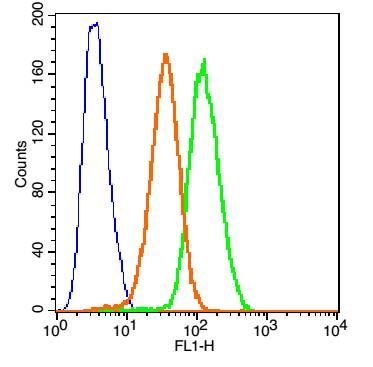
| 产品图片 | 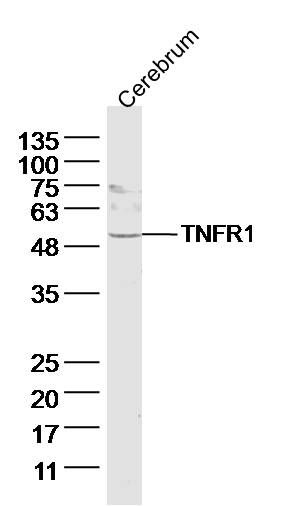 Sample: Cerebrum (Rat) Lysate at 40 ug Primary: Anti-TNFR1 (bs-2941R) at 1/300 dilution Secondary: IRDye800CW Goat Anti-Rabbit IgG at 1/20000 dilution Predicted band size: 50 kD Observed band size: 50 kD 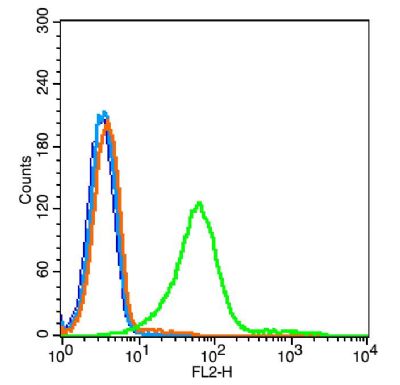 Blank control:TM4(blue). Primary Antibody: Rabbit Anti- TNFR2 antibody(bs-2941R), Dilution: 1μg in 100 μL 1X PBS containing 0.5% BSA; Isotype Control Antibody: Rabbit IgG (orange) ,used under the same conditions. Secondary Antibody: Goat anti-rabbit IgG-PE(white blue), Dilution: 1:200 in 1 X PBS containing 0.5% BSA. 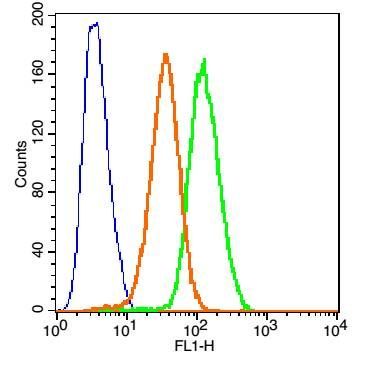 Blank control(blue): Hep G2 Cells(fixed with 2% paraformaldehyde (10 min) and then permeabilized with ice-cold 90% methanol for 30 min on ice). Primary Antibody: Rabbit Anti-TNFR1/FITC Conjugated antibody (bs-2941R /FITC), Dilution: 1μg in 100 μL 1X PBS containing 0.5% BSA; Isotype Control Antibody: Rabbit IgG/FITC(orange) ,used under the same conditions. 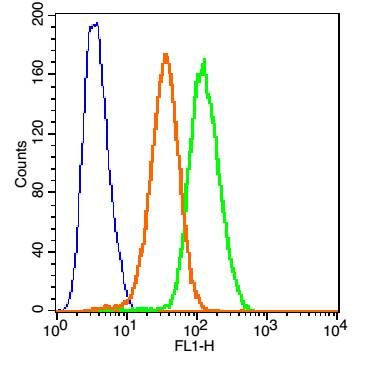 Blank control(blue): Hep G2 Cells(fixed with 2% paraformaldehyde (10 min) and then permeabilized with ice-cold 90% methanol for 30 min on ice). Primary Antibody: Rabbit Anti-TNFR1/FITC Conjugated antibody (bs-2941R /FITC), Dilution: 1μg in 100 μL 1X PBS containing 0.5% BSA; Isotype Control Antibody: Rabbit IgG/FITC(orange) ,used under the same conditions. |
风险提示:丁香通仅作为第三方平台,为商家信息发布提供平台空间。用户咨询产品时请注意保护个人信息及财产安全,合理判断,谨慎选购商品,商家和用户对交易行为负责。对于医疗器械类产品,请先查证核实企业经营资质和医疗器械产品注册证情况。
- 作者
- 内容
- 询问日期
 文献和实验
文献和实验TRAF‐Mediated TNFR‐Family Signaling
Keywords: TNF family; TNFR family; IL?1R/TLR; TRAF proteins; signal transduction; inflammation GO TO THE FULL PROTOCOL: PDF or HTML at Wiley Online Library
Genetic Engineering in the Mouse: Tuning TNF/TNFR Expression
With the exponential increase in the number of genes identified by various genome projects, it has become imperative that efficient methods be developed for deciphering gene function. Genetically engineered strains of mice are now critical
Generation of Antibody Molecules Through Antibody Engineering
been overcome to a large extent using genetic-engineering techniques to produce chimeric mouse/human and completely human antibodies. Such an approach is particularly suitable because of the domain structure of the antibody molecule ( 2 ), where functional
 技术资料
技术资料暂无技术资料 索取技术资料