

- ¥780 - 2200
- LMAI Bio
- LM-0633R
- 进口/国产
- 2025年07月12日
- WB=1:500-2000 ELISA=1:500-1000 IHC-P=1:400-800 IHC-F=1:400-800 Flow-Cyt=1μg/Test IF=1:100-500 (石蜡切片需做抗原修复)
- Rabbit
- Human, Mouse, Rat, Pig, Cow,

企业认证
相关产品推荐更多 >
万千商家帮你免费找货
0 人在求购买到急需产品
- 详细信息
- 文献和实验
- 技术资料
- 供应商:
上海联迈生物工程有限公司
- 库存:
大量
- 目录编号:
LM-0633R
- 克隆性:
多克隆
- 抗原来源:
Rabbit
- 保质期:
1年
- 抗体英文名:
CDK4
- 抗体名:
周期素依赖性激酶4抗体
- 宿主:
Rabbit
- 适应物种:
Human, Mouse, Rat, Pig, Cow,
- 免疫原:
KLH conjugated synthetic peptide derived from human CDK4:241-303/303
- 亚型:
IgG
- 形态:
Lyophilized or Liquid
- 应用范围:
WB=1:500-2000 ELISA=1:500-1000 IHC-P=1:400-800 IHC-F=1:400-800 Flow-Cyt=1μg/Test IF=1:100-500 (石蜡切片需做抗原修复)
- 浓度:
1mg/ml
- 保存条件:
Store at -20 °C
- 规格:
50ul 100ul 200ul
| 英文名称 | CDK4 |
| 中文名称 | 周期素依赖性激酶4抗体 |
| 别 名 | Cdk 4; CDK4 protein; Cell division kinase 4; Cell division protein kinase 4; CMM 3; CMM3; Crk3; Cyclin dependent kinase 4; Melanoma cutaneous malignant 3; MGC14458; p34 cdk4; PSK J3; CDK4_HUMAN. |
 |
Specific References (2) | bs-0633R has been referenced in 2 publications. [IF=2.84] Yang, Ning, et al. "SOX 1, contrary to SOX 2, suppresses proliferation, migration, and invasion in human laryngeal squamous cell carcinoma by inhibiting the Wnt/β-catenin pathway." Tumor Biology (2015): 1-11. WB ; Human. PubMed:26040764 [IF=1.48] Zhou, Yue, et al. "Protective effects of ginsenoside Rg1 on aging Sca‑1+ hematopoietic cells." Molecular Medicine Reports. other ; PubMed:26045300 |
| 规格价格 | 50ul/780元 购买 100ul/1380元 购买 200ul/2200元 购买 大包装/询价 |
| 说 明 书 | 50ul 100ul 200ul |
| 研究领域 | 肿瘤 细胞生物 染色质和核信号 信号转导 细胞周期蛋白 激酶和磷酸酶 |
| 抗体来源 | Rabbit |
| 克隆类型 | Polyclonal |
| 交叉反应 | Human, Mouse, Rat, Pig, Cow, |
| 产品应用 | WB=1:500-2000 ELISA=1:500-1000 IHC-P=1:400-800 IHC-F=1:400-800 Flow-Cyt=1μg/Test IF=1:100-500 (石蜡切片需做抗原修复) not yet tested in other applications. optimal dilutions/concentrations should be determined by the end user. |
| 分 子 量 | 34kDa |
| 细胞定位 | 细胞核 细胞浆 细胞膜 |
| 性 状 | Lyophilized or Liquid |
| 浓 度 | 1mg/ml |
| 免 疫 原 | KLH conjugated synthetic peptide derived from human CDK4:241-303/303 |
| 亚 型 | IgG |
| 纯化方法 | affinity purified by Protein A |
| 储 存 液 | 0.01M TBS(pH7.4) with 1% BSA, 0.03% Proclin300 and 50% Glycerol. |
| 保存条件 | Store at -20 °C for one year. Avoid repeated freeze/thaw cycles. The lyophilized antibody is stable at room temperature for at least one month and for greater than a year when kept at -20°C. When reconstituted in sterile pH 7.4 0.01M PBS or diluent of antibody the antibody is stable for at least two weeks at 2-4 °C. |
| PubMed | PubMed |
| 产品介绍 | background: The protein encoded by this gene is a member of the Ser/Thr protein kinase family. This protein is highly similar to the gene products of S. cerevisiae cdc28 and S. pombe cdc2. It is a catalytic subunit of the protein kinase complex that is important for cell cycle G1 phase progression. The activity of this kinase is restricted to the G1-S phase, which is controlled by the regulatory subunits D-type cyclins and CDK inhibitor p16(INK4a). This kinase was shown to be responsible for the phosphorylation of retinoblastoma gene product (Rb). Mutations in this gene as well as in its related proteins including D-type cyclins, p16(INK4a) and Rb were all found to be associated with tumorigenesis of a variety of cancers. Multiple polyadenylation sites of this gene have been reported. [provided by RefSeq, Jul 2008] Function: Ser/Thr-kinase component of cyclin D-CDK4 (DC) complexes that phosphorylate and inhibit members of the retinoblastoma (RB) protein family including RB1 and regulate the cell-cycle during G(1)/S transition. Phosphorylation of RB1 allows dissociation of the transcription factor E2F from the RB/E2F complexes and the subsequent transcription of E2F target genes which are responsible for the progression through the G(1) phase. Hypophosphorylates RB1 in early G(1) phase. Cyclin D-CDK4 complexes are major integrators of various mitogenenic and antimitogenic signals. Also phosphorylates SMAD3 in a cell-cycle-dependent manner and represses its transcriptional activity. Component of the ternary complex, cyclin D/CDK4/CDKN1B, required for nuclear translocation and activity of the cyclin D-CDK4 complex. Subunit: Component of the D-CDK4 complex, composed of CDK4 and some D-type G1 cyclin (CCND1, CCND2 or CCND3). Interacts directly in the complex with CCND1, CCND2 or CCND3. Interacts with SEI1 and ZNF655. Forms a ternary complex, cyclin D-CDK4-CDKN1B, involved in modulating CDK4 enzymatic activity. Interacts directly with CDKN1B (phosphorylated on 'Tyr-88' and 'Tyr-89'); the interaction allows assembly of the cyclin D-CDK4 complex, Thr-172 phosphorylation, nuclear translocation and enhances the cyclin D-CDK4 complex activity. CDK4 activity is either inhibited or enhanced depending on stoichiometry of complex. The non-tyrosine-phosphorylated form of CDKN1B prevents T-loop phosphorylation of CDK4 producing inactive CDK4. Interacts (unphosphorylated form) with CDK2. Also forms ternary complexes with CDKN1A or CDKN2A. Interacts directly with CDKN1A (via its N-terminal); the interaction promotes the assembly of the cyclin D-CDK4 complex, its nuclear translocation and promotes the cyclin D-dependent enzyme activity of CDK4. Subcellular Location: Cytoplasm. Nucleus. Membrane. Cytoplasmic when non-complexed. Forms a cyclin D-CDK4 complex in the cytoplasm as cells progress through G(1) phase. The complex accumulates on the nuclear membrane and enters the nucleus on transition from G(1) to S phase. Also present in nucleoli and heterochromatin lumps. Colocalizes with RB1 after release into the nucleus. Post-translational modifications: Phosphorylation at Thr-172 is required for enzymatic activity. Phosphorylated, in vitro, at this site by CCNH-CDK7, but, in vivo, appears to be phosphorylated by a proline-directed kinase. In the cyclin D-CDK4-CDKN1B complex, this phosphorylation and consequent CDK4 enzyme activity, is dependent on the tyrosine phosphorylation state of CDKN1B. Thus, in proliferating cells, CDK4 within the complex is phosphorylated on Thr-172 in the T-loop. In resting cells, phosphorylation on Thr-172 is prevented by the non-tyrosine-phosphorylated form of CDKN1B. DISEASE: Defects in CDK4 are a cause of susceptibility to cutaneous malignant melanoma type 3 (CMM3) [MIM:609048]. Malignant melanoma is a malignant neoplasm of melanocytes, arising de novo or from a pre-existing benign nevus, which occurs most often in the skin but also may involve other sites. Similarity: Belongs to the protein kinase superfamily. CMGC Ser/Thr protein kinase family. CDC2/CDKX subfamily. Contains 1 protein kinase domain. SWISS: P11802 Gene ID: 1019 Database links: Entrez Gene: 1019 Human Entrez Gene: 12567 Mouse Entrez Gene: 94201 Rat Omim: 123829 Human SwissProt: P11802 Human SwissProt: P30285 Mouse SwissProt: P35426 Rat Unigene: 95577 Human Unigene: 6839 Mouse Unigene: 6115 Rat Important Note: This product as supplied is intended for research use only, not for use in human, therapeutic or diagnostic applications. Cdk4为周期素依赖激酶4,主要参与细胞周期的调控,在细胞分化、有丝分裂中起重要作用。目前主要用于各种肿瘤的研究。 |
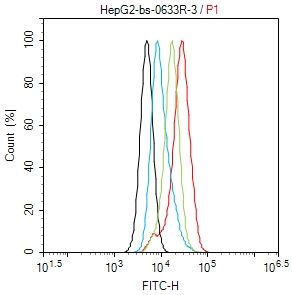
| 产品图片 | 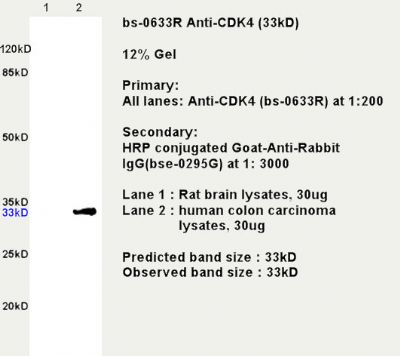 Sample: Brain (Rat) Lysate at 30 ug Colon carcinoma(Human) lysate at 30 ug Primary: Anti- CDK4 (bs-0633R) at 1/200 dilution Secondary: HRP conjugated Goat-Anti-rabbit IgG (bs-0295G-HRP) at 1/3000 dilution Predicted band size: 33 kD Observed band size: 33 kD 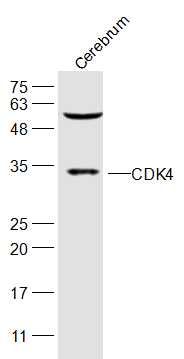 Sample: Cerebrum (Mouse) Lysate at 40 ug Primary: Anti-CDK4 (bs-0633R) at 1/300 dilution Secondary: IRDye800CW Goat Anti-Rabbit IgG at 1/20000 dilution Predicted band size: 34 kD Observed band size: 34 kD 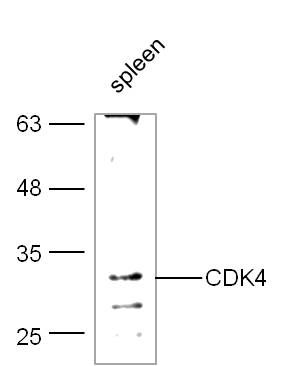 Sample: Spleen (Mouse) Lysate at 40 ug Primary: Anti-CDK4 (bs-0633R) at 1/300 dilution Secondary: IRDye800CW Goat Anti-Rabbit IgG at 1/20000 dilution Predicted band size: 34 kD Observed band size: 34 kD 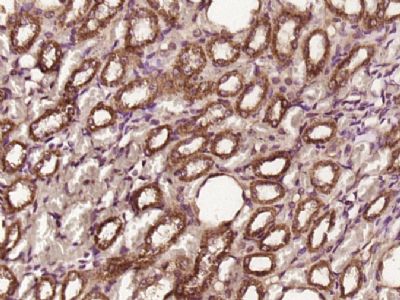 Paraformaldehyde-fixed, paraffin embedded (rat kidney tissue); Antigen retrieval by boiling in sodium citrate buffer (pH6.0) for 15min; Block endogenous peroxidase by 3% hydrogen peroxide for 20 minutes; Blocking buffer (normal goat serum) at 37°C for 30min; Antibody incubation with (CDK4) Polyclonal Antibody, Unconjugated (bs-0633R) at 1:400 overnight at 4°C, followed by operating according to SP Kit(Rabbit) (sp-0023) instructionsand DAB staining. 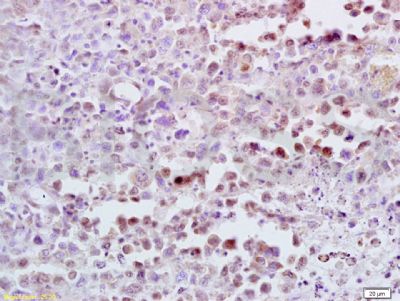 Tissue/cell: mouse lymphoma tissue; 4% Paraformaldehyde-fixed and paraffin-embedded; Antigen retrieval: citrate buffer ( 0.01M, pH 6.0 ), Boiling bathing for 15min; Block endogenous peroxidase by 3% Hydrogen peroxide for 30min; Blocking buffer (normal goat serum,C-0005) at 37℃ for 20 min; Incubation: Anti-CDK4 Polyclonal Antibody, Unconjugated(bs-0633R) 1:300, overnight at 4°C, followed by conjugation to the secondary antibody(SP-0023) and DAB(C-0010) staining 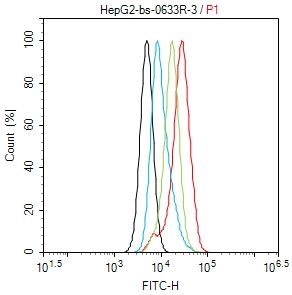 Blank control (black line): HepG2(black) (The cells were fixed with 2% paraformaldehyde (10 min) , then permeabilized with PBST for 30 min on room temperature) Primary Antibody (Red line): Rabbit Anti-CDK4 antibody (bs-0633R) ; Dilution: 1μg /10^6 cells; Isotype Control Antibody (green line): Rabbit IgG . Secondary Antibody (white blue line): Goat anti-rabbit IgG-FITC;Dilution: 1μg /test. |
风险提示:丁香通仅作为第三方平台,为商家信息发布提供平台空间。用户咨询产品时请注意保护个人信息及财产安全,合理判断,谨慎选购商品,商家和用户对交易行为负责。对于医疗器械类产品,请先查证核实企业经营资质和医疗器械产品注册证情况。
 文献和实验
文献和实验3 篇 Nature 连发,解决世纪难题,周期蛋白的毁灭调控蕴含癌症患者的新生
细胞周期是细胞生命活动的基本过程,受到细胞内外信号交互作用的精密调控。D 型细胞周期蛋白 (cyclin D1, D2 和 D3) 与细胞周期蛋白依赖性激酶(cyclin-dependent kinases,CDKs)是整个细胞周期调控机制中的核心分子,驱动细胞增殖。细胞周期失调是人类癌症的一个共同特征,其中 cyclin D-CDK4/6 复合物的水平和活性与不受约束的细胞增殖密切相关。自从 20 世纪 90 年代发现 cyclin D 以来,人们就对其进行了深入研究,但是关于 cyclin
只在siRNA靶向DONSON处理的细胞中下调80%。 在GDF3转染的细胞中,周期素E2只有轻微改变。 如果我们对在相同样品中上调的基因进行分析,那么在两个样品中上调最强烈的是p21,也被称为周期素依赖的激酶抑制剂1a。 当与转染siGFP的对照细胞相比时,p21在GDF3和DONSON siRNA转染细胞中分别上调1.81-3.31倍(图4)。 图4:细胞周期基因表达水平的变化。显示了在RealTime ready细胞周期检测预制板中检测的所选基因表达水平(周期素和周期素依赖的激酶
于细胞周期依赖性激酶(CDK),该酶只有与细胞周期素(cyclins)结合才有活性,可促进细胞周期中G1→S和G2→M的转变。在细胞周期素中最有意义的是细胞周期蛋白D(cyclin D),它能激活CDK2、4、5,促进细胞由G1期进入S期,进行DNA合成。 目前认为p53、p16、Rb基因与G1-S调节点有关。p53基因的表达产物p53蛋白的作用机制主要是间接作用于细胞周期,p53可促进P21蛋白(CDK2的抑制剂)的表达,从而在细胞周期中抑制G1期至S期的转换,阻碍细胞进入DNA合成期
 技术资料
技术资料暂无技术资料 索取技术资料

