

- ¥1380 - 2200
- 康朗生物
- kl-20714R
- 中国/美国/德国
- 2025年07月12日
- WB=1:500-2000 ELISA=1:500-1000 IHC-P=1:400-800 IHC-F=1:400-800 Flow-Cyt=1μg/Test ICC=1:100-500 IF=1:100-500
- Rabbit
- Human, Mouse, Rat, Pig, Horse,

企业认证
相关产品推荐更多 >

万千商家帮你免费找货
0 人在求购买到急需产品
- 详细信息
- 文献和实验
- 技术资料
- 供应商:
上海康朗生物科技有限公司
- 库存:
大量
- 目录编号:
kl-20714R
- 克隆性:
多克隆
- 抗原来源:
Rabbit
- 保质期:
12个月
- 抗体英文名:
LDL receptor antibody
- 抗体名:
低密度脂蛋白受体抗体
- 宿主:
Rabbit
- 适应物种:
Human, Mouse, Rat, Pig, Horse,
- 免疫原:
KLH conjugated synthetic peptide derived from human LDL receptor:501-600/860 <Extracellular>
- 亚型:
IgG
- 形态:
冻干粉或液体
- 应用范围:
WB=1:500-2000 ELISA=1:500-1000 IHC-P=1:400-800 IHC-F=1:400-800 Flow-Cyt=1μg/Test ICC=1:100-500 IF=1:100-500
- 浓度:
1mg/ml
- 保存条件:
-20 °C
- 规格:
100ul 200ul
| 中文名称 | 低密度脂蛋白受体抗体 |
| 别 名 | Low-density lipoprotein receptor precursor; LDL-R; LDL R; FH; FHC; LDL R; LDLR; Low Density Lipoprotein Receptor; Low density lipoprotein receptor familial hypercholesterolemia. |
| 规格价格 | 100ul/1380元 购买 200ul/2200元 购买 大包装/询价 |
| 说 明 书 | 100ul 200ul |
| 研究领域 | 肿瘤 免疫学 |
| 抗体来源 | Rabbit |
| 克隆类型 | Polyclonal |
| 交叉反应 | Human, Mouse, Rat, Pig, Horse, |
| 产品应用 | WB=1:500-2000 ELISA=1:500-1000 IHC-P=1:400-800 IHC-F=1:400-800 Flow-Cyt=1μg/Test ICC=1:100-500 IF=1:100-500 (石蜡切片需做抗原修复) not yet tested in other applications. optimal dilutions/concentrations should be determined by the end user. |
| 分 子 量 | 92kDa |
| 细胞定位 | 细胞浆 细胞膜 |
| 性 状 | Lyophilized or Liquid |
| 浓 度 | 1mg/ml |
| 免 疫 原 | KLH conjugated synthetic peptide derived from human LDL receptor:501-600/860 <Extracellular> |
| 亚 型 | IgG |
| 纯化方法 | affinity purified by Protein A |
| 储 存 液 | 0.01M TBS(pH7.4) with 1% BSA, 0.03% Proclin300 and 50% Glycerol. |
| 保存条件 | Store at -20 °C for one year. Avoid repeated freeze/thaw cycles. The lyophilized antibody is stable at room temperature for at least one month and for greater than a year when kept at -20°C. When reconstituted in sterile pH 7.4 0.01M PBS or diluent of antibody the antibody is stable for at least two weeks at 2-4 °C. |
| PubMed | PubMed |
| 产品介绍 | background: The low density lipoprotein receptor (LDLR) gene family consists of cell surface proteins involved in receptor-mediated endocytosis of specific ligands. Low density lipoprotein (LDL) is normally bound at the cell membrane and taken into the cell ending up in lysosomes where the protein is degraded and the cholesterol is made available for repression of microsomal enzyme 3-hydroxy-3-methylglutaryl coenzyme A (HMG CoA) reductase, the rate-limiting step in cholesterol synthesis. At the same time, a reciprocal stimulation of cholesterol ester synthesis takes place. Mutations in this gene cause the autosomal dominant disorder, familial hypercholesterolemia. Function: Binds LDL, the major cholesterol-carrying lipoprotein of plasma, and transports it into cells by endocytosis. In order to be internalized, the receptor-ligand complexes must first cluster into clathrin-coated pits. In case of HIV-1 infection, functions as a receptor for extracellular Tat in neurons, mediating its internalization in uninfected cells. Subunit: Interacts with LDLRAP1. Interacts with SNX17. Interacts with HCV E1/E2 heterodimer. Interacts with HIV-1 Tat. Subcellular Location: Cell membrane; Single-pass type I membrane protein. Endomembrane system; Single-pass type I membrane protein. Membrane, clathrin-coated pit; Single-pass type I membrane protein. Note=Found distributed from the plasma membrane to intracellular compartments. Tissue Specificity: Binds LDL, the major cholesterol-carrying lipoprotein of plasma, and transports it into cells by endocytosis. In order to be internalized, the receptor-ligand complexes must first cluster into clathrin-coated pits. In case of HIV-1 infection, functions as a receptor for extracellular Tat in neurons, mediating its internalization in uninfected cells. Post-translational modifications: N- and O-glycosylated. Ubiquitinated by MYLIP leading to degradation. Similarity: Belongs to the LDLR family. Contains 3 EGF-like domains. Contains 7 LDL-receptor class A domains. Contains 6 LDL-receptor class B repeats. SWISS: P01130 Gene ID: 3949 Database links: Entrez Gene: 3949 Human Entrez Gene: 16835 Mouse Entrez Gene: 300438 Rat Omim: 606945 Human SwissProt: P01130 Human SwissProt: P35951 Mouse SwissProt: P35952 Rat Unigene: 213289 Human Unigene: 728190 Human Unigene: 3213 Mouse Unigene: 10483 Rat Important Note: This product as supplied is intended for research use only, not for use in human, therapeutic or diagnostic applications. 低密度脂蛋白受体 LDLR是一种存在于细胞表面的、可识别多种配体的脂蛋白受体,在体内对于富含甘油三酯的脂蛋白代谢非常重要; LDL R目前主要用于代谢及肿瘤方面的研究。 |
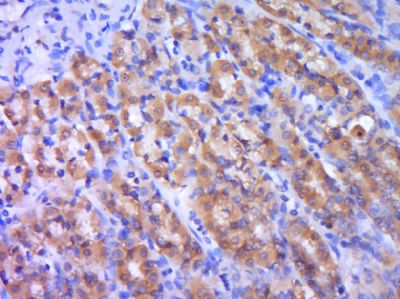
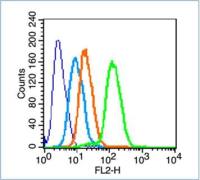
| 产品图片 | 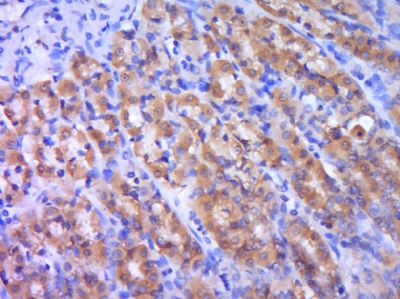 Paraformaldehyde-fixed, paraffin embedded (Rat stomach); Antigen retrieval by boiling in sodium citrate buffer (pH6.0) for 15min; Block endogenous peroxidase by 3% hydrogen peroxide for 20 minutes; Blocking buffer (normal goat serum) at 37°C for 30min; Antibody incubation with (LDL receptor) Polyclonal Antibody, Unconjugated (bs-20714R) at 1:400 overnight at 4°C, followed by operating according to SP Kit(Rabbit) (sp-0023) instructionsand DAB staining. 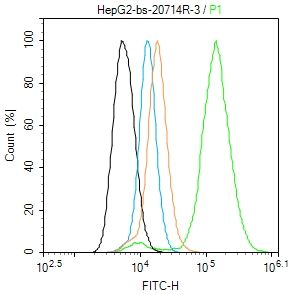 Blank control (black line): HepG2 (black) (The cells were fixed with 2% paraformaldehyde (10 min) , then permeabilized with PBST for 30 min on room temperature) Primary Antibody (green line): Rabbit Anti-LDL receptor antibody (bs-20714R) ; Dilution: 1μg /10^6 cells; Isotype Control Antibody (orange line): Rabbit IgG . Secondary Antibody (white blue line): Goat anti-rabbit IgG-FITC;Dilution: 1μg /test. |
风险提示:丁香通仅作为第三方平台,为商家信息发布提供平台空间。用户咨询产品时请注意保护个人信息及财产安全,合理判断,谨慎选购商品,商家和用户对交易行为负责。对于医疗器械类产品,请先查证核实企业经营资质和医疗器械产品注册证情况。
 文献和实验
文献和实验Aspects of CNS Lupus: Mouse Models of Anti-NMDA Receptor Antibody Mediated Reactivity
This chapter describes methods utilized in establishing a mouse model of neuropsychiatric lupus encompassing both cognitive and emotional dysfunction, and a model of the influence of maternal antibody on the developing brain. The antibody
Measurement of Receptor Endocytosis and Recycling
endosome. The low-density lipoprotein (LDL) receptor-related protein (LRP) is a multiligand endocytic receptor and a member of the LDL receptor family. At the cell surface, it binds to and continuously internalizes numerous ligands including lipoproteins
This work describes protocols for the production of single-chain antibody and T-cell receptor fragments inE. coli . A choice of methods is given for the purification of the recombinant fragments that rely on the use of either immunoaffinity
 技术资料
技术资料暂无技术资料 索取技术资料

