

- ¥1380
- 进口
- 中国
- YS-23347R
- 2026年05月21日
- WB=1:500-2000 ELISA=1:500-1000 IHC-P=1:400-800 IHC-F=1:400-800 IF=1:100-500
- Rabbit
- 见说明书

企业认证
万千商家帮你免费找货
0 人在求购买到急需产品
相关阅读
细胞污染识别与处理全攻略:5 种常见类型+关键误区Cytoscape 教程来了!快速实现顶刊同款通路网络图五大应用案例:Mustang Q 膜层析应用全解析1 个小工具,一次性搞定流程图、质粒图谱和信号通路图- 详细信息
- 文献和实验
- 技术资料
- 免疫原:
KLH conjugated
- 亚型:
IgG
- 形态:
冻干粉
- 保存条件:
Store at -20 °C for one year
- 克隆性:
多克隆
- 标记物:
见说明书
- 适应物种:
见说明书
- 宿主:
Rabbit
- 应用范围:
WB=1:500-2000 ELISA=1:500-1000 IHC-P=1:400-800 IHC-F=1:400-800 IF=1:100-500
- 浓度:
1mg/ml
- 靶点:
见说明书
- 抗体英文名:
PALB2
- 抗体名:
乳腺癌易感基因相关蛋白2免疫组化荧光抗体
- 规格:
100ul
中文名称乳腺癌易感基因相关蛋白2
别 名DKFZp667I166; 4732427B05; BC066140; DKFZp686E1054; FANCN; FANCN GENE; FLJ21816; OTTMUSP00000025884; PALB2; partner and localizer of BRCA2; RGD1304759; PALB2_HUMAN.
规格价格50ul/780元 购买 100ul/1380元 购买 200ul/2200元 购买 大包装/询价
说 明 书50ul 100ul 200ul
研究领域肿瘤 神经生物学 信号转导 细胞凋亡
抗体来源Rabbit
克隆类型Polyclonal
交叉反应 Human, Mouse, Rat, Pig, Cow,
产品应用WB=1:500-2000 ELISA=1:500-1000 IHC-P=1:400-800 IHC-F=1:400-800 Flow-Cyt=1μg/Test IF=1:100-500 (石蜡切片需做抗原修复)
not yet tested in other applications.
optimal dilutions/concentrations should be determined by the end user.
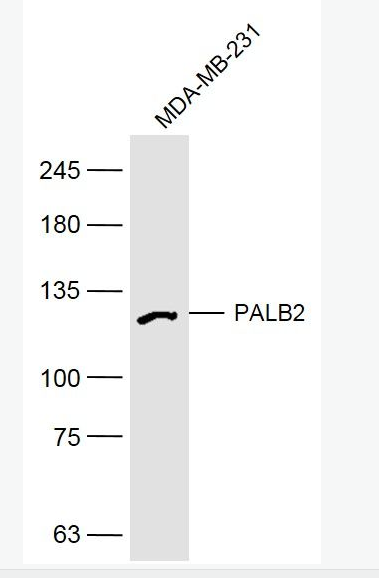
分 子 量131kDa
细胞定位细胞核
性 状Lyophilized or Liquid
浓 度1mg/ml
免 疫 原KLH conjugated synthetic peptide derived from human PALB2 C-terminus:1101-1186/1186
亚 型IgG
纯化方法affinity purified by Protein A
储 存 液0.01M TBS(pH7.4) with 1% BSA, 0.03% Proclin300 and 50% Glycerol.
保存条件Store at -20 °C for one year. Avoid repeated freeze/thaw cycles. The lyophilized antibody is stable at room temperature for at least one month and for greater than a year when kept at -20°C. When reconstituted in sterile pH 7.4 0.01M PBS or diluent of antibody the antibody is stable for at least two weeks at 2-4 °C.
PubMedPubMed
产品介绍background:
This gene encodes a protein that may function in tumor suppression. This protein binds to and colocalizes with the breast cancer 2 early onset protein (BRCA2) in nuclear foci and likely permits the stable intranuclear localization and accumulation of BRCA2. Essential partner of BRCA2 that promotes the localization and stability of BRCA2. Also enables its recombinational repair and checkpoint functions of BRCA2. May act by promoting stable association of BRCA2 with nuclear structures, allowing BRCA2 to escape the effects of proteosome-mediated degradation.
Function:
Plays a critical role in homologous recombination repair (HRR) through its ability to recruit BRCA2 and RAD51 to DNA breaks. Serves as the molecular scaffold in the formation of the BRCA1-PALB2-BRCA2 complex which is essential for homologous recombination. Strongly stimulates the DNA strand-invasion activity of RAD51, stabilizes the nucleoprotein filament against a disruptive BRC3-BRC4 polypeptide and helps RAD51 to overcome the suppressive effect of replication protein A (RPA). Functionally cooperates with RAD51AP1 in promoting of D-loop formation by RAD51. Essential partner of BRCA2 that promotes the localization and stability of BRCA2. Also enables its recombinational repair and checkpoint functions of BRCA2. May act by promoting stable association of BRCA2 with nuclear structures, allowing BRCA2 to escape the effects of proteasome-mediated degradation. Binds DNA with high affinity for D loop, which comprises single-stranded, double-stranded and branched DNA structures.
Subunit:
Homooligomer. Oligomerization is essential for its focal accumulation at DNA breaks. Part of a trimeric complex containing BRCA1, BRCA2 and PALB2. Interacts with BRCA1 and this interaction is essential for its function in HRR. Interacts with RAD51, BRCA2, RAD51AP1 and MORF4L1/MRG15.
Subcellular Location:
Nucleus. Note=Colocalizes with BRCA2 in nuclear foci.
DISEASE:
Breast cancer (BC) [MIM:114480]: A common malignancy originating from breast epithelial tissue. Breast neoplasms can be distinguished by their histologic pattern. Invasive ductal carcinoma is by far the most common type. Breast cancer is etiologically and genetically heterogeneous. Important genetic factors have been indicated by familial occurrence and bilateral involvement. Mutations at more than one locus can be involved in different families or even in the same case. Note=Disease susceptibility is associated with variations affecting the gene represented in this entry. Breast cancer susceptibility is strongly associated with PALB2 truncating mutations. Conversely, rare missense mutations do not strongly influence breast cancer risk (PubMed:22241545).
Fanconi anemia complementation group N (FANCN) [MIM:610832]: A disorder affecting all bone marrow elements and resulting in anemia, leukopenia and thrombopenia. It is associated with cardiac, renal and limb malformations, dermal pigmentary changes, and a predisposition to the development of malignancies. At the cellular level it is associated with hypersensitivity to DNA-damaging agents, chromosomal instability (increased chromosome breakage) and defective DNA repair. Note=The disease is caused by mutations affecting the gene represented in this entry.
Pancreatic cancer 3 (PNCA3) [MIM:613348]: A malignant neoplasm of the pancreas. Tumors can arise from both the exocrine and endocrine portions of the pancreas, but 95% of them develop from the exocrine portion, including the ductal epithelium, acinar cells, connective tissue, and lymphatic tissue. Note=The disease is caused by mutations affecting the gene represented in this entry.
Similarity:
Contains 7 WD repeats.
SWISS:
Q86YC2
Gene ID:
79728
Database links:
Entrez Gene: 79728 Human
Entrez Gene: 233826 Mouse
Entrez Gene: 293452 Rat
Omim: 610355 Human
SwissProt: Q86YC2 Human
SwissProt: Q3U0P1 Mouse
Unigene: 444664 Human
Unigene: 38348 Mouse
Unigene: 43638 Rat
Important Note:
This product as supplied is intended for research use only, not for use in human, therapeutic or diagnostic applications.
BRCA1,BRCA2和其他已经确定的易感性基因,只能解释不到一半的乳腺癌已知遗传性易感特征,芬兰科学家对113个有乳腺癌患者的家族进行了研究。他们在3个家族中发现了一种名为PALB2的基因,这种基因出现缺陷与家族成员患乳腺癌关系密切。PALB2基因与BRCA2基因在DNA修复中发生作用,新发现的突变会削弱这一功能。
研究结果表明,PALB2基因出现缺陷使这些家族成员患乳腺癌的危险增加3倍。另外,这一基因出现缺陷也使这些家族的男性成员患前列腺癌的危险增加。
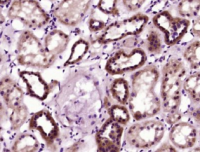
| 产品图片 |  Sample: MDA-MB-231(Human) Cell Lysate at 40 ug Primary: Anti-PALB2 (bs-0588R) at 1/300 dilution Secondary: IRDye800CW Goat Anti-Rabbit IgG at 1/20000 dilution Predicted band size: 131 kD Observed band size: 131 kD  Sample: HepG2(Human) Cell Lysate at 40 ug Primary: Anti-PALB2 (bs-0588R) at 1/300 dilution Secondary: IRDye800CW Goat Anti-Rabbit IgG at 1/20000 dilution Predicted band size: 131 kD Observed band size: 131 kD  Independently Validated Antibody, image provided by Science Direct, badge number 029682:Formalin-fixed and paraffin embedded pig skeletal muscle labeled with Rabbit Anti-PALB2 Polyclonal Antibody, Unconjugated (bs-0588R) at 1:100 for one hour at room temperature followed by conjugation to the secondary antibody Mach2 rabbit HRP-Polymer for 30 min at room temperature and DAB staining.  Independently Validated Antibody, image provided by Science Direct, badge number 029682:Formalin-fixed and paraffin embedded human breast cancer labeled with Rabbit Anti-PALB2 Polyclonal Antibody, Unconjugated (bs-0588R) at 1:100 from one hour at room temperature followed by conjugation to the secondary antibody Mach2 rabbit HRP-Polymer for 30 minutes at room temperature. Positive Control, the staining is correct.  Tissue/cell: human breast carcinoma; 4% Paraformaldehyde-fixed and paraffin-embedded; Antigen retrieval: citrate buffer ( 0.01M, pH 6.0 ), Boiling bathing for 15min; Block endogenous peroxidase by 3% Hydrogen peroxide for 30min; Blocking buffer (normal goat serum,C-0005) at 37℃ for 20 min; Incubation: Anti-PALB2 Polyclonal Antibody, Unconjugated(bs-0588R) 1:200, overnight at 4°C, followed by conjugation to the secondary antibody(SP-0023) and DAB(C-0010) staining  Blank control: Hela(blue), the cells were fixed with 2% paraformaldehyde (10 min) and then permeabilized with ice-cold 90% methanol for 30 min on ice.. Isotype Control Antibody: Rabbit IgG(orange) ; Secondary Antibody: Goat anti-rabbit IgG-FITC(white blue), Dilution: 1:100 in 1 X PBS containing 0.5% BSA ; Primary Antibody Dilution: 1μg in 100 μL1X PBS containing 0.5% BSA(green). |
风险提示:丁香通仅作为第三方平台,为商家信息发布提供平台空间。用户咨询产品时请注意保护个人信息及财产安全,合理判断,谨慎选购商品,商家和用户对交易行为负责。对于医疗器械类产品,请先查证核实企业经营资质和医疗器械产品注册证情况。
 文献和实验
文献和实验三句话读懂一篇 CNS,酗酒背后的机制,环境-基因互作诱导肿瘤发生,Cas9 时钟...
Cancer Risk Genes — Association Analysis in More than 113,000 Women,该研究以应用由 34 个推测的易感基因构成的基因面板,对 60,466 例乳腺癌女性患者和 53,461 例对照女性的样本进行了测序,筛选出如 ATM、BRCA1、BRCA2、CHEK2 和 PALB2 等数个预测乳腺癌风险最有用的基因,这些结果能有效用于备孕人士的遗传咨询。乳腺癌作为全球第一大癌症,女性朋友们定要多加防范,做好癌症筛查! 图片来源:站酷海洛
与基因稳定性有关的基因 与基因 稳定性有关的基因主要是乳腺癌易感基因―1(BRCA―1),它位于17q21,是熟知的乳腺癌易感基因。用反义核酸技术抑制BRCAl的表达,可增加正常及恶性乳腺细胞的增殖,而野生型BRCAl的过度表达可抑制MCF―7等乳腺癌细胞在小鼠体内的成瘤能力。在近一半的遗传性乳腺肿瘤中发现BRCAl的遗传性突变。与其他抑癌基因不同的是,尽管在乳腺癌及卵巢癌中BRCAl基因发生LOH的频率很高,但其体细胞突变很少见。既然在散发性乳腺癌中
三句话读懂一篇 CNS:代糖也有害,增加焦虑风险 | 每天运动仅 3 分钟,死亡风险降低 40%
相关蛋白 LKB1-SIK3 激酶以及组蛋白脱乙酰化酶 HDAC4 和 HDAC5 对于睡眠持续时间的调节,HDAC4 和 HDAC5 的磷酸化与睡眠需求增加有关,证明了体细胞遗传操纵对于小鼠睡眠研究的重要性。 图 4:来源 Nature 5. STTT:发现具有广谱抗癌活性的强效 USP25/28 抑制剂 每年因癌症失去生命的人不计其数,因此如何攻克癌症成为了科学家们最关注的问题。 2022 年 12 月 8 日,浙江大学张普民、梁廷波及中国科学院上海药物研究所谭昌恒共同


