
- $527
- Alomone
- 以色列
- ACC-060-F
- 2025年07月11日
- FC
- Rabbit
- 见官方网站

企业认证
相关产品推荐更多 >

万千商家帮你免费找货
0 人在求购买到急需产品
- 详细信息
- 技术资料
- 免疫原:
见官方网站
- 亚型:
见官方网站
- 形态:
液体或冻干粉
- 保存条件:
-20°C
- 克隆性:
多克隆
- 标记物:
见官方网站
- 适应物种:
见官方网站
- 保质期:
6个月
- 抗原来源:
Rabbit
- 目录编号:
ACC-060-F
- 级别:
高
- 库存:
大量
- 供应商:
上海信裕生物科技有限公司
- 宿主:
Rabbit
- 应用范围:
FC
- 浓度:
见官方网站
- 靶点:
见官方网站
- 抗体英文名:
Anti-Human Orai1 (extracellular)-FITC
- 抗体名:
Anti-Human Orai1 (extracellular)-FITC
- 规格:
50 µl
Anti-Human Orai1 (extracellular)-FITC
CRACM1, TMEM142ACat #: ACC-060-F
Sizes: 50 µl
Source: Rabbit
Type: Polyclonal
Applications: FC
Reactivity: H
Application key:
CBE- Cell-based ELISA, FC- Flow cytometry, IC- Immunocytochemistry, IE- Indirect ELISA, IFC- Indirect flow cytometry, IH- Immunohistochemistry, IP- Immunoprecipitation, LCI- Live cell imaging, N- Neutralization, WB- Western blotSpecies reactivity key:
H- Human, M- Mouse, R- RatAlomone Labs is pleased to offer a new version of the Anti-Human Orai1 (extracellular) antibody (#ACC-060) directly conjugated to FITC. The Anti-Human Orai1 (extracellular)-FITC antibody (#ACC-060-F) can be used in immunofluorescent applications such as direct flow cytometry and recognizes Orai1 from human samples.
- Applications
- Specifications
- Scientific Background
- Related Products
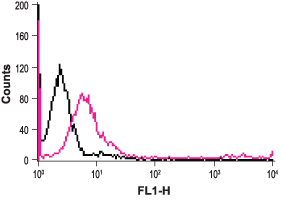
Direct flow cytometry analysis of live Jurkat (human acute T cell leukemia) cells:
___ Unstained cells.
___ Cells + Anti-Human Orai1 (extracellular)-FITC antibody (#ACC-060-F), (10 µg/1x106 cells).
The control antigen is not suitable for this application.
Immunogen
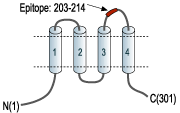
Peptide (C)KKQPGQPRPTSK, corresponding to amino acid residues 203-214 of human Orai1 (Accession Q96D31). 2nd extracellular loop.
HomologyCanis - identical; bovine - 12/13 amino acid residues.
PurityAffinity purified on immobilized antigen.
FormulationLyophilized powder. Reconstituted antibody contains phosphate buffered saline (PBS), pH 7.4, 1% BSA, 0.05% NaN3.
SpecificityWill not recognize mouse or rat Orai1.
LabelFluorescein isothiocyanate (FITC).
Standard quality control of each lotWestern blot analysis (unlabeled antibody, #ACC-060), and direct flow cytometry analysis (labeled antibody).
Peptide confirmationConfirmed by amino acid analysis and mass spectrometry.
Storage before reconstitutionThe antibody ships as a lyophilized powder at room temperature. Upon arrival, it should be stored at -20°C.
Reconstitution50 µl double distilled water (DDW).
Antibody concentration after reconstitution1 mg/ml.
Storage after reconstitutionThe reconstituted solution can be stored at 4°C, protected from the light, for up to 1 week. For longer periods, small aliquots should be stored at -20°C. Avoid multiple freezing and thawing. Centrifuge all antibody preparations before use (10000 × g 5 min).
Control antigen storage before reconstitutionLyophilized powder can be stored intact at room temperature for 2 weeks. For longer periods, it should be stored at -20°C.
Control antigen reconstitution100 µl double distilled water (DDW).
Control antigen storage after reconstitution-20ºC.
Preadsorption Control1 µg peptide per 1 µg antibody.
Scientific background
Cytosolic calcium (Ca2+) has long been known to act as a key second messenger in many intracellular pathways including synaptic transmission, muscle contraction, hormonal secretion, cell growth, and proliferation.1,2 The mechanism controlling intracellular Ca2+ level influx either by calcium-release-activated Ca2+ channels (CRAC) or from intracellular stores has become of great interest.
Recently, several key players of the store-operated complex have been identified.3 Orai1 (also known as CRACM1) acts as the store-operated calcium channel (SOC) and STIM1 acts as an endoplasmic reticulum (ER) Ca2+ sensor.3,4 The formation of functional channels requires the presence of both Orai1 and STIM1 proteins working as a complex that involves co-clustering of Orai1 on the plasma membrane with STIM1 on the ER.4-6TRPC1, a member of the transient receptor potential family was also suggested to act as a player in the SOC complex.7 In T cells, Ca2+ entry following activation by antigen-receptor engagement occurs solely through CRAC channels where Orai1 constitutes the pore-forming subunit.3,8
Orai1 is a plasma membrane protein with four potential transmembrane domains and intracellular N- and C-termini. In addition, two mammalian homologs of Orai1 have been identified: Orai2 and Orai3.3,9 All three (Orai1, Orai2, and Orai3) have been shown to be capable of forming store-operated channels.9,10
References
- Eisner, D.A. et al. (2005) Exp.Physiol. 90, 3.
- Chakrabarti, R. and Chakrabarti, R. (2006) J.Cell. Biochem. 99, 1503.
- Feske, S. et al. (2006) Nature 441, 179.
- Pickett, J. (2006) Nature Reviews Mol. Cell Biol. 7, 794.
- Luik, R.M. et al. (2006) J.Cell. Biol. 174, 815.
- Wu, M.M. et al. (2006) J.Cell. Biol. 174, 803.
- Hong H.L. et al. (2007) J. Biol. Chem. 282, 9105.
- Luik, R.M and Lewis, R.S. (2007) Trends Mol. Med. 13, 103.
- DeHaven, W.I. et al. (2007) J. Biol. Chem. 282, 17548.
- Lis, A. et al. (2007) Curr. Biol. 17, 794.
风险提示:丁香通仅作为第三方平台,为商家信息发布提供平台空间。用户咨询产品时请注意保护个人信息及财产安全,合理判断,谨慎选购商品,商家和用户对交易行为负责。对于医疗器械类产品,请先查证核实企业经营资质和医疗器械产品注册证情况。
 技术资料
技术资料暂无技术资料 索取技术资料