


- $527
- Alomone
- 以色列
- ACC-0101-AR
- 2025年07月09日
- IC, IH
- Rabbit
- 见官方网站

企业认证
相关产品推荐更多 >


万千商家帮你免费找货
0 人在求购买到急需产品
- 详细信息
- 文献和实验
- 技术资料
- 免疫原:
见官方网站
- 亚型:
见官方网站
- 形态:
液体或冻干粉
- 保存条件:
-20°C
- 克隆性:
多克隆
- 标记物:
见官方网站
- 适应物种:
见官方网站
- 保质期:
6个月
- 抗原来源:
Rabbit
- 目录编号:
ACC-0101-AR
- 级别:
高
- 库存:
大量
- 供应商:
上海信裕生物科技有限公司
- 宿主:
Rabbit
- 应用范围:
IC, IH
- 浓度:
见官方网站
- 靶点:
见官方网站
- 抗体英文名:
Anti-Calcium Homeostasis Modulator 1-ATTO-594
- 抗体名:
Anti-Calcium Homeostasis Modulator 1-ATTO-594
- 规格:
50 µl
Anti-Calcium Homeostasis Modulator 1-ATTO-594
CalHM1, FAM26CCat #: ACC-0101-AR
Sizes: 50 µl
Source: Rabbit
Type: Polyclonal
Applications: IC, IH
Reactivity: H, M, R
Application key:
CBE- Cell-based ELISA, FC- Flow cytometry, IC- Immunocytochemistry, IE- Indirect ELISA, IFC- Indirect flow cytometry, IH- Immunohistochemistry, IP- Immunoprecipitation, LCI- Live cell imaging, N- Neutralization, WB- Western blotSpecies reactivity key:
H- Human, M- Mouse, R- RatAnti-Calcium Homeostasis Modulator 1 (#ACC-101) is a highly specific antibody directed against an epitope of the human protein. The antibody can be used in western blot and immunohistochemistry applications. It has been designed to recognize calcium homeostasis modulator 1 from rat, mouse, and human samples.
Alomone Labs is pleased to offer a new version of this antibody that is directly labeled with an ATTO-594 fluorescent dye. ATTO dyes are characterized by strong absorption (high extinction coefficient), high fluorescence quantum yield, and high photo-stability. The ATTO-594 fluorescent label belongs to the class of Rhodamine dyes and can be used with fluorescent equipment typically optimized to detect Texas Red and Alexa-594. Anti-Calcium Homeostasis Modulator 1–ATTO-594 antibody (#ACC-101-AR) has been tested in immunohistochemistry applications and is specially suited for experiments requiring simultaneous labeling of different markers. The conjugated antibody is ideal for immuno-colocalization studies. For example we demonstrate that Calcium Homeostasis Modulator 1 co-localizes with GluN1 in mouse hippocampus using labeled CALHM1 antibody and Anti-NMDA Receptor (GluN1) (extracellular) antibody (#AGC-001).
- Applications
- Specifications
- Scientific Background
- Related Products
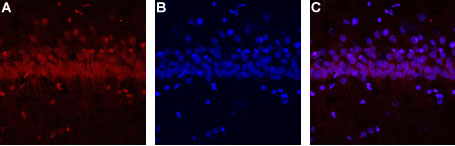
Expression of Calcium Homeostasis Modulator 1 in rat hippocampus
Immunohistochemical staining of rat hippocampus using Anti-Calcium Homeostasis Modulator 1-ATTO-594 antibody (#ACC-101-AR). A. Staining of Calcium Homeostasis Modulator 1 appears only in the hippocampal CA1 pyramidal layer. B. Nuclear staining using DAPI as the counterstain. C. Merge of A and B.
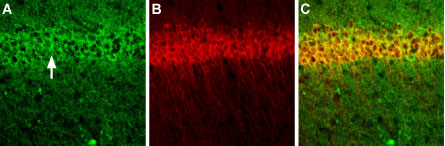
Immuno-colocalization of GluN1 and CALHM1 in mouse hippocampal CA1 region
Immunohistochemical staining of perfusion-fixed frozen mouse brain sections using Anti-NMDA Receptor 1 (GluN1) (extracellular) antibody (#AGC-001), (1:200) and Anti-Calcium Homeostasis Modulator 1-ATTO-594 antibody (#ACC-101-AR), (1:60). A. Sections were stained with Anti-NMDA Receptor 1 (GluN1) (extracellular) antibody, followed by goat-anti-rabbit-Cy2 (green). Staining reveals expression in neurons of the pyramidal layer (an arrow points at the layer). B. The same section was incubated with Anti-Calcium Homeostasis Modulator 1-ATTO-594 antibody, (red). C. Merge of the two images demonstrates colocalization of GluN1 and CALHM1 in pyramidal neurons.
Immunogen
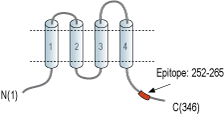
Peptide (C)EAMNHDLELGHTHG, corresponding to amino acid residues 252-265 of human calcium homeostasis modulator protein 1 (Accession Q8IU99).
HomologyRat, mouse - identical.
PurityAffinity purified on immobilized antigen.
FormulationLyophilized powder. Reconstituted antibody contains phosphate buffered saline (PBS), pH 7.4, 1% BSA, 0.05% NaN3.
LabelATTO-594. Maximum absorption 601 nm; maximum fluorescence 627 nm. The fluorescence is excited most efficiently in the 580 - 615 nm range. This label is related to the Rhodamine dyes and can be used with filters used to detect Texas Red and Alexa-594.
Standard quality control of each lotWestern blot analysis (unlabeled antibody, #ACC-101), and immunohistochemistry (labeled antibody).
Peptide confirmationConfirmed by amino acid analysis and mass spectrometry.
Storage before reconstitutionThe antibody ships as a lyophilized powder at room temperature. Upon arrival, it should be stored at -20°C.
Reconstitution50 µl double distilled water (DDW).
Antibody concentration after reconstitution0.8 mg/ml.
Storage after reconstitutionThe reconstituted solution can be stored at 4°C, protected from the light, for up to 1 week. For longer periods, small aliquots should be stored at -20°C. Avoid multiple freezing and thawing. Centrifuge all antibody preparations before use (10000 × g 5 min).
Control antigen storage before reconstitutionLyophilized powder can be stored intact at room temperature for 2 weeks. For longer periods, it should be stored at -20°C.
Control antigen reconstitution100 µl double distilled water (DDW).
Control antigen storage after reconstitution-20ºC.
Preadsorption Control1 µg peptide per 1 µg antibody.
Scientific background
A misbalance in Ca2+ homeostasis seems to be related to the development of Alzheimer’s disease (AD). Indeed Neuronal Ca2+ balance may affect the levels of proteins associated with AD, such as amyloid-beta (Ab) and tau1.
Calcium homeostasis modulator 1 (CALHM1) is a cerebral Ca2+ channel component responsible for controlling intracellular Ca2+ levels and Ab metabolism2,3. CALHM1 is a three transmembrane glycoprotein, mostly localized to the endoplasmic reticulum (ER) although it can be detected at the plasma membrane. A functional channel is formed by multiple subunits which has some structural similarities to the NMDA receptor. It is expressed in all brain regions1.
In cultured cells, overexpression of CALHM1 increases intracellular Ca2+ levels and reduces Ab accumulation, thereby reinforcing its implication in the development of AD. Indeed, a polymorphism in the gene was found to affect the onset of AD2.
References
- Green, K.N. and LaFerla, F.M. (2008) Neuron 59, 190.
- Koppel, J. et al. (2011) Mol. Med. 17, 974.
- Dreses-Werringloer, U. et al. (2008) Cell 133, 1149.
风险提示:丁香通仅作为第三方平台,为商家信息发布提供平台空间。用户咨询产品时请注意保护个人信息及财产安全,合理判断,谨慎选购商品,商家和用户对交易行为负责。对于医疗器械类产品,请先查证核实企业经营资质和医疗器械产品注册证情况。
 文献和实验
文献和实验Protein Kinase C as a Modulator of 5- HT1A and Dopamine- D2 Receptor Signaling
Since its identification as a family of protein kinases that is activated in the presence of calcium, phosphatidyl serine, and diacylglycerol (DAG), protein kinase C (PKC) has been regarded as one of the early steps in receptor signaling
Fluorescent Assessment of Intracellular Calcium in Individual Cells
Calcium is an important intracellular ion involved in numerous cell processes. There are multiple factors that contribute to the release of Ca2+ . Some factors induce release as part of intracellular signaling cascades, while others result
Measurement of Calcium Buffering by Intracellular Organelles in Brain
within the neuron are illustrated in Fig. 1 . The efficient operation of calcium sequestration and extrusion mechanisms within the cell is crucial for the maintenance of normal calcium homeostasis. Fig. 1. Different calcium-buffering
 技术资料
技术资料暂无技术资料 索取技术资料

