

- 询价
- GeneAll
- 进口
- 307-106; 307-150
- 2025年07月08日

企业认证
相关产品推荐更多 >
万千商家帮你免费找货
0 人在求购买到急需产品
- 详细信息
- 文献和实验
- 技术资料
- 保存条件:
Room temperature (15~25 ℃) / DNase I (-20 ℃)
- 英文名:
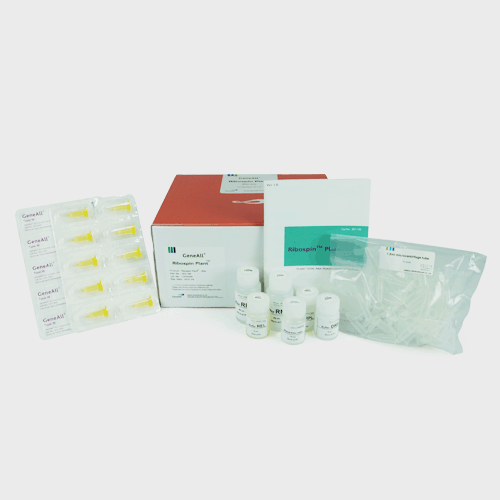
Ribospin Plant
- 规格:
6T; 50T
| Cat.No. | Product Description | Size |
| 307-106 | RibospinTM Plant | 6 |
| 307-150 | RibospinTM Plant | 50 |
Description
RibospinTM Plant is specially designed for purification of total RNA from various plant tissues such as leaves, stems, roots and picky plant samples. This kit provides the optimized buffer and spin column, which
is effective in removing polysaccharides and polyphenolic compounds and isolating intact plant RNA. All components of RibospinTM Plant are ready to use, so any further preparation for experiment is not required.
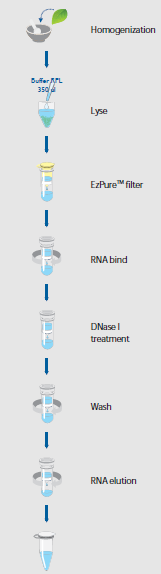
The procedure of RibospinTM Plant begins with the disruption of sample in liquid nitrogen using mortar and pestle. The disrupted sample can be lysed in buffer RPL or REL. In most case, buffer RPL is the best buffer
for lysis. However in some plant samples, solidification of lysate can be occurred with buffer RPL due to endosperm of seed or peculiar metabolites and this can be avoided by using buffer REL as alternative
for buffer RPL. Most impurities except RNA in the lysate are eliminated by filtration through EzPureTM filter and then the passed-through lysate is mixed with ethanol to adjust binding condition. Total RNA including a little impurity is bound to the membrane of spin column type W while the mixture is passing through. Survived genomic DNA can be exterminated by oncolumn DNase I treatment at this step. After a series of washing step
using buffer RBW and RNW, plant total RNA is eluted by RNase-free water. Whole procedure of RibospinTMPlant takes only 25 minutes. The purified RNA is suitable for cDNA synthesis, RT-PCR, northern blotting and other analytical procedure.
Features and Benefits
■ Glassfiber membrane technology
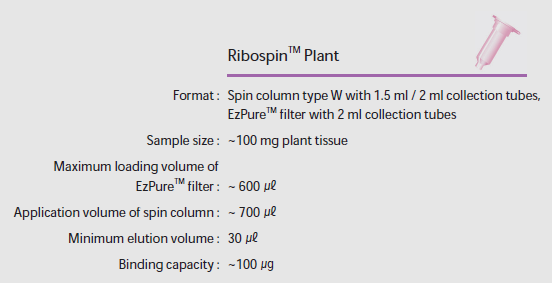
■ Sample size : Up to 100 mg plant tissue
■ Including DNase I and treatment step
■ Typical yield of RNA : ~ 50 ㎍ / 100 mg tissue
■ High purity : A260/A280 1.8~2.2, A260/A230 >2.0
■ Preparation time : ~ 25 minutes
■ No phenol / chloroform extraction
■ No ethanol precipitation
■ Ready for use in RT-PCR, northern blotting, dot blotting, in vitro translation, molecular cloning, real-time
PCR, RNase protection assay and other analytical procedures
Procedures
Specification
风险提示:丁香通仅作为第三方平台,为商家信息发布提供平台空间。用户咨询产品时请注意保护个人信息及财产安全,合理判断,谨慎选购商品,商家和用户对交易行为负责。对于医疗器械类产品,请先查证核实企业经营资质和医疗器械产品注册证情况。
 文献和实验
文献和实验Extraction DNA from Plant Materials
Plant_Leaf_DNA_Extraction.pdf
阴生植物 shade plant 指耐阴性强,能在阴地生长的植物,是阳生植物的对应词。阴树幼龄时带有阴生植物的性质,长大后生长条件越良好越是明显的阴生植物。阴生植物的叶呼吸小,在弱光下(照度在 1000勒克斯以下)比阳生植物的叶净同化作用要大。叶的排列为一平面,同时又有镶嵌性,在弱光下的物质生产是大的。但是由于叶片的角质层较薄,对干燥的抵抗力弱、所以属于典型的阴生植物(特别是阴生植物 skiophyte)在直射光下不能生长(如堇菜属的一种)。但是在背阴下生长的许多植物有的可
植物社会学 plant sociology 研究植被或植物群落的植物生态学的一个分支领域,在广义上是与植物群落学(植被学vegeta-tion sicence)或群落生态学同义;但在狭义上,是指Z rich-Montpellier学派所采取的研究方法的植物群落学。在日本多采纳这种意义。后者是以C.Schrter.J.Braun-Blanquet,R.T xen等所发展的中欧地植物学(德Geobotanik)特别是以社会学的地植物学为基础。植物社会学(广义)的主要研究课题:(1)阐明植物


