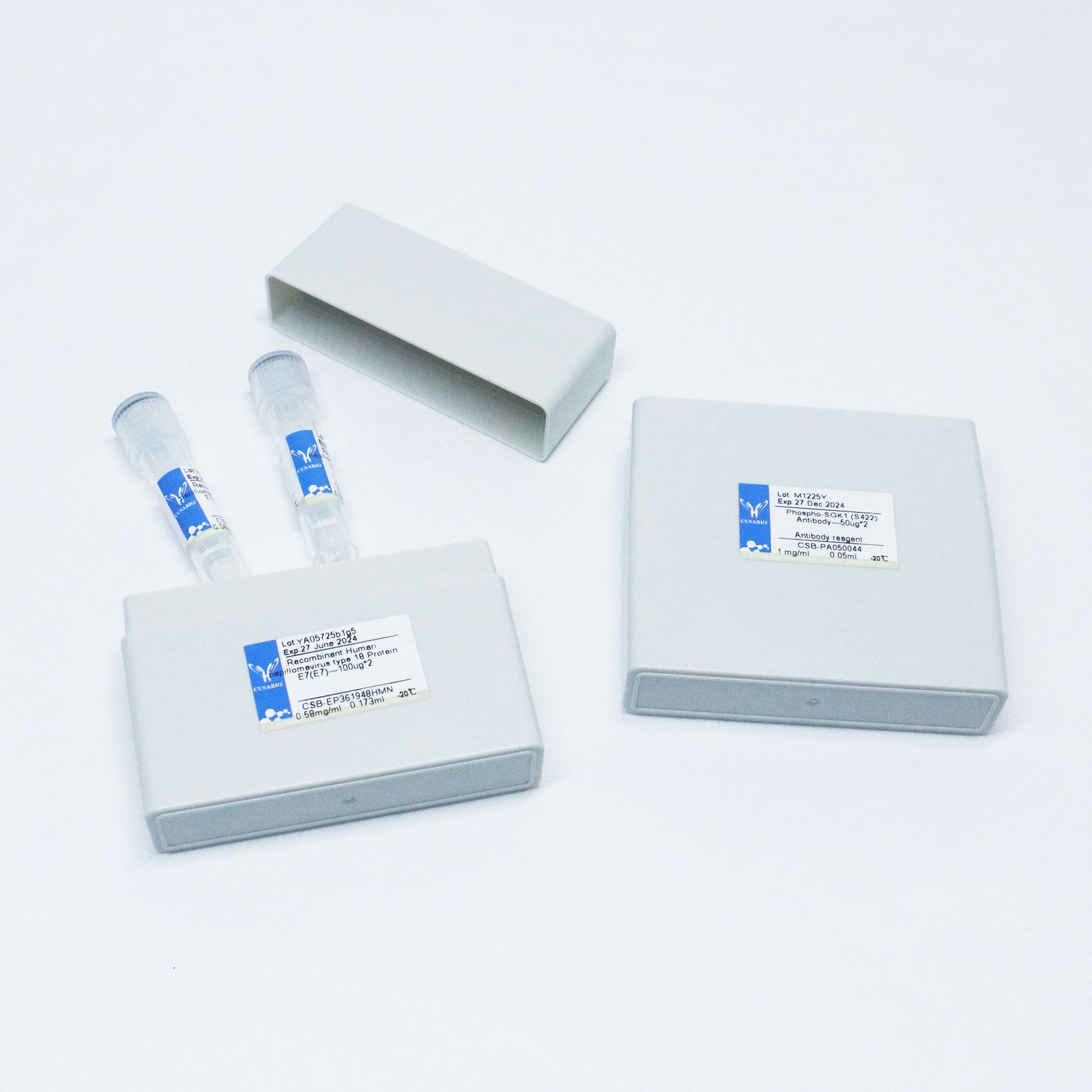
//重组蛋白Genome polyprotein [Clea
ved into: P1;Capsid protein VP0;VP4-VP2);Capsid protein VP4;P1A;Virion protein 4);Capsid protein VP2;P1B;Virion protein 2);Capsid protein VP3;P1C;Virion protein 3);Capsid protein VP1;P1D;Virion protein 1);P- ¥1344
- CUSABIO

- CN
- CSB-EP362073HQD
- 2026年01月20日

企业认证
相关产品推荐更多 >
Recombinant-Saccharum-officinarum-Cytochrome-b6-f-complex-subunit-4petDCytochrome b6-f complex subunit 4 Alternative name(s): 17 kDa polypeptide
¥10206
Recombinant-Glycerol-uptake-facilitator-proteinglpFGlycerol uptake facilitator protein Alternative name(s): Aquaglyceroporin
¥11284
Recombinant-Saccharomyces-cerevisiae-Putative-uncharacterized-protein-YBR116C-YBR116CPutative uncharacterized protein YBR116C
¥10332
Recombinant-Haloarcula-argentinos-Cruxrhodopsin-1cop1Cruxrhodopsin-1; COP-1; CR-1
¥11004
Recombinant-Polypterus-ornatipinnis-Cytochrome-c-oxidase-subunit-2mt-co2Cytochrome c oxidase subunit 2 EC= 1.9.3.1 Alternative name(s): Cytochrome c oxidase polypeptide II
¥10822
万千商家帮你免费找货
0 人在求购买到急需产品
- 详细信息
- 文献和实验
- 技术资料
- 保存条件:
We recommend to add 5-50% of glycerol (final concentration) and aliquot for long-term storage at -20℃/-80℃.
- 保质期:
Generally, the shelf life of liquid form is 6 months at -20℃/-80℃. The shelf life of lyophilized form is 12 months at -20℃/-80℃.
- 英文名:
Recombinant Human rhinovirus A serotype 89 Genome polyprotein, partial
- 库存:
200
- 供应商:
武汉华美生物工程有限公司
- 规格:
20μg
英文名称:
Recombinant Human rhinovirus A serotype 89 Genome polyprotein, partial品名简称:
Recombinant Human rhinovirus A serotype 89 Genome polyprotein, partial货号:
CSB-EP362073HQD规格:
20μg价格:
1344LC-MS/Western Blot:
/SDS-PAGE:
(Tris-Glycine gel) Discontinuous SDS-PAGE (reduced) with 5% enrichment gel and 15% separation gel.纯度:
Greater than 90% as determined by SDS-PAGE.内毒素:
Not test生物活性:
/基因名:
N/AUniprot No.:
P07210别名:
Genome polyprotein [Cleaved into: P1; Capsid protein VP0; VP4-VP2); Capsid protein VP4; P1A; Virion protein 4); Capsid protein VP2; P1B; Virion protein 2); Capsid protein VP3; P1C; Virion protein 3); Capsid protein VP1; P1D; Virion protein 1); P2; Protease 2A; P2A; EC 3.4.22.29; Picornain 2A; Protein 2A); Protein 2B; P2B); Protein 2C; P2C; EC 3.6.1.15); P3; Protein 3AB; Protein 3A; P3A); Viral protein genome-linked; VPg; Protein 3B; P3B); Protein 3CD; EC 3.4.22.28); Protease 3C; EC 3.4.22.28; Picornain 3C; P3C); RNA-directed RNA polymerase; RdRp; EC 2.7.7.48; 3D polymerase; 3Dpol; Protein 3D; 3D)]种属:
Human rhinovirus A serotype 89 (strain 41467-Gallo) (HRV-89)蛋白长度:
Partial来源:
E.coli分子量:
48.6 kDa表达区域:
575-866aa氨基酸序列:
NPVENYIDSVLNEVLVVPNIQPSTSVSSHAAPALDAAETGHTSSVQPEDMIETRYVITDQTRDETSIESFLGRSGCIAMIEFNTSSDKTEHDKIGKGFKTWKVSLQEMAQIRRKYELFTYTRFDSEITIVTAAAAQGNDSGHIVLQFMYVPPGAPVPEKRDDYTWQSGTNASVFWQEGQPYPRFTIPFMSIASAYYMFYDGYDGDSAASKYGSVVTNDMGTICVRIVTSNQKHDSNIVCRIYHKAKHIKAWCPRPPRAVAYQHTHSTNYIPSNGEATTQIKTRPDVFTVTNV蛋白标签:
N-terminal 6xHis-SUMO-tagged产品提供形式:
Liquid or Lyophilized powder缓冲液:
If the delivery form is liquid, the default storage buffer is Tris/PBS-based buffer, 5%-50% glycerol. If the delivery form is lyophilized powder, the buffer before lyophilization is Tris/PBS-based buffer, 6% Trehalose, pH 8.0.储存条件:
We recommend that this vial be briefly centrifuged prior to opening to bring the contents to the bottom. Please reconstitute protein in deionized sterile water to a concentration of 0.1-1.0 mg/mL.We recommend to add 5-50% of glycerol (final concentration) and aliquot for long-term storage at -20℃/-80℃. Our default final concentration of glycerol is 50%. Customers could use it as reference.保质期:
The shelf life is related to many factors, storage state, buffer ingredients, storage temperature and the stability of the protein itself. Generally, the shelf life of liquid form is 6 months at -20℃/-80℃. The shelf life of lyophilized form is 12 months at -20℃/-80℃.货期:
13-23 business days注意事项:
Repeated freezing and thawing is not recommended. Store working aliquots at 4℃ for up to one week.功能1:
Capsid protein VP1: Forms an icosahedral capsid of pseudo T=3 symmetry with capsid proteins VP2 and VP3. The capsid is 300 Angstroms in diameter, composed of 60 copies of each capsid protein and enclosing the viral positive strand RNA genome. Capsid protein VP1 mainly forms the vertices of the capsid. Capsid protein VP1 interacts with host cell receptor to provide virion attachment to target host cells. This attachment induces virion internalization. Tyrosine kinases are probably involved in the entry process. After binding to its receptor, the capsid undergoes conformational changes. Capsid protein VP1 N-terminus (that contains an amphipathic alpha-helix) and capsid protein VP4 are externalized. Together, they shape a pore in the host mbrane through which viral genome is translocated to host cell cytoplasm. After genome has been released, the channel shrinks .Capsid protein VP2: Forms an icosahedral capsid of pseudo T=3 symmetry with capsid proteins VP2 and VP3. The capsid is 300 Angstroms in diameter, composed of 60 copies of each capsid protein and enclosing the viral positive strand RNA genome .Capsid protein VP3: Forms an icosahedral capsid of pseudo T=3 symmetry with capsid proteins VP2 and VP3. The capsid is 300 Angstroms in diameter, composed of 60 copies of each capsid protein and enclosing the viral positive strand RNA genome .Capsid protein VP4: Lies on the inner surface of the capsid shell. After binding to the host receptor, the capsid undergoes conformational changes. Capsid protein VP4 is released, Capsid protein VP1 N-terminus is externalized, and together, they shape a pore in the host mbrane through which the viral genome is translocated into the host cell cytoplasm. After genome has been released, the channel shrinks .Capsid protein VP0: Component of immature procapsids, which is cleaved into capsid proteins VP4 and VP2 after maturation. Allows the capsid to rain inactive before the maturation step .Protein 2A: Cysteine protease that cleaves viral polyprotein and specific host proteins. It is responsible for the cleavage between the P1 and P2 regions, first cleavage occurring in the polyprotein. Cleaves also the host translation initiation factor EIF4G1, in order to shut down the capped cellular mRNA translation. Inhibits the host nucleus-cytoplasm protein and RNA trafficking by cleaving host mbers of the nuclear pores .Protein 2B: Plays an essential role in the virus replication cycle by acting as a viroporin. Creates a pore in the host reticulum endoplasmic and as a consequence releases Ca2+ in the cytoplasm of infected cell. In turn, high levels of cyctoplasmic calcium may trigger mbrane trafficking and transport of viral ER-associated proteins to viroplasms, sites of viral genome replication .Protein 2C: Induces and associates with structural rearrangents of intracellular mbranes. Displays RNA-binding, nucleotide binding and NTPase activities. May play a role in virion morphogenesis and viral RNA encapsidation by interacting with the capsid protein VP3 .Protein 3AB: Localizes the viral replication complex to the surface of mbranous vesicles. Together with protein 3CD binds the Cis-Active RNA Elent (CRE) which is involved in RNA synthesis initiation. Acts as a cofactor to stimulate the activity of 3D polymerase, maybe through a nucleid acid chaperone activity .Protein 3A: Localizes the viral replication complex to the surface of mbranous vesicles. It inhibits host cell endoplasmic reticulum-to-Golgi apparatus transport and causes the dissassbly of the Golgi complex, possibly through GBF1 interaction. This would result in depletion of MHC, trail receptors and IFN receptors at the host cell surface .Viral protein genome-linked: acts as a primer for viral RNA replication and rains covalently bound to viral genomic RNA. VPg is uridylylated prior to priming replication into VPg-pUpU. The oriI viral genomic sequence may act as a tplate for this. The VPg-pUpU is then used as primer on the genomic RNA poly(A) by the RNA-dependent RNA polymerase to replicate the viral genome. VPg may be roved in the cytoplasm by an unknown enzyme termed "unlinkase". VPg is not cleaved off virion genomes because replicated genomic RNA are encapsidated at the site of replication .Protein 3CD: Is involved in the viral replication complex and viral polypeptide maturation. It exhibits protease activity with a specificity and catalytic efficiency that is different from protease 3C. Protein 3CD lacks polymerase activity. The 3C domain in the context of protein 3CD may have an RNA binding activity .Protease 3C: cleaves host DDX58/RIG-I and thus contributes to the inhibition of type I interferon production. Cleaves also host PABPC1 .RNA-directed RNA polymerase: Replicates the viral genomic RNA on the surface of intracellular mbranes. May form linear arrays of subunits that propagate along a strong head-to-tail interaction called interface-I. Covalently attaches UMP to a tyrosine of VPg, which is used to prime RNA synthesis. The positive stranded RNA genome is first replicated at virus induced mbranous vesicles, creating a dsRNA genomic replication form. This dsRNA is then used as tplate to synthesize positive stranded RNA genomes. ss+RNA genomes are either translated, replicated or encapsidated ..功能2:
Capsid protein VP1文献:
Productive entry pathways of human rhinoviruses.Fuchs R., Blaas D.Adv. Virol. 2012:826301-826301(2012)研究领域:
Others请点击“在线询价”找客服索取产品说明书及引用文献目录,产品实时更新参数、价格信息、更多文献信息可以查看cusabio官网
风险提示:丁香通仅作为第三方平台,为商家信息发布提供平台空间。用户咨询产品时请注意保护个人信息及财产安全,合理判断,谨慎选购商品,商家和用户对交易行为负责。对于医疗器械类产品,请先查证核实企业经营资质和医疗器械产品注册证情况。
 文献和实验
文献和实验Expression and Dimerization of Hepatitis C Virus Core Protein in E. coli
Hepatitis C virus (HCV) is a positive-stranded RNA virus with a genome size of about 9–10 kb. The genome of this virus encodes a polyprotein with a length of over 3000 amino acids. This polyprotein is cleaved by cellular and viral proteases
of icosahedral phage particle which contains the viral genome: During replication, the phage DNA is produced in a concatameric form, which is cleaved by appropriate endonucleases to allow packaging of a single genome within the phage
 技术资料
技术资料暂无技术资料 索取技术资料