

- ¥6379
- Roche
- USA
- 11684817910
- 2025年07月16日


相关产品推荐更多 >


万千商家帮你免费找货
0 人在求购买到急需产品
- 详细信息
- 询价记录
- 文献和实验
- 技术资料
- 保质期:
11684817910
- 英文名:
Roche
- 库存:
大量
- 供应商:
Roche
| Catalog # | Pack size | Qty | Price | |
|---|---|---|---|---|
| 11684817910 | 1 kit (for up to 50 tests) | 6379 |
Application
Qualitative detection of apoptosis at the single-cell level by light microscopy.
Benefits
- Sensitive: The maximum intensity of labeling (cell staining) of apoptotic cells is higher than the nick translation method
- Fast: The use of fluorescein-dUTP allows analysis of the samples directly after the TUNEL reaction, but before the addition of the secondary detection system
- Convenient: The direct labeling procedure using fluorescein-dUTP allows verification of the efficiency of the TUNEL reaction during the assay procedure
- Accurate: Identification of apoptosis at a molecular level (DNA-strand breaks) and identification of cells at the very early stages of apoptosis
- Flexible: No substrate included; provides the opportunity to select the staining procedure of choice
Product Description
Sample material: Cytospin and cell smear preparations, adherent cells grown on slides, and frozen and paraffin-embedded tissue sections.
Background Information
Widely used methods to determine apoptosis include the analysis of the genomic DNA by agarose-gel electrophoresis and DNA fragmentation assays based on 3H-thymidine and, alternatively, 5-Bromo-2'-deoxy-uridine. The methods involve the separation of fragmented, low molecular-weight DNA from unfragmented, high molecular-weight DNA in a given cell population. Thus, these methods do not provide information about the fate of an individual cell in a given cell population or, particularly, in tissue sections. Alternatively, individual apoptotic cells may be microscopically recognized because of the characteristic appearance of nuclear chromatin condensation and fragmentation, but this method is subjective and limited to a relatively narrow time window when the morphological changes are at a maximum.
The hallmark of apoptosis is DNA degradation, which in early stages is selective to the internucleosomal DNA linker regions. The DNA cleavage may yield double-stranded and single-stranded DNA breaks (nicks). Both types of breaks can be detected by labeling the free 3'-OH termini with modified nucleotides (e.g., biotin-dUTP, DIG-dUTP, fluorescein-dUTP) in an enzymatic reaction. The enzyme terminal deoxynucleotidyl transferase (TdT) catalyzes the template-independent polymerization of deoxyribonucleotides to the 3'-end of single- and double-stranded DNA. This method has also been termed TUNEL (TdT-mediated dUTP-X nick endlabeling). Alternatively, free 3'-OH groups may be labeled using DNA polymerases by the template-dependent mechanism called nick translation. However, the TUNEL method is considered to be more sensitive and faster.
Contents
- Enzyme Solution (TdT), 5 vials
- Label Solution (fluorescein-dUTP), 5 vials
- Converter POD (anti-fluorescein antibody-POD), ready-to-use
Principle
The In Situ Cell Death Detection Kit, POD is based on the detection of single- and double-stranded DNA breaks that occur at the early stages of apoptosis.
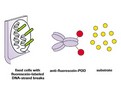
Apoptotic cells are fixed and permeabilized. Subsequently, the cells are incubated with the TUNEL reaction mixture that contains TdT and fluorescein-dUTP. During this incubation period, TdT catalyzes the addition of fluorescein-dUTP at free 3'-OH groups in single- and double-stranded DNA. After washing, the label incorporated at the damaged sites of the DNA is marked by an anti-fluorescein antibody conjugated with the reporter enzyme peroxidase. After washing to remove unbound enzyme conjugate, the POD retained in the immune complex is visualized by a substrate reaction.
Figure 1: Test principle.
Additional Information
Special Interest Sites
Product Literature
Product Articles
Instructions for Use and Material Safety Data Sheets
Associated Products
- ;
Non-liposomal low cytotoxic transfection reagent well-suited for cellular analysis in a wide range of commonly used cell lines. - ;
State-of-the-art high performance transfection reagent designed for most efficient delivery of DNA into a wide range of eukaryotic cells, including hard-to-transfect cells, across various applications.
Disclaimer
风险提示:丁香通仅作为第三方平台,为商家信息发布提供平台空间。用户咨询产品时请注意保护个人信息及财产安全,合理判断,谨慎选购商品,商家和用户对交易行为负责。对于医疗器械类产品,请先查证核实企业经营资质和医疗器械产品注册证情况。
- 作者
- 内容
- 询问日期
 文献和实验
文献和实验(In situ cell death detection kit-POD法)一、 原理:TUNEL(TdT-mediated dUTP nick end labeling)细胞凋亡检测试剂盒是用来检测组织细胞在凋亡早期过程中细胞核DNA的断裂情况。其原理是荧光素(fluorescein)标记的dUTP在脱氧核糖核苷酸末端转移酶(TdT Enzyme)的作用下,可以连接到凋亡细胞中断裂DNA的3’-OH末端,并与连接辣根过氧化酶(HRP,horse-radish peroxidase)的荧
Programmed Cell Death In Situ Detection Using Terminal deoxynucleotidyl Transfer(TdT)
Terminal deoxynucleotidyl Transferase-mediated dUTP nick end labeling (TUNEL) is an in situ method for detecting the 3'-OH ends of DNA exposed during the internucleosomal cleavage that occurs during apoptosis. Incorporation of biotinylated dUTP
Detection of apoptotic process in situ using immunocytochemical and TUNEL assays
information Moreover, as this procedure is quite complex, the use of commercial kits such as ApoTagTM (Oncor, Gaithersburg, MD, USA) and "In situ cell death detection Kit" (Boeringer-Mannheim, Germany), is recommended. Utilizing
 技术资料
技术资料暂无技术资料 索取技术资料

