

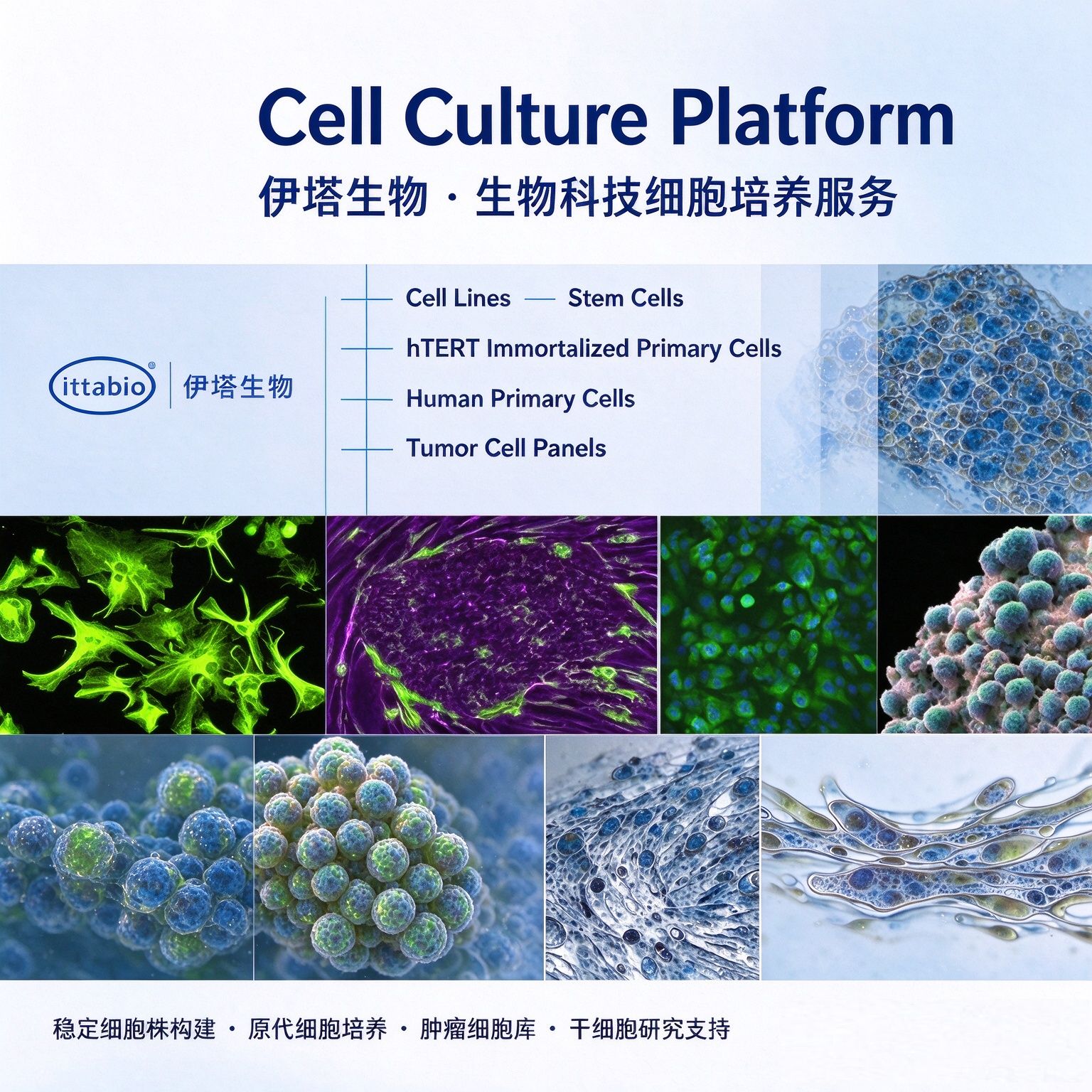
- ¥2400
- 伊塔生物
- 中国
- YT903490
- 2026年11月06日

企业认证
相关产品推荐更多 >
万千商家帮你免费找货
0 人在求购买到急需产品
相关阅读
AI 赋能培养基定制开发:CHO 培养基是如何实现产量提升Cytoscape 教程来了!快速实现顶刊同款通路网络图五大应用案例:Mustang Q 膜层析应用全解析1 个小工具,一次性搞定流程图、质粒图谱和信号通路图- 详细信息
- 文献和实验
- 技术资料
- 英文名:
UM-Chor1
- 库存:
10
- 供应商:
北京伊塔生物科技有限公司
- 肿瘤类型:
脊索瘤
- 细胞类型:
肿瘤细胞
- 品系:
UM-Chor1
- 组织来源:
mesangium
- 相关疾病:
脊索瘤
- 物种来源:
人
- 免疫类型:
不适用
- 细胞形态:
星形
- 是否是肿瘤细胞:
是
- 器官来源:
系膜
- 运输方式:
常温/冻存
- 年限:
长期
- 生长状态:
贴壁细胞
- 规格:
1×10⁶ cells / T25
英文名称:UM-Chor1 Human Mesangial Cells
规格:1×10^6 cells/管(冻存管,1mL/管);或1×10^6 cells/T25培养瓶(复苏后培养)
产品简介:UM-Chor1人系膜细胞属于人源系膜来源的正常细胞。该细胞在体外可稳定增殖,呈悬浮生长,形态为上皮样、多角形,广泛用于细胞生物学、毒理学评价及体外模型构建等研究方向。本品经STR图谱鉴定,与标准STR图谱一致,无交叉污染,可提供稳定可重复的实验结果。
基本信息:细胞名称:UM-Chor1人系膜细胞;种属:人;组织来源:系膜;细胞类型:系膜细胞;生长特性:悬浮;完全培养基:CD CHO无血清培养基(摇床悬浮培养);培养条件:37℃、5% CO2;传代比例:1:2-1:3;冻存条件:90% FBS + 10% DMSO;生物安全等级:BSL-2
产品优势:①STR图谱鉴定合格,与权威STR数据库一致,无HeLa等交叉污染;②代次低、活力高,复苏后存活率≥90%,贴壁/增殖状态稳定;③支原体、细菌、真菌检测均为阴性,无外源因子污染;④批次稳定,可长期重复供货,配套完整培养方案;⑤提供鉴定报告与批次质检记录,数据可追溯
产品售后:收到细胞后7天内,如出现污染、贴壁不良、存活率低或鉴定不符等问题,经核实可免费更换或补发;提供全程技术支持(培养基配制、复苏传代、冻存与实验设计建议);可应要求出具STR/种属鉴定报告、支原体检测报告及批次质检记录。
储存条件:液氮(-196℃)气相长期保存;-80℃冰箱仅可短期存放(不超过3个月);避免反复冻融,冻存管取出后于37-40℃水浴快速解冻并在2分钟内转移至完全培养基。
运输条件:冻存管采用干冰运输(全程维持-70℃以下);T25培养瓶采用常温运输(灌满完全培养基、密封防漏),收到后用75%酒精消毒表面,静置培养箱24小时后再观察处理。
物种来源:种属:人(Human);组织来源:系膜;经STR鉴定确认种属与组织来源
细胞形态:上皮样、多角形,贴壁生长,呈单层紧密排列
生长状态:悬浮生长(摇床培养),密度可达1×10^6 cells/mL以上
年限:液氮条件下长期保存,有效保存期5年;复苏后建议连续传代不超过10代(原代细胞建议3-5代内使用),代次过高可能引起表型漂移与增殖能力下降。
免疫类型:人源细胞,属异种移植背景;进行体内移植时需使用免疫缺陷小鼠(如BALB/c nude、NOD-SCID、NSG),体外培养不涉及免疫排斥;如用于免疫学实验应关注人源MHC与小鼠免疫系统的匹配性。
质量控制与检测:STR图谱鉴定与标准一致(≥20个位点);支原体检测阴性;细菌、真菌无菌检测阴性;细胞活力≥90%;内毒素检测合格
传代方法:无需胰酶消化,直接按1:2-1:3比例吸取细胞悬液接种于新鲜完全培养基;或1000rpm离心5分钟弃上清后重悬接种,每2-3天换液一次
培养条件:37℃、5% CO2、饱和湿度摇床培养,转速120-140rpm;每2-3天按1:3-1:5传代
培养基:CD CHO无血清培养基(摇床悬浮培养)
UM-Chor1 Human Mesangial Cells (human chordoma cells; STR authentication verified)
English Name: UM-Chor1 Human Mesangial Cells
Specifications: 1×10^6 cells/vial (cryovial, 1 mL/vial); or 1×10^6 cells/T25 flask (cultured after recovery)
UM-Chor1 Human Mesangial Cells is a normal cell line derived from human mesangium. These cells proliferate stably in vitro, showing growth in suspension, an epithelioid and polygonal morphology, and are widely used in research on cell biology, toxicological evaluation, and in vitro model construction. This product has passed STR profiling and matches the reference STR profile, with no cross-contamination, ensuring stable and reproducible experimental results.
Basic Information: Cell name: UM-Chor1 Human Mesangial Cells; Species: Human; Tissue source: Mesangium; Cell type: Mesangial cells; Growth characteristics: Suspension; Complete medium: CD CHO serum-free medium (shaker suspension culture); Culture conditions: 37°C, 5% CO2; Subculture ratio: 1:2–1:3; Cryopreservation: 90% FBS + 10% DMSO; Biosafety level: BSL-2
Product Advantages: ① STR profiling passed and consistent with the authoritative STR database, with no HeLa or other cross-contamination; ② Low passage number and high viability, with a post-thaw survival rate of ≥90% and stable adherence/proliferation; ③ Negative for mycoplasma, bacteria, and fungi, with no adventitious agent contamination; ④ Stable batches for long-term repeat supply, with a complete culture protocol; ⑤ Identification reports and batch quality inspection records available for traceability
After-Sales Service: Within 7 days of receiving the cells, if issues such as contamination, poor adherence, low viability, or failed authentication occur, free replacement or resupply will be provided after verification. Full technical support is available (medium preparation, recovery and subculture, cryopreservation, and experimental design advice), and STR/species identification reports, mycoplasma testing reports, and batch quality inspection records can be issued upon request.
Storage Conditions: Long-term storage in the gas phase of liquid nitrogen (-196°C); the -80°C freezer is suitable only for short-term storage (no more than 3 months). Avoid repeated freeze-thaw cycles; after removing the cryovial, thaw it rapidly in a 37-40°C water bath and transfer it to complete medium within 2 minutes.
Shipping Conditions: Cryovials are shipped on dry ice (maintained below -70°C throughout); T25 flasks are shipped at ambient temperature (filled with complete medium and sealed against leakage). Upon receipt, disinfect the surface with 75% ethanol and leave the cells in the incubator for 24 hours before observation and handling.
Species and Source: Species: Human; Tissue source: Mesangium; Species and tissue origin confirmed by STR profiling
Cell Morphology: Epithelioid and polygonal; adherent growth with a tightly packed monolayer arrangement
Growth Status: Suspension growth (shaker culture); density can exceed 1×10^6 cells/mL
Storage Life and Passage Limit: Long-term preservation under liquid nitrogen with a valid storage period of 5 years; after recovery, continuous passaging of no more than 10 passages is recommended (primary cells are recommended for use within 3-5 passages), as an excessively high passage number may cause phenotypic drift and reduced proliferative capacity.
Immunological Background: Human cells, with a xenotransplantation background; in vivo transplantation requires immunodeficient mice (e.g., BALB/c nude, NOD-SCID, NSG), while in vitro culture does not involve immune rejection; for immunological experiments, the compatibility between human MHC and the murine immune system should be considered.
Quality Control and Testing: STR profiling consistent with the reference standard (≥20 loci); mycoplasma testing negative; sterility testing negative for bacteria and fungi; cell viability ≥90%; endotoxin testing passed
Subculture Method: No trypsin digestion is required; directly transfer the cell suspension into fresh complete medium at a ratio of 1:2-1:3, or centrifuge at 1000 rpm for 5 minutes, discard the supernatant, resuspend, and inoculate; renew the medium every 2-3 days
Culture Conditions: Shaker culture at 37°C, 5% CO2, saturated humidity, 120-140 rpm; subculture every 2-3 days at a ratio of 1:3-1:5
Culture Medium: CD CHO serum-free medium (shaker suspension culture)
| FAQ(选取前2个问题) | 问:多久可以传代 | 答:一般情况下70%–80%可以传代 |
| 问:如何发货 | 答:复苏好的T25瓶发货 ,冻存的干冰发货 |
风险提示:丁香通仅作为第三方平台,为商家信息发布提供平台空间。用户咨询产品时请注意保护个人信息及财产安全,合理判断,谨慎选购商品,商家和用户对交易行为负责。对于医疗器械类产品,请先查证核实企业经营资质和医疗器械产品注册证情况。
 文献和实验
据统计约 30% 细胞系被交叉污染或错误辨识,因使用了交叉污染或错误辨识的细胞而导致研究结论错误、结果不可重复、临床细胞治疗灾难性后果……,这浪费大量时间、精力和金钱。Everything was going along fine until they discovered their HeLa cell line expressed Y chromosome markers因此近年 NIH、ATCC、Nature 和 Science 等对此多次发出呼吁,要求研究者对细胞进行鉴定。STR 基因
1. CHO-K1 细胞CHO-K1 细胞是实验中非常常用的一个细胞株,在生物制药中使用也非常广泛。该细胞株培养条件简单,贴壁强度适中,比较容易转染,很适合用它来研究一般哺乳动物基因的功能。来源:Cricetulus griseus (中国仓鼠) 卵巢形态:表皮细胞生长特性:贴壁注释:CHO-K1 由 CHO 衍生而来,CHO 是 T. T. Puck 在 1957 年从一只成年中国仓鼠卵巢获得的。培养液:Ham's F12K(含 2 mM L - 谷氨酰胺,1.5 g/L NaHCO
RAW 264.7细胞攻略 | 巨噬细胞研究的"标准工具",从培养到实验的避坑指南
鼠科白血病病毒诱导的肿瘤;单核细胞;巨噬细胞 细胞类型:肿瘤细胞 肿瘤类型:白血病细胞 生物安全等级:BSL-2 抗原/受体表达:H-2d; complement (C3) 基因表达:lysozyme, H-2d; 鼠痘病毒(ectromelia virus)检测阴性 保藏机构:ATCC(TIB-71); ECACC(91062702) STR鉴定是确保细胞身份的关键。该细胞系经STR鉴定正确,为实验数据的可重复性提供了坚实基础。其生长特性为贴壁生长,细胞形态呈不规则形
 技术资料
暂无技术资料 索取技术资料