

- 询价
- Epigentek
- P-3100
- 美国
- 2025年11月17日

企业认证
相关产品推荐更多 >
![Mouse anti-CD68 Recombinant Monoclonal Antibody, Purified [KP-1]-小鼠抗 CD68 重组单克隆抗体,纯化[KP-1]](https://img1.dxycdn.com/p/s14/2026/0417/210/0886018356837005402.jpg!wh200)
Mouse anti-CD68 Recombinant Monoclonal Antibody, Purified [KP-1]-小鼠抗 CD68 重组单克隆抗体,纯化[KP-1]
¥55
Goat anti-Human Ferritin Antibody, IgG Fraction-山羊抗人铁蛋白抗体,IgG 分数
¥55
Goat anti-Chicken IgG (IgY) Heavy and Light Chain Cross-Adsorbed Antibody Cy5® Conjugated-山羊抗鸡 IgG(IgY)重链和轻链交叉吸附抗体 Cy5®偶联抗体
¥55Rabbit anti-Human ApoCI [A09] Antibody, Affinity Purified-兔子反人类 ApoCI [A09]抗体,亲和纯化
¥55Rabbit anti-MERIT40 Antibody, Affinity Purified-兔子抗 MERIT40 抗体,亲和力纯化
¥55
万千商家帮你免费找货
0 人在求购买到急需产品
相关阅读
细胞污染识别与处理全攻略:5 种常见类型+关键误区Cytoscape 教程来了!快速实现顶刊同款通路网络图五大应用案例:Mustang Q 膜层析应用全解析1 个小工具,一次性搞定流程图、质粒图谱和信号通路图- 详细信息
- 文献和实验
- 技术资料
- 供应商:
艾美捷
- 库存:
5
- 样本:
Amount Quantitation
- 适应物种:
6 months
- 应用:
Histone Methylation
- 检测方法:
96-Well Plate
- 规格:
96 Reactions
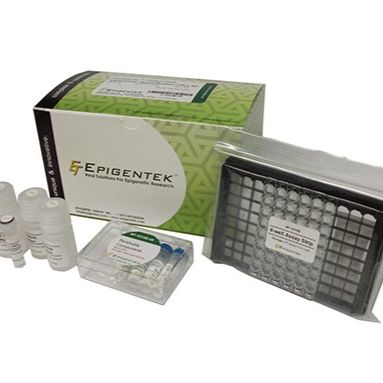
The EpiQuik™ Histone H3 Modification Multiplex Assay Kit (Colorimetric) is a complete set of optimized reagents to detect and quantify up to twenty-one (21) modified histone H3 patterns simultaneously in a simple, ELISA-like format with use of a standard microplate reader. The kit has the following advantages and features:
- Simultaneously screen and measure 21 different histone H3 modifications, which includes all of the most important and the most well-characterized patterns.
- Quick and efficient procedure, which can be finished within 2 hours and 30 minutes.
- Innovative colorimetric assay without the need for radioactivity, electrophoresis, chromatography, or expensive equipment.
- High sensitivity with a detection threshold as low as 0.5 ng/well for each modification pattern and a detection range from 20 ng to 500 ng/well of histone extracts.
- An assay control is conveniently included for quantification of each histone H3 modification.
- Total histone H3 sets are included, which can be used for normalizing total histone H3 levels for relative comparison of histone H3 content between different samples or different treatment conditions.
- Strip microplate format makes the assay flexible: manual or high throughput, which enables analysis of a single modification or total 21 modification patterns within the same samples.
- Two extra 8-well strips are included in the kit which can be used, if necessary, for sample amount pre-optimization to determine the input amount (ex: 50, 100, 200 ng/well) needed to fall within the detection limits of the assay. Extra strips may also be used as assay controls and total histone level controls if selective detection of some histone H3 modifications from the total 21 modification pattern is desired.
- Simple, reliable, and consistent assay conditions.
Background Information
Histone modifications have been defined as epigenetic modifiers. Post-translational modifications (PTMs) of histones include the acetylation of specific lysine residues by histone acetyltransferases (HATs), deacetylation by histone deacetylase (HDACs), the methylation of lysine and arginine residues by histone methytransferases (HMTs), the demethylation of lysine residues by histone demethylases (HDMTs), and the phosphorylation of specific serine groups by histone kinases (HKs). Additional histone modifications include the attachment of ubiquitin (Ub), small ubiquitin-like modifiers (SUMOs), and poly ADP-ribose (PAR) units. Next to DNA methylation, histone acetylation and histone methylation are the most well characterized epigenetic marks. Generally, tri-methylation at H3-K4, H3-K36, or H3-K79 results in an open chromatin configuration and is therefore characteristic of euchromatin. Euchromatin is also characterized by a high level of histone acetylation, which is mediated by histone acetyltransferases. Lysine residues can be mono-, di-, or tri-methylated, each of which can differentially regulate chromatin structure and transcription. Along with other histone modifications such as phosphorylation, this enormous variation leads to a multiplicity of possible combinations of different modifications. This may constitute a “histone code”, which can be read and interpreted by different cellular factors.
Principle & Procedure
In an assay with this kit, each histone H3 modified at specific sites will be captured by an antibody that is coated on the strip wells and specifically targets the appropriate histone modification pattern. The captured histone modified at specific sites will be detected with a detection antibody, followed by a color development reagent. The ratio of modified histone is proportional to the intensity of absorbance measured by a microplate reader at a wavelength of 450 nm.
Starting Materials
Input materials can be histone extracts or purified histone H3 proteins. The amount of histone extracts for each assay can be 20 ng to 500 ng with an optimal range of 50 ng to 100 ng depending on the purity of histone extracts. The amount of purified histone H3 proteins for each assay can be 1 ng to 25 ng with an optimal range of 4 ng to 5 ng.
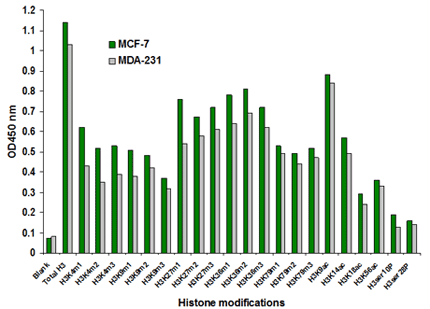
 Fig. 3. Histone extracts were prepared from MCF-7 and MDA-231 cells using the EpiQuik™ Total Histone Extraction Kit (Cat. No. OP-0006) and multiple histone H3 modifications were screened and measured using the EpiQuik™ Histone H3 Modification Multiplex Assay Kit (Colorimetric). 100 ng of total histone proteins were used.
风险提示:丁香通仅作为第三方平台,为商家信息发布提供平台空间。用户咨询产品时请注意保护个人信息及财产安全,合理判断,谨慎选购商品,商家和用户对交易行为负责。对于医疗器械类产品,请先查证核实企业经营资质和医疗器械产品注册证情况。
 文献和实验
文献和实验upon the dual pulldown to incorporate a third pulldown which is an iteration of the ChIP and is a pulldown for H3K27me3+ (Figure 1b). The third assay described here is the biotin-RNA pulldown of a low-copy RNA that spans the siRNA targeted promoter region
," made up of fragments of up to seven nucleosomes in length, is incubated with an antiserum directed against the histone modification of interest. The antibody-bound fraction is separated from the unbound fraction and, after extraction of genomic DNA from the bound
HDAC(Histone Deacetylase)组蛋白去乙酰化酶活性测定及药物筛选方案
去乙酰化酶活性比色分析试剂盒 -HDAC Colorimetric Assay Kit Biovision K331-100 100次分析 详情 HDAC组蛋白去乙酰化酶抑制剂药物筛选试剂盒 -HDAC Inhibitor Drug Screening Kit Biovision K340-100 100次分析 详情 其中,艾美
 技术资料
技术资料暂无技术资料 索取技术资料

