

- ¥1600
- Sciencell
- A-5301
- 美国
- 2026年05月21日

企业认证
相关产品推荐更多 >
万千商家帮你免费找货
0 人在求购买到急需产品
相关阅读
细胞污染识别与处理全攻略:5 种常见类型+关键误区Cytoscape 教程来了!快速实现顶刊同款通路网络图五大应用案例:Mustang Q 膜层析应用全解析1 个小工具,一次性搞定流程图、质粒图谱和信号通路图- 详细信息
- 文献和实验
- 技术资料
- 库存:
100
- 供应商:
上海酶研生物科技有限公司
- 英文名:
SteCM (Stellate Cell Medium)
- 规格:
500ml/T
|
货号 |
5301 |
|
产地 |
美国 |
|
缩写 |
SteCM |
|
规格 |
500ml |
|
用途 |
科研 |
|
储存 |
4度,-20度 |
|
运输 |
胶冰 |
星状细胞培养基是为正常人类肝脏星状细胞体外培养设计的适于其生长的培养基。经灭菌的液体培养基,包含必需和非必需氨基酸、维生素、有机和无机化合物、激素、生长因子、微量矿物质和低浓度胎牛血清(2%)。该培养基缓冲体系为重碳酸盐,在含5%CO2的细胞培养箱中平衡后pH值为7.4。该培养基的配方能够选择性的促进正常人类星形细胞体外培养中的增殖和生长,并为其达到理想营养平衡状态提供数量上和质量上的保证。
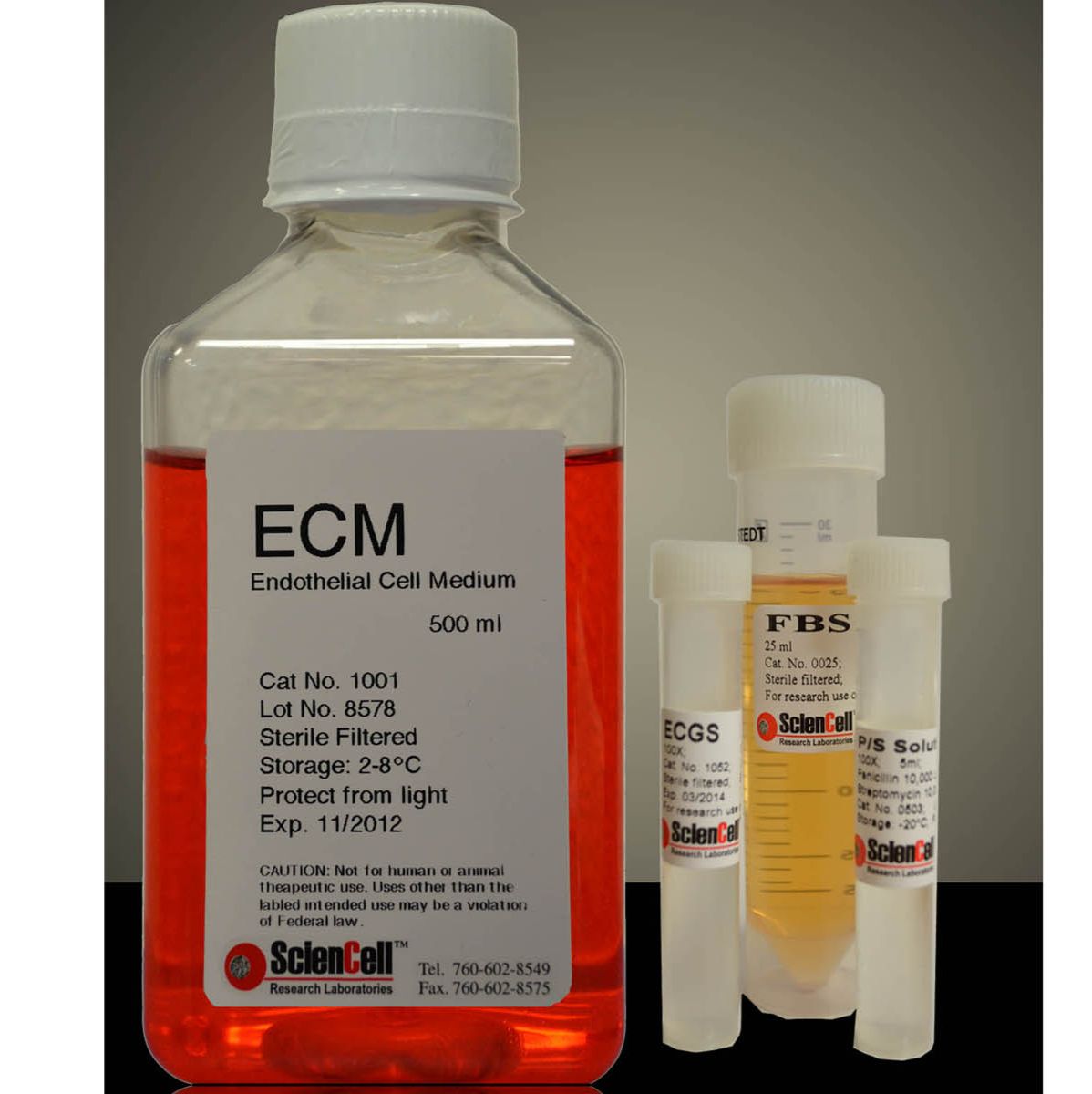
星状细胞培养基包含500 ml基础培养基,10ml胎牛血清(FBS,目录编号0010),5ml星状细胞生长添加物(SteCGS,目录编号5352)和5 ml青霉素/链霉素溶液(P/S,目录编号0503)
1. Sasaki, R., Kanda, T., Nakamura, M., Nakamoto, S., Haga, Y., Wu, S., Shirasawa, H. & Yokosuka, O. (2016) Possible Involvement of Hepatitis B Virus Infection of Hepatocytes in the Attenuation of Apoptosis in Hepatic Stellate Cells PLoS One. 11
Background The induction of apoptosis in hepatic stellate cells (HSCs) is a promising therapeutic strategy against hepatitis B virus (HBV)-related hepatic fibrosis. The underlying mechanisms of apoptosis in HSCs, however, are unknown under consideration of HBV infection. In this study, the effects of HBV on apoptosis and endoplasmic reticulum (ER) stress signaling in HSCs were examined. Methods The effects of conditioned media (CM) from HepG2.2.15 on apoptosis induced by the proteasome inhibitor MG132 in LX-2 and HHSteC were studied in regard to c-Jun. In combination with c-Fos, c-Jun forms the AP-1 early response transcription factor, leading to AP-1 activation, signal transduction, endoplasmic reticulum (ER) stress and apoptosis. Results In LX-2 cells, MG132 treatment was associated with the phosphorylation of c-Jun, activation of AP-1 and apoptosis. However, in the presence of CM from HepG2.2.15, these phenomena were attenuated. In HHSteC cells, similar results were observed. HBV genomic DNA is not involved in the process of HSC apoptosis. It is possible that HBeAg has an inhibitory effect on MG132-induced apoptosis in LX-2. We also observed the upregulation of several ER stress-associated genes, such as cAMP responsive element binding protein 3-like 3, inhibin-beta A and solute carrier family 17-member 2, in the presence of CM from HepG2.2.15, or CM from PXB cells infected with HBV. Conclusions HBV inhibits the activation of c-Jun/AP-1 in HSCs, contributing to the attenuation of apoptosis and resulting in hepatic fibrosis. HBV also up-regulated several ER stress genes associated with cell growth and fibrosis. These mechanistic insights might shed new light on a treatment strategy for HBV-associated hepatic fibrosis. Less
2. Kramer, B., Finnemann, C., Sastre, B., Lutz, P., Gl?ssner, A., Wolter, F., Goeser, F., Kokordelis, P., Kaczmarek, D., Nischalke, H.D., Strassburg, C.P., Spengler, U. & Nattermann, J.(2016) 'IL28B Genetic Variants Determine the Extent of MonocyteInduced Activation of NK Cells in Hepatitis C' PLoS One. VOL 11
3. Jakubowska, M.A., Ferdek, P.E., Gerasimenko, O.V., Gerasimenko, J.V. & Petersen, O.H.(2016) 'Nitric oxide signals are interlinked with calcium signals in normal pancreatic stellate cells upon oxidative stress and inflammation' Open Biology. VOL 6
The mammalian diffuse stellate cell system comprises retinoid-storing cells capable of remarkable transformations from a quiescent to an activated myofibroblast-like phenotype. Activated pancreatic stellate cells (PSCs) attract attention owing to the pivotal role they play in development of tissue fibrosis in chronic pancreatitis and pancreatic cancer. However, little is known about the actual role of PSCs in the normal pancreas. These enigmatic cells have recently been shown to respond to physiological stimuli in a manner that is markedly different from their neighbouring pancreatic acinar cells (PACs). Here, we demonstrate the capacity of PSCs to generate nitric oxide (NO), a free radical messenger mediating, for example, inflammation and vasodilatation. We show that production of cytosolic NO in PSCs is unambiguously related to cytosolic Ca2+ signals. Only stimuli that evoke Ca2+ signals in the PSCs elicit consequent NO generation. We provide fresh evidence for the striking difference between signalling pathways in PSCs and adjacent PACs, because PSCs, in contrast to PACs, generate substantial Ca2+-mediated and NOS-dependent NO signals. We also show that inhibition of NO generation protects both PSCs and PACs from necrosis. Our results highlight the interplay between Ca2+ and NO signalling pathways in cell–cell communication, and also identify a potential therapeutic target for anti-inflammatory therapies. Less
风险提示:丁香通仅作为第三方平台,为商家信息发布提供平台空间。用户咨询产品时请注意保护个人信息及财产安全,合理判断,谨慎选购商品,商家和用户对交易行为负责。对于医疗器械类产品,请先查证核实企业经营资质和医疗器械产品注册证情况。
 文献和实验
文献和实验
1.) Wagner I,?Materne EM,?Brincker S,?S??bier U,?Fr?drich C,?Busek M,?Sonntag F,?Sakharov DA,?Trushkin EV,?Tonevitsky AG,?Lauster R,?Marx U. (2013) "A dynamic multi-organ-chip for long-term cultivation and substance testing proven by 3D human liver and skin tissue co-culture." Lab Chip. doi: 10.1039/c3lc50234a
正常小鼠原代脑星形胶质细胞培养 一、实验试剂1、培养基: PriCells Medium + 10% FBS + 1% P/S + PriCells Supplement2、冻存液: PriCells Medium + 20% FBS + 10% DMSO3、洗涤液: 1 × PBS (pH 7.4 )+ 1% P/S4、染色液: 0.4% Trypan Blue5、消化液: PriCells Isolation of Primary Cell Kit6、检测试剂:抗小鼠CD 11b/c抗体
后,转移细胞悬液至新瓶中,加入DMEM/F12完全培养基,在37ºC, 5%CO2培养箱中培养9天(每3天更换培养液一次),第9天将培养瓶置于恒温旋转摇床上37ºC, 240rpm,摇18小时,去掉悬浮的细胞,用D-Hanks液清洗3次,进行传代培养即得纯化的星形胶质细胞。经免疫细胞化学法检测,98%以上的细胞GFAP免疫反应为阳性。
文献 通用共识:hSyn(人突触蛋白 I 启动子)为神经元特异,CaMKIIα 为兴奋性神经元相关,GFAP 为星形胶质细胞特异,CAG 为 CMV 增强子 + 鸡 β-actin 杂合广谱启动子。 吉凯基因技术资料:CMV 启动子在干细胞、原代神经元、T 细胞等易表观沉默,体内项目优先 CAG 等更稳的广谱启动子。 Atchison R.W. 等(1965)发现 AAV;组织/细胞特异启动子的应用见大量神经科学 AAV 文献(具体篇目以官方为准)。 ---
 技术资料
技术资料暂无技术资料 索取技术资料

