

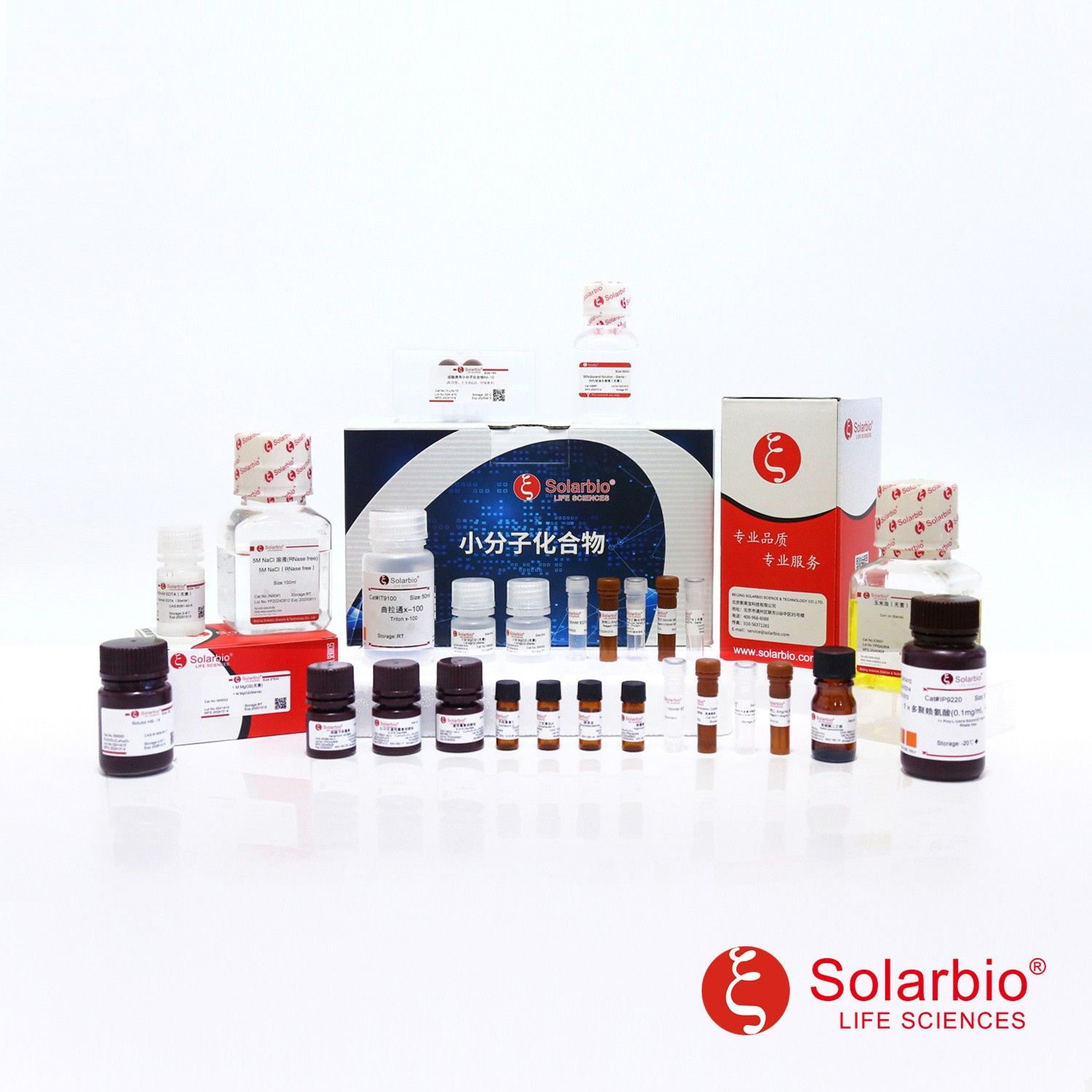
- ¥380
- Solarbio

- 北京
- IC06101
- 2025年07月23日

企业认证
相关产品推荐更多 >
万千商家帮你免费找货
0 人在求购买到急需产品
- 详细信息
- 文献和实验
- 技术资料
- 保存条件:
Stroe at -20℃,6 months.
- 保质期:
Stroe at -20℃,6 months.
- 英文名:
Curcumin(10mM in DMSO,Sterile)
- 库存:
现询
- 供应商:
北京索莱宝科技有限公司
- CAS号:
458-37-7
- 规格:
1ml
| 基本信息 | |
| CAS | No.458-37-7 |
| 中文名称 | 姜黄素(10mM in DMSO,无菌) |
| 英文名称 | Curcumin(10mM in DMSO,Sterile) |
| 分子式 | C21H20O6 |
| 分子量 | 368.38 |
| 溶解性 | 请根据自己的实验要求使用。 |
| 外观(性状) | 无菌溶液 |
| 储存条件 | Stroe at -20℃,6 months. |
| 靶点 | P300/CREB;HAT;Keap1-Nrf2 |
| 通路 | Epigenetics;NF-κB |
| 背景说明 | Curcumin是乙酰转移酶 p300/CREB 结合蛋白特异性抑制剂,抑制组蛋白/非组蛋白的乙酰化和组蛋白乙酰转移酶依赖的染色质转录。Curcumin 对 NF-κb 和 MAPKs 有抑制作用,并具有抗炎、抗氧化、抗血管生成等多种生理活性。 |
| 生物活性 | Curcumin (Diferuloylmethane), a natural phenolic compound, is a p300/CREB-binding protein-specific inhibitor of acetyltransferase, represses the acetylation of histone/nonhistone proteins and histone acetyltransferase-dependent chromatin transcription. Curcumin shows inhibitory effects on NF-κB and MAPKs, and has diverse pharmacologic effects including anti-inflammatory, antioxidant, antiproliferative and antiangiogenic activities. Curcumin induces stabilization of Nrf2 protein through Keap1 cysteine modification.[1-8] |
| In Vitro | Curcumin exerts its chemopreventive effects partly through the activation of nuclear factor (erythroid-2 related) factor 2 (Nrf2) and its antioxidant and phase II detoxifying enzymes[1]. Curcumin inhibits T47D cells growth, with IC50s of 25, 19 and 17.5 μM for 24, 48 and 72 h MTT assays respectively. IC50s of curcumin and silibinin mixture against T47D cells, are 17.5, 15, and 12 μM for 24, 48, and 72 h exposure times, respectively[2]. Curcumin (2.5-80 μM) induces apoptotic cell death in AGS and HT-29 cell lines, and the IC50 is 21.9±0.1, 40.7±0.5 μM, respectively, in both AGS and HT-29 cell lines. Curcumin-induced apoptosis requires caspase activities in AGS and HT-29 cells. Curcumin induces ER Ca2+ decline and mitochondrial Ca2+ overloading[3]. Curcumin induces the G2/M cell cycle arrest of LNCaP and PC-3 cells in a dose dependent manner. Curcumin upregulates the protein level of NF-kappaB inhibitor IkappaBalpha and downregulates protein levels of c-Jun and AR[5]. |
| 细胞实验 | Curcumin (10 mg/kg, p.o.) significantly prevents decrease in the percentage of sucrose consumption, as compared to the CMS-exposed rats. Curcumin treatment results in significant prevention of increase in TNF-α and IL-6 levels in stressed rats[4]. Curcumin decreases binding of p300/CREB-binding protein (CBP) at the brain-derived neurotrophic factor (BDNF) promoter at 20 mg/kg (i.p.), reduces binding of P300/CBP at the BDNF promoter at 40 mg/kg, and decreases binding all the four proteins of p300/CBP and H3K9ac/H4K5ac at the BDNF promoter at 60 mg/kg in chronic constriction injury (CCI) rats[6]. |
| 细胞实验 | T47D breast cancer cell line is grown in RPMI 1640 supplemented with 10% FBS, 2 mg/mL sodium bicarbonate, 0.05 mg/mL penicillin G, 0.08 mg/mL streptomycin. Culture is maintained on plastic flask and incubated at 37°C in 5% CO2. After growing sufficient amount of cells, cytotoxic effect of silibinin and curcumin is studied by 24, 48 and 72 h MTT assays in which 1000 cell/well are cultivated in a 96 well plate. After 24 h incubation in 37°C with humidified atmosphere containing 5% CO2, the cells are treated with serial concentrations of curcumin (5, 10, 20, 30, 40, 50, 60, 80, 100 μM), silibinin (20, 40, 60, 80, 100, 120, 140, 180, 200 μM), and curcumin-silibinin mixture (each of them 5, 10, 20, 30, 40, 50, 60, 80, 100 μM) for 24, 48 and 72 h in the quadruplicate manner, in addition to cells with 200 μL culture medium containing 10% DMSO for control. After incubation, the medium of all wells of the plate are exchanged with fresh medium and the cells are leaved for 24 h in incubator. Then, medium of all wells are removed carefully and 50 μL of 2 mg/mL MTT dissolved in PBS is added to each wells and the plate is covered with aluminum foil and incubated for 4.5 h again. After removing content of the wells, 200 μL pure DMSO is added to the wells. Then, 25 μL Sorensen’s glycine buffer is added and immediately absorbance of each wells is read in 570 nm using EL×800 Microplate Absorbance Reader with reference wavelength of 630 nm.[2] |
| 动物实验 | Curcumin (10?mg/kg), freshly suspended in saline, is administrated by oral gavage once a day for 3?weeks. Forty rats are randomLy assigned to 4 groups (n=10/each group): group I receives saline and serves as control, group II receives curcumin, group III is exposed to CMS andreceive saline and group IV are subjected to CMS andreceive curcumin.[4] |
| 数据来源文献 | [1]. Gao S, et al. Curcumin attenuates arsenic-induced hepatic injuries and oxidative stress in experimental mice through activation of Nrf2 pathway, promotion of arsenic methylation and urinary excretion. Food Chem Toxicol. 2013 Jul 18. pii: S0278-6915(13)004 [2]. Nasiri M, et al. Curcumin and Silibinin Inhibit Telomerase Expression in T47D Human Breast Cancer Cells. Asian Pac J Cancer Prev. 2013;14(6):3449-53. [3]. Cao A, et all. Curcumin induces apoptosis in human gastric carcinoma AGS cells and colon carcinoma HT-29 cells through mitochondrial dysfunction and endoplasmic reticulum stress. Apoptosis. 2013 Jul 24. [Epub ahead of print] [4]. Jiang H, et al. Antidepressant-like effects of curcumin in chronic mild stress of rats: Involvement of its anti-inflammatory action. Prog Neuropsychopharmacol Biol Psychiatry. 2013 Jul 20. pii: S0278-5846(13)00150-4. [5]. Guo H, et al. Curcumin induces cell cycle arrest and apoptosis of prostate cancer cells by regulating the expression of IkappaBalpha, c-Jun and androgen receptor. Pharmazie. 2013 Jun;68(6):431-4. [6]. Zhu X, et al. Curcumin alleviates neuropathic pain by inhibiting p300/CBP histone acetyltransferase activity-regulated expression of BDNF and cox-2 in a rat model. PLoS One. 2014 Mar 6;9(3):e91303. [7]. Balasubramanyam K, et al. Curcumin, a novel p300/CREB-binding protein-specific inhibitor of acetyltransferase, represses the acetylation of histone/nonhistone proteins and histone acetyltransferase-dependent chromatin transcription. J Biol Chem. 2004 Dec 3;279(49):51163-71. [8]. Jun Wan Shin, et al. Curcumin induces stabilization of Nrf2 protein through Keap1 cysteine modification. Biochem Pharmacol. 2020 Mar;173:113820. |
| 单位 | 瓶 |
风险提示:丁香通仅作为第三方平台,为商家信息发布提供平台空间。用户咨询产品时请注意保护个人信息及财产安全,合理判断,谨慎选购商品,商家和用户对交易行为负责。对于医疗器械类产品,请先查证核实企业经营资质和医疗器械产品注册证情况。
 文献和实验
文献和实验表观遗传失调通常与人类疾病,特别是与癌症有关,而各种针对表观遗传调节剂的药物也在如火如荼的开发。组蛋白修饰包括乙酰化,甲基化,泛素化,磷酸化,磺酰化,核糖基化等,其中组蛋白乙酰化修饰始终占据着核心地位。组蛋白乙酰化存在三步调控体系:组蛋白乙酰转移酶(HATs)作为 “写入器”,向组蛋白赖氨酸残基添加乙酰基团;组蛋白去乙酰化酶(HDACs)充当 “擦除器”,去除乙酰修饰以逆转该过程;溴结构域(Bromodomains)等蛋白模块则作为 “读取器”,特异性结合乙酰化位点,介导染色质状态与基因
花香蝶自来|Solarbio小分子化合物“优秀员工展”第二十五期
不少产品被用户频繁的订购,并发表了不错的文章,也常有用户循着文献的痕迹找到Solarbio的产品进行采购使用。此后的“优秀员工展”会继续分享我们的畅销产品、明星产品,欢迎大家关注订阅~ 优秀“员工”展 结晶紫 CAT IC0600 CAS 548-62-9 溶解度 Soluble in Water/DMSO 溶解度 Soluble in DMSO≥5mg/mL; Soluble in Ethanol/Water<1mg/mL 生物
体,通常为10mm的茎段和直径10mm的叶片部分(太大激素作用减弱,太小则不易成活)。 消毒注意事项:1、表面消毒剂对植物组织是有害的,应正确选择消毒剂的浓度和处理时间,以减少组织的死亡。2、在表面消毒后,必须用无菌水漂洗材料3次以上以除去残留杀菌剂,但若用酒精消毒,则不必漂洗。3、与消毒剂接触过的切面在转移到无菌基质前需将其切除,因为消毒剂会阻碍植物细胞对基质中营养物质的吸收。4、若外植体污染严重则应先用流水漂洗1小时以上或先种子培养得到无菌种苗,然后用其各个部分建立组织培养。5、HgCl2效果
 技术资料
技术资料暂无技术资料 索取技术资料

