

- ¥3550
- BD
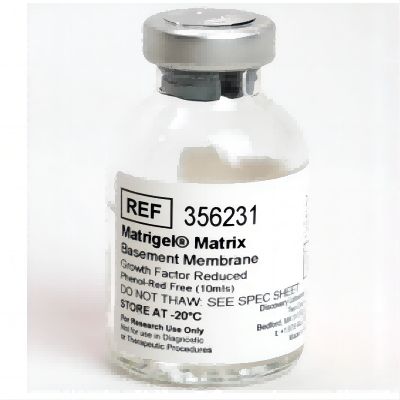
- 356231
- 2026年09月01日

企业认证
相关产品推荐更多 >


万千商家帮你免费找货
0 人在求购买到急需产品
相关阅读
源叶生物 十万种现货试剂速发,品质稳、品类全,实验不再等!Takara 秋促来袭,提取+反转录+定量套装仅 1200 元abinScience 体内级抗体 全年锁价 低至 ¥1200阿拉丁 22万+ 科研级产品现货速发,品质严控、科研无忧- 详细信息
- 询价记录
- 文献和实验
- 技术资料
- 库存:
100
- 供应商:
苏州瑞诺德生物科技有限公司
- 保存条件:
-20°
- 规格:
10ml
康宁Matrigel基质是分离自Engelbreth-Holm-Swarm (EHS) 小鼠肉瘤的可溶性基底膜提取物,该肿瘤富含细胞外基质蛋白,包括层粘连蛋白 (主要成分)、IV型胶原、硫酸乙酰肝素蛋白聚糖、巢蛋白和多种生长因子。
质量
- 通过小鼠抗体产物 (MAP) 检测进行常规小鼠菌落病原体筛选
- 通过广泛的PCR检测对多种病原体进行筛选
- 细菌、真菌和支原体检测均为阴性
- 通过Lowry方法测定蛋白浓度
- 通过鲎阿米巴样细胞溶解物试验测定内毒素水平
- 在37℃下进行14天Matrigel基质凝胶稳定性测试
- 利用神经轴突生长试验测定各批次的生物活性。
来源 Engelbreth-Holm-Swarm小鼠肿瘤
制备和储存 置于-20℃下保存。避免反复冻融。切勿储存于无霜冰箱内。冷冻保存。
应用
- 细胞生长和分化
- 代谢/毒理学研究
- 侵袭实验
- 体外和体内血管生成实验
- 体内血管生成研究和促进免疫抑制小鼠肿瘤形成
仅适用于加利福尼亚州的客户:警告:请参阅安全技术说明书 (SDS) 第15部分或相应豁免函,了解有关加州第65号法案的更多信息。
| 产品编号 | 356231 |
| 数量/包 | 1 /包 |
| 数量/箱 | 1 /箱 |
| 品牌 | Corning® |
| 尺寸 | 10 mL |
| 来源 | 层粘连蛋白:Engelbreth-Holm-Swarm (EHS) 小鼠肿瘤 |
风险提示:丁香通仅作为第三方平台,为商家信息发布提供平台空间。用户咨询产品时请注意保护个人信息及财产安全,合理判断,谨慎选购商品,商家和用户对交易行为负责。对于医疗器械类产品,请先查证核实企业经营资质和医疗器械产品注册证情况。
 询价记录
询价记录 暂无询价记录
 文献和实验
文献和实验Corning® Matrigel® Basement Membrane
Matrix for 3D Culture In Vitro
Protocol
Corning® Matrigel® basement membrane matrix is a soluble basement membrane extract of the
Engelbreth-Holm-Swarm (EHS) mouse tumor that gels at room temperature to form a genuine
reconstituted basement membrane. The major components of Corning Matrigel matrix are laminin
(~60%), collagen IV (~30%), entactin (~8%) and heparan sulfate proteoglycan. Growth factors,
collagenases, plasminogen activators, and other undefined components have also been reported
in Corning Matrigel matrix.
◗ ◗ ◗ ◗ ◗ ◗ ◗ ◗ ◗ ◗ ◗ ◗ ◗ ◗ Reagents and Materials
MDCK cell line (ATCC CCL-34, Canis familiaris kidney cell line, derived from normal tissue)
Corning Matrigel matrix (Corning Cat. No. 356234)
MEM (Corning Cat. No. 10-009-CV)
FBS (Corning Cat. No. 35-015-CV)
PBS (Corning Cat. No. 21-040-CV)
0.25% Trypsin/EDTA (Corning Cat. No. 25-053-Cl)
24-well plate (Corning Cat. No. 3524)
Protocol 1. On-top MDCK 3D culture
1. Thaw Matrigel matrix overnight by submerging the vial in a 4°C refrigerator before use. Once Matrigel
matrix is thawed, swirl vial to ensure the material is dispersed.
2. Add 200 μL of Matrigel matrix (8 to 11 mg/mL) into each well of a pre-chilled 24-well plate, spread
evenly with a pipet tip, and then incubate at 37°C for 30 min. to allow the Matrigel matrix to gel.
Note: All cultureware or media coming in contact with Matrigel matrix should be pre-chilled/ice-cold.
Keep Matrigel matrix on ice during the entire process and do not overdry the Matrigel matrix during
the gel process.
3. 4. Wash the MDCK cells once with PBS. Trypsinize the cells to make a single-cell suspension, and then
pellet the cells through centrifugation at 125 x g for 5 min. at room temperature (RT).
Note: Use cells that are healthy and not more than 85% confluent. MDCK cells tend to form cell
clumps; therefore, it is often necessary to pipet them vigorously to obtain a single cell suspension.
Re-suspend the cells with MDCK complete medium (MEM + 10% FBS) to adjust the final cell density to
3 x 10⁵ cells/mL, plate 250 μL prepared cell suspension into each well of the pre-coated 24-well plate,
and then incubate at 37°C for 30 min.
5. Note: The number of cells may need optimization depending on the growth properties of the cell line.
Chill the MDCK complete medium on ice and add Matrigel matrix to 10% of the final volume (final
concentration: 0.8 to 1.1 mg/mL). Gently add 250 μL of Matrigel matrix medium mixture to the plated
culture.
6. 7. Note: Medium must be thoroughly chilled before the addition of Matrigel matrix to ensure
homogenous mixing and even deposition of Matrigel matrix onto cells in culture. Pipet the Matrigel
matrix medium mixture down the side of the well to avoid disturbance of the cells or Matrigel Matrix.
Continuously culture for 4 to 7 days and change Matrigel matrix medium mixture every 2 days.
Immunostaining of 3D cultures and observing cell morphology with confocal microscopy
is recommended.Protocol 2. Embedded MDCK 3D culture
1. 2. 3. 4. 5. 6. 7. 8. Thaw Corning® Matrigel® basement membrane matrix overnight by submerging the vial in ice in a 4°C
refrigerator before use. Once Matrigel matrix is thawed, swirl vial to ensure the material is dispersed.
On Day 0, dilute the Matrigel matrix to 5 mg/mL with ice-cold MDCK complete cell culture medium
(MEM + 10% FBS).
Note: Keep all cultureware and reagents coming in contact with Matrigel matrix on ice during the
entire operation process.
Using pre-chilled tips, coat the pre-chilled 24-well plate by adding 100 μL of Matrigel matrix (5 mg/mL)
into each well, spread evenly with a pipet tip, and incubate at 37°C for 30 min. to form gel.
Note: Do not overdry the Matrigel matrix during the gel process.
Trypsinize the MDCK cells from a monolayer to make a single-cell suspension, and then pellet the cells
through centrifugation at 125 x g for 5 min. at room temperature (RT).
Note: Use cells that are healthy and not more than 85% confluent. MDCK cells tend to form cell
clumps; therefore, it is often necessary to pipet them vigorously to obtain a single cell suspension.
Re-suspend the cells with MDCK complete medium and adjust the cell density to 5 × 10⁶ cells/mL. Add
30 μL prepared cell suspension to 270 μL Matrigel matrix solution (5 mg/mL) which is kept on ice for a
final cell density is 5 x 10⁵ cells/mL. Incubate the plate at 37°C for 30 to 45 min.
Note: The volume of the cells should not be over 10% of the Matrigel solution to ensure the diluted
Matrigel solution can polymerize properly into a matrix. The number of cells may need optimization
depending on the growth properties of the cell line.
Gently add 500 μL MDCK complete media to each well.
Keep culture for 8 to 10 days and change medium every 2 days.
Immunostaining of 3D cultures and observing cell morphology with confocal microscopy are
recommended.
References
1. Genee Y Lee, et al., Nature Methods. 4(4):359-365 (2007).
1. Natalie Elia, et al., Curr Protoc Cell Biol. Chapter 4:Unit 4.22 (2009).
For more specific information on claims, visit the Certificates page at www.corning.com/lifesciences.
Warranty/Disclaimer: Unless otherwise specified, all products are for research use only. Not intended for use in
diagnostic or therapeutic procedures. Not for use in humans. Corning Life Sciences makes no claims regarding
the performance of these products for clinical or diagnostic applications.
For additional product or technical information, visit www.corning.com/lifesciences or
call 800.492.1110. Outside the United States, call +1.978.442.2200 or contact your local
Corning sales office.
-Free 基质胶 高浓度 ≥18mg/mL 40187ES Ceturegel® Matrix High Concentration,LDEV-Free 基质胶 主要应用于体内成瘤实验(较难成的细胞系) 40189ES Ceturegel® Matrix High Concentration,GFR,LDEV-Free 基质胶 40188ES Ceturegel® Matrix High Concentration,Phenol Red-Free,LDEV
境由细胞外基质(ECM)蛋白、周围细胞、细胞因子、生长因子、激素和其他生物活性分子组成,具有张力和硬度等方面的纳米/微量级机械性能。传统的3D细胞培养依靠成分不明确的Engelbreth-Holm-Swarm(EHS)肉瘤来源的基底膜(BME)提取物,比如Matrigel®基质(E1270)包裹细胞。这类水凝胶是由浓度较高的生长因子(TGFβ、EGF、IGF等)和ECM蛋白(层粘连蛋白、胶原蛋白、巢蛋白等)组成的异质性混合物,而且这些肿瘤来源的水凝胶不能完全再现天然组织微环境,可能会导致不一致且具有
ng/ml) 和 EGF (终浓度100ng/ml),用移液器吹打混匀,配制成肠基质胶。 13、将球状体滴加在预冷的肠基质胶中,并将样品混匀,总体积将达到 75μl (50μl 基质胶+ 25μl 培养基+球状体)。 14、将混合物接种在 4 孔板中,注意需接种在孔的中心,避免接触侧壁。 15、将 4 孔板放入 37℃,5%CO2 的培养箱中孵育 10min,使 Matrigel 固化。 16、向每个孔中缓慢滴加 5ml 肠道生长培养基,确保基质胶被完全覆盖。 17、每隔 4 天,或当培养基中的
 技术资料
技术资料暂无技术资料 索取技术资料

