

- ¥500 - 700
- 西浓科技
- COR302001M/COR432001R
- 北京
- 2026年04月20日

企业认证
相关产品推荐更多 >
万千商家帮你免费找货
0 人在求购买到急需产品
- 详细信息
- 询价记录
- 文献和实验
- 技术资料
- 库存:
大量
转角实验
产品编号:COR302001M(小鼠),COR432001R(大鼠)
The corner test assesses the direction pattern of sensorimotor dysfunction. It was initially
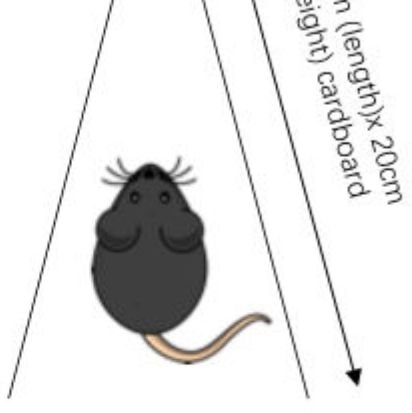
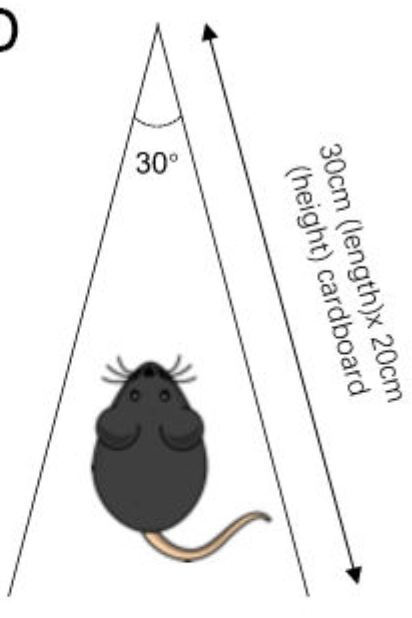
applied on rats, and later modified to use on mice. Generally, two 30cm × 20cm cardboards are attached at 30° angle with a small opening at the joint. Animals are placed in the middle of the two cardboards, so that vibrissae on both sides can be stimulated when they enter the corner. The direction in which they turn back is recorded. Normally, animals do not have preference to either direction. After stroke, which causes contralateral limb deficits, however, animals tend to use their ipsilateral limbs to turn back. Higher tendency to one side indicates more severe stroke outcome.
As a sensorimotor asymmetry assessment, corner test has been applied in unilateral stroke studies to evaluate stroke outcome. Ischemic mice made more ipsilateral turns, while sham controls turned to either side equally after ischemic injury. This behavioral asymmetry was detected from 2-90 days after injury. Similarly, ischemic rats displayed significantly more ipsilateral turns than sham controls after ischemic stroke, and the difference could still be observed 4 weeks after injury. In addition, ischemic rats with bone marrow cell treatment made fewer ipsilateral turns within 28 days after injury, indicating decreased sensorimotor deficits. These results suggest that corner test can be used to assess sensorimotor asymmetry after ischemic stroke and evaluate neuroprotective effects of novel treatments.
The corner test is also effective in assess sensorimotor function in hemorrhagic stroke. It was reported that ICH rats showed significant increased ipsilateral turns compared to sham controls, and that this asymmetry remained detectable 4 weeks after injury. In addition, ICH rats with deferoxamine treatment made less ipsilateral turns at day 28 after stroke, indicating improved recovery. These findings suggest that the corner test is also able to assess sensorimotor function in ICH. It should be noted that the corner test cannot be used in SAH, which causes global brain damage and thus minimal sensorimotor asymmetry.
Compared to other tests that assess sensorimotor asymmetry, corner test has several advantages. First, it is an objective and quantitative test. Next, the corner test is able to evaluate sensorimotor deficits in the chronic phase after stroke. One drawback of the corner test, however, is that animals may not perform well when they are too sick or lose motivation due to repeated testing. To reduce or avoid this effect, long intervals should be given between tests. In addition, the use of corner test should be limited to unilateral stroke models, since global stroke models (e.g. global ischemia and SAH) result in mild sensorimotor asymmetry.
风险提示:丁香通仅作为第三方平台,为商家信息发布提供平台空间。用户咨询产品时请注意保护个人信息及财产安全,合理判断,谨慎选购商品,商家和用户对交易行为负责。对于医疗器械类产品,请先查证核实企业经营资质和医疗器械产品注册证情况。
- 作者
- 内容
- 询问日期
 文献和实验
文献和实验亦称燕麦试法。是以燕麦为材料,定量测定生长素的最古典的方法。属于生物测试( bioassay,即用生物体对化学物质的反应计算该物质的量)。燕麦试法的理论依据是生长素在胚芽鞘切段内的运输是垂直向下的,如用生长素处理胚芽鞘一侧,使胚芽两侧生长速率不同,处理一侧生长快,而使芽鞘弯曲,其弯曲度与生长素浓度(在一定范围内)成正比。将含有生长素的植物材料或合成生长素置于洋菜(即琼脂)小块上,使生长素扩散到其中而累积,然后将洋菜小块置于去尖的燕麦胚芽鞘一侧,测验一定时间后,以胚芽鞘基部
艾姆斯( B. N. Ames)所创造的沙门氏菌( Salmonella)、 typhimurium诱导色氨酸嗜性恢复突变而通过简单的平皿试验来获取变异原物质的方法。由于该方法可以显示许多致癌物质的变异原,所以作为致癌物质的筛选法而被广泛应用。因许多致癌物质在哺乳类动物体内受代谢活化而显示其作用,所以对药物代谢酶系统诱导处理的动物肝脏均浆 9000克、 10分钟离心沉淀的上澄液( S9)将加有辅酶的 S9mix作为致癌物质的代谢活化系统加入于平皿中是必要的。为检取碱基代换
燕麦试验 Avena test 以燕麦芽鞘的伸长,来表示对生长促进物质的敏感反应,生长素的定量法。通常所说的燕麦试验,是指燕麦弯曲试验法,但是现在除了燕麦弯曲法外,还有燕麦伸长生长试验法、去胚乳燕麦试验法、纵裂胚芽鞘切片的弯曲测定法,以及利用根毛伸长的方法等,这些都是利用燕麦的生长素定量法。
 技术资料
技术资料暂无技术资料 索取技术资料

