


- ¥1200
- Biorigin
- BN41605R
- 2026年05月29日
- WB,
- Human,Mouse,Rat,Pig,Cow,Horse,Rabbit,

企业认证
相关产品推荐更多 >
万千商家帮你免费找货
0 人在求购买到急需产品
相关阅读
源叶生物 十万种现货试剂速发,品质稳、品类全,实验不再等!Takara 秋促来袭,提取+反转录+定量套装仅 1200 元abinScience 体内级抗体 全年锁价 低至 ¥1200阿拉丁 22万+ 科研级产品现货速发,品质严控、科研无忧- 详细信息
- 文献和实验
- 技术资料
- 适应物种:
Human,Mouse,Rat,Pig,Cow,Horse,Rabbit,
- 应用范围:
WB,
- 抗体英文名:
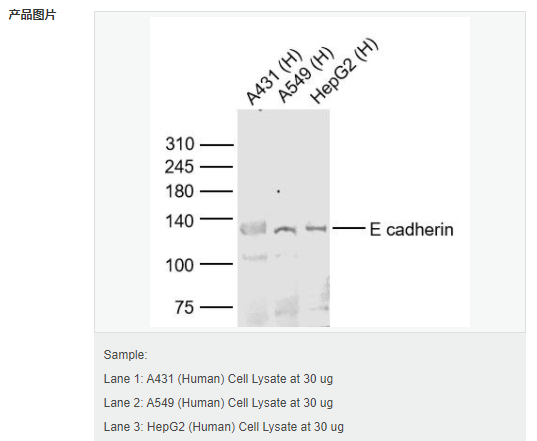
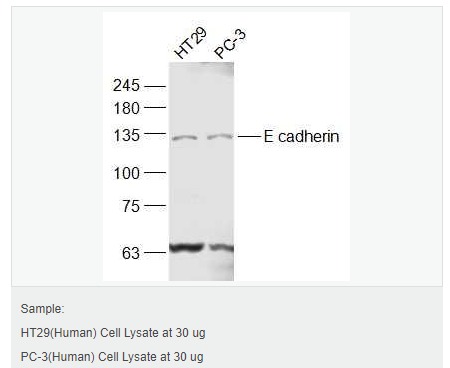
E cadherin
- 规格:
50ul
| 英文名称 | E cadherin |
| 中文名称 | 上皮钙粘附分子抗体 |
| 别 名 | E-cadherin; anion exchanger protein 3; Arc 1; Cadherin 1; cadherin 1 type 1 E-cadherin; Cadherin1; CAM 120/80; CD 234; CD324; CD324 antigen; CDH1; CDHE; ECAD; Epithelial cadherin; epithelial calcium dependant adhesion protein; LCAM; Liver cell adhesion molecule; UVO; Uvomorulin. |
| 研究领域 | 肿瘤 细胞生物 免疫学 发育生物学 信号转导 干细胞 转录调节因子 细胞粘附分子 |
| 抗体来源 | Rabbit |
| 克隆类型 | Polyclonal |
| 交叉反应 | Human, (predicted: Mouse, Rat, Pig, Cow, Horse, Rabbit, ) |
| 产品应用 | WB=1:500-2000 ELISA=1:5000-10000 IHC-P=1:100-500 IHC-F=1:100-500 ICC=1:100-500 IF=1:100-500 (石蜡切片需做抗原修复) not yet tested in other applications. optimal dilutions/concentrations should be determined by the end user. |
| 分 子 量 | 90/97kDa |
| 细胞定位 | 细胞膜 |
| 性 状 | Liquid |
| 浓 度 | 1mg/ml |
| 免 疫 原 | KLH conjugated synthetic peptide derived from human E-cadherin:401-500/882 <Extracellular> |
| 亚 型 | IgG |
| 纯化方法 | affinity purified by Protein A |
| 储 存 液 | 0.01M TBS(pH7.4) with 1% BSA, 0.03% Proclin300 and 50% Glycerol. |
| 保存条件 | Shipped at 4℃. Store at -20 °C for one year. Avoid repeated freeze/thaw cycles. |
| PubMed | PubMed |
| 产品介绍 | This gene encodes a classical cadherin of the cadherin superfamily. Alternative splicing results in multiple transcript variants, at least one of which encodes a preproprotein that is proteolytically processed to generate the mature glycoprotein. This calcium-dependent cell-cell adhesion protein is comprised of five extracellular cadherin repeats, a transmembrane region and a highly conserved cytoplasmic tail. Mutations in this gene are correlated with gastric, breast, colorectal, thyroid and ovarian cancer. Loss of function of this gene is thought to contribute to cancer progression by increasing proliferation, invasion, and/or metastasis. The ectodomain of this protein mediates bacterial adhesion to mammalian cells and the cytoplasmic domain is required for internalization. This gene is present in a gene cluster with other members of the cadherin family on chromosome 16. [provided by RefSeq, Nov 2015] Function: Cadherins are calcium-dependent cell adhesion proteins. They preferentially interact with themselves in a homophilic manner in connecting cells; cadherins may thus contribute to the sorting of heterogeneous cell types. CDH1 is involved in mechanisms regulating cell-cell adhesions, mobility and proliferation of epithelial cells. Has a potent invasive suppressor role. It is a ligand for integrin alpha-E/beta-7. E-Cad/CTF2 promotes non-amyloidogenic degradation of Abeta precursors. Has a strong inhibitory effect on APP C99 and C83 production. Subunit: Homodimer. Subcellular Location: Cell junction. Cell membrane; Single-pass type I membrane protein. Tissue Specificity: Non-neural epithelial tissues. Post-translational modifications: Defects in CDH1 are the cause of hereditary diffuse gastric cancer (HDGC) . An autosomal dominant cancer predisposition syndrome with increased susceptibility to diffuse gastric cancer. Diffuse gastric cancer is a malignant disease characterized by poorly differentiated infiltrating lesions resulting in thickening of the stomach. Malignant tumors start in the stomach, can spread to the esophagus or the small intestine, and can extend through the stomach wall to nearby lymph nodes and organs. It also can metastasize to other parts of the body. Note=Heterozygous germline mutations CDH1 are responsible for familial cases of diffuse gastric cancer. Somatic mutations in the has also been found in patients with sporadic diffuse gastric cancer and lobular breast cancer. Similarity: Contains 5 cadherin domains. SWISS: P12830 Gene ID: 999 Database links: Entrez Gene: 999 Human Entrez Gene: 12550 Mouse Omim: 192090 Human SwissProt: P12830 Human SwissProt: P09803 Mouse Unigene: 461086 Human Unigene: 35605 Mouse Unigene: 1303 Rat Important Note: This product as supplied is intended for research use only, not for use in human, therapeutic or diagnostic applications. |
风险提示:丁香通仅作为第三方平台,为商家信息发布提供平台空间。用户咨询产品时请注意保护个人信息及财产安全,合理判断,谨慎选购商品,商家和用户对交易行为负责。对于医疗器械类产品,请先查证核实企业经营资质和医疗器械产品注册证情况。
 文献和实验
文献和实验与肿瘤侵袭转移有关的基因 侵袭性是恶性肿瘤的重要特征。肿瘤的侵袭、转移包括细胞黏附能力下降、穿破基底膜进入血液循环、逃避免疫监视及在远隔部位生长。目前,已发现3种参与乳腺癌侵袭转移的基因发生异常甲基化。 1.钙粘连蛋白 (cadherin) 钙粘连蛋白在抑制肿瘤侵袭、转移中起重要作用。E―钙粘连蛋白定位于16q22,编码细胞表面的黏附分子。E―钙粘连蛋白的表达下降在分化差、分级高的肿瘤中十分常见。在E―钙粘连蛋白表达阴性的乳腺癌细胞系和乳腺原发肿瘤中,E―钙粘
粘着带连接位于上皮细胞紧密连接的下方, 靠钙粘着蛋白同肌动蛋白相互作用, 将两个细胞连接起来。粘着带处相邻细胞质膜的间隙为20~30nm, 介于紧密连接和桥粒之间, 所以又叫中间连接(intermediate junction)或带状桥粒。 参与粘着带连接的主要蛋白是钙粘着蛋白(cadherin)和肌动蛋白。钙粘着蛋白属Ca2 依赖性的细胞粘着分子,所以这种连接也是钙依赖性的。在粘着带连接中,钙粘着蛋白的细胞外结构域同相邻细胞质膜上另一个钙粘着蛋白的细胞外结构域相互
又称为斑点粘着(maculae adherens),是最常见的连接方式,主要存在于上皮组织,如皮肤和肠组织。桥粒连接的形态象圆盘,直径大约为1μm,桥粒连接能赋予组织机械强度。从形态上看,通过桥粒连接,两细胞间形成钮扣式的结构。桥粒连接处相邻细胞质膜间的间隙约30nm, 细胞质斑的厚度为15~20nm。 从结构上看,桥粒连接也是通过钙粘着蛋白将两个相邻细胞结合起来。参与桥粒连接的钙粘着蛋白与粘着连接中的钙粘着蛋白在结构上有所不同,有两种类型的钙粘着蛋白,分别称为桥粒芯
 技术资料
技术资料暂无技术资料 索取技术资料

