- 询价
- Agrisera
- AS13 2671
- 瑞典
- 2025年12月02日
- Western blot (WB)
- Chicken
- Arabidopsis thaliana, Spinacia oleracea, Zea mays

企业认证
相关产品推荐更多 >


万千商家帮你免费找货
0 人在求购买到急需产品
- 详细信息
- 文献和实验
- 技术资料
- 抗体名:
H+ATPase | Plasma membrane H+ATPase (chicken antibody)
- 抗体英文名:
H+ATPase | Plasma membrane H+ATPase (chicken antibody)
- 靶点:
The Plasma Membrane H+ATPase is a family of proteins of ca. 100 kDa that are believed to be exclusive to the plasma membranes of plants and fungi. The protein is anchored within biological membrane which creates an electrochemical gradient used as an ener
- 应用范围:
Western blot (WB)
- 宿主:
Chicken
- 适应物种:
Arabidopsis thaliana, Spinacia oleracea, Zea mays
- 抗原来源:
Q9FNS3
- 级别:
Affinity purified IgY in PBS pH 7.4
- 供应商:
Agrisera AB
- 克隆性:
单克隆
- 保存条件:
Store lyophilized/reconstituted at -20°C; once reconstituted make aliquots to avoid repeated freeze-thaw cycles. Please, remember to spin tubes briefly prior to opening them to avoid any losses that might occur from lyophilized material adhering to the ca
- 形态:
Lyophilized
- 免疫原:
KLH-conjugated synthetic peptide derived from available di and monocot, fern, mosses and algal plasma membrane ATPase sequences including Arabidopsis thaliana ATPase 1 (At2g18960) and ATPase 2,3,4,6,7,8,9 of Arabidopsis thaliana and hydrogen ATPase of Chl
- 规格:
50 µg
- PRODUCT INFO
-
Immunogen: KLH-conjugated synthetic peptide derived from available di and monocot, fern, mosses and algal plasma membrane ATPase sequences including Arabidopsis thaliana ATPase 1 (At2g18960) and ATPase 2,3,4,6,7,8,9 of Arabidopsis thaliana and hydrogen ATPase of Chlamydomonas reinhardtii (Q9FNS3)
Host: Chicken Clonality: Polyclonal Purity: Immunogen affinity purified IgY in PBS pH 7.4. Format: Lyophilized Quantity: 50 µg Reconstitution: For reconstitution add 50 µl of sterile water Storage: Store lyophilized/reconstituted at -20°C; once reconstituted make aliquots to avoid repeated freeze-thaw cycles. Please remember to spin the tubes briefly prior to opening them to avoid any losses that might occur from material adhering to the cap or sides of the tube. Tested applications: Western blot (WB) Recommended dilution: 1 : 1000-1 : 5000 (WB) Expected | apparent MW: 95 kDa (Arabidopsis thaliana)
- REACTIVITY
-
Confirmed reactivity: Arabidopsis thaliana, Spinacia oleracea, Zea mays Predicted reactivity: Angomonas deanei, Avena sativa, Brassica napus, Citrus limon, Coffea canephora, Cucumis sativus, Cucurbita moschata, Dunaliella spp, Eichhornia crassipes, Emiliana huxleyi, Glycine max (weak), Hordeum vulgare, Lactobacillus johnsonii, Laishamania braziliensis, Nicotiana tabacum, Oryza sativa, Solanum lycopersicon, Solanum tuberosum, Medicago truncatula, Mesembruanthemum crystallinum), Nannochloropsis gaditana CCMP526, Nepenthes alata, Nicotiana tabaccum, Nitrospira bacterium, Oryza sativa, Ostreococcus spp., Phaseolus acutifolius, Physocomitrella patens, Picea abies, Pinus thunbergii, Populus tremula, Pteris vittata, Ricinus communis, Saccharomyces cerevisiae, Solanum lycopersicum, Strigomonas culicis, Toxoplasma gondii, Triticum urartu, Trypanosoma cruzi, Zosteria marina, Vicia faba, Vigna angularis
Species of your interest not listed? Contact us - APPLICATION EXAMPLES
-
application example
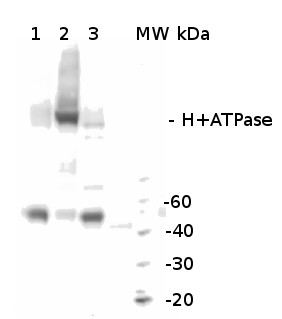
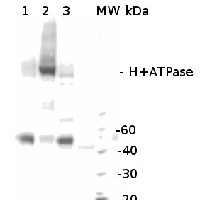
10 µg of total protein from whole leaf extracts of Arabidopsis thaliana (1), Zea mays (2), Spinacia oleracea (3), extracted with Protein Extration Buffer, PEB (AS08 300), were boiled for 10 min. in 70°C and separated on 4-12% NuPage (Invitrogen) LDS-PAGE and blotted 1h to PVDF. Blots were blocked immediately following transfer in 2% ECL blocking reagent (GE Healthcare) in 20 mM Tris, 137 mM sodium chloride pH 7.6 with 0.1% (v/v) Tween-20 (TBS-T) for 1h at room temperature with agitation. Blots were incubated in the primary antibody at a dilution of 1: 2 500 for 1h at room temperature with agitation. The antibody solution was decanted and the blot was rinsed briefly twice, then washed once for 15 min and 3 times for 5 min in TBS-T at room temperature with agitation. Blots were incubated in secondary antibody (anti-rabbit IgG horse radish peroxidase conjugated, recommended secondary antibody AS10 1489) diluted to 1:25 000 for 1h at room temperature with agitation. The blots were washed as above and developed for 5 minutes according the manufacturers instructions. Images of the blots were obtained using a CCD imager (FluorSMax, Bio-Rad) and Quantity One software (Bio-Rad).
风险提示:丁香通仅作为第三方平台,为商家信息发布提供平台空间。用户咨询产品时请注意保护个人信息及财产安全,合理判断,谨慎选购商品,商家和用户对交易行为负责。对于医疗器械类产品,请先查证核实企业经营资质和医疗器械产品注册证情况。
 文献和实验
文献和实验Measurement of Plasma Membrane CalciumCalmodulin-Dependent ATPase (PMCA) Activity
The plasma membrane calcium–calmodulin-dependent ATPase (PMCA) is a calcium-extruding enzymatic pump that ejects calcium from the cytoplasm to the extracellular compartment. Although in excitable cells such as skeletal and cardiac muscle
The plasma membrane calcium ATPase, or PMCA, functions to extrude calcium out of cells as a key component necessary for adequate calcium homeostasis in all cells. However, calcium is particularly important at synapses between neurons
Measurement of Ca2+-ATPase Activity (in PMCA and SERCA1)
and a purified enzyme, best suited for studies of Ca2+ -ATPase activity are described. The two selected membranes are the human red blood cell (RBC) ghosts, a representative of plasma membranes (PM), and the rabbit skeletal muscle SR, an intracellular membrane
 技术资料
技术资料暂无技术资料 索取技术资料