

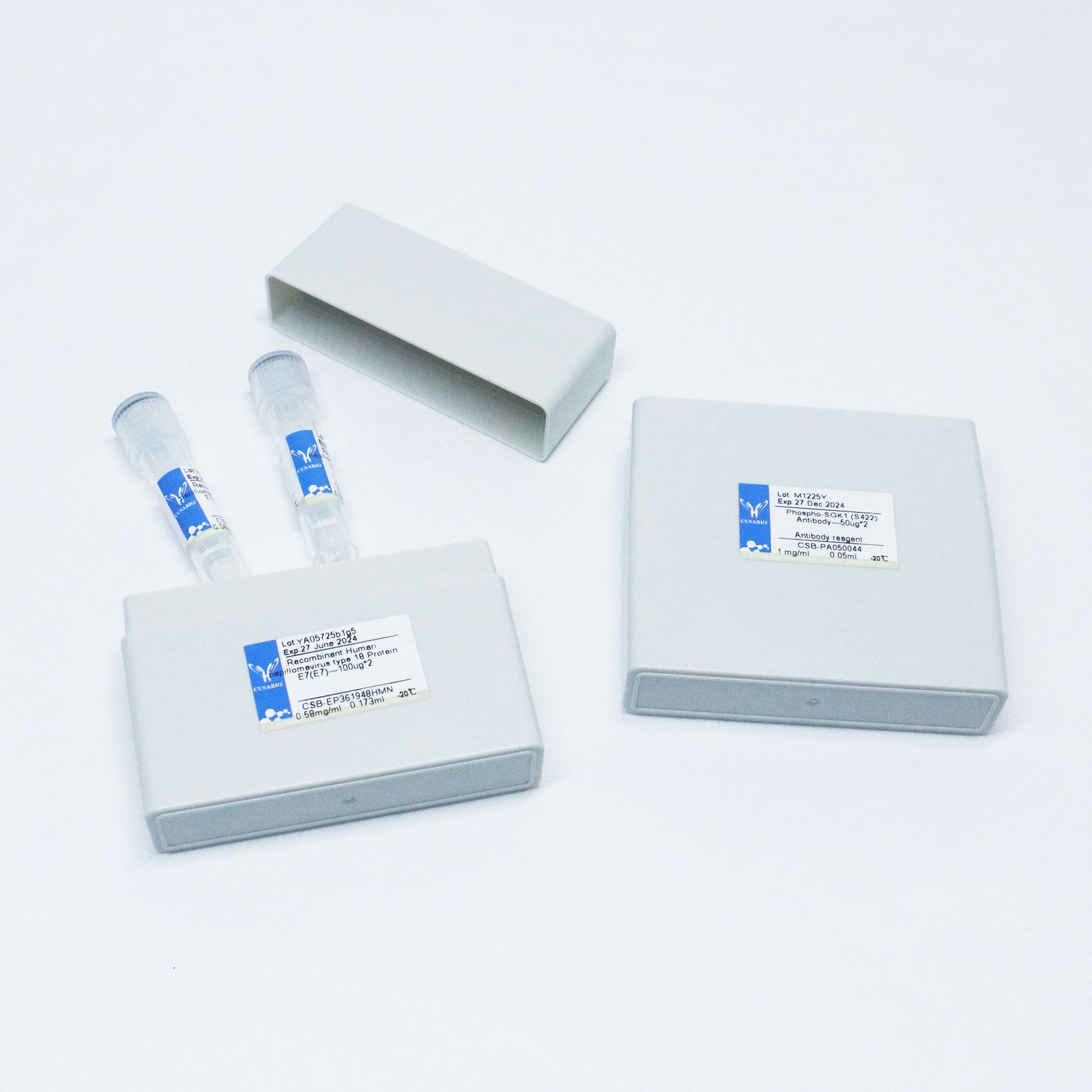
人SRC重组蛋白Proto-oncogene c-Src(p
p60c-src)(p60-Src)(SRC1)Human Proto-oncogene tyrosine-protein kinase Src(SRC)蛋白- ¥2328
- CUSABIO

- CN
- CSB-EP022650HU
- 2026年01月20日

企业认证
相关产品推荐更多 >
Recombinant-Candida-glabrata-Solute-carrier-family-25-member-38-homologCAGL0H10538gSolute carrier family 25 member 38 homolog
¥11424
Recombinant-Human-CD97-antigenCD97CD97 antigen Alternative name(s): Leukocyte antigen CD97 CD_antigen= CD97 Cleaved into the following 2 chains: 1. CD97 antigen subunit alpha 2. CD97 antigen subunit beta
¥11494
小鼠Ccdc3重组蛋白Fat/vessel-derived secretory protein;FavineMouse Coiled-coil domain-containing protein 3(Ccdc3)蛋白
¥1536Recombinant-Gluconobacter-oxydans-Undecaprenyl-diphosphataseuppPUndecaprenyl-diphosphatase EC= 3.6.1.27 Alternative name(s): Bacitracin resistance protein Undecaprenyl pyrophosphate phosphatase
¥11270
Recombinant-Burkholderia-phymatum-Monofunctional-biosynthetic-peptidoglycan-transglycosylasemtgAMonofunctional biosynthetic peptidoglycan transglycosylase; Monofunctional TGase EC= 2.4.2.-
¥10962
万千商家帮你免费找货
0 人在求购买到急需产品
- 详细信息
- 询价记录
- 文献和实验
- 技术资料
- 保存条件:
We recommend to add 5-50% of glycerol (final concentration) and aliquot for long-term storage at -20℃/-80℃.
- 保质期:
Generally, the shelf life of liquid form is 6 months at -20℃/-80℃. The shelf life of lyophilized form is 12 months at -20℃/-80℃.
- 英文名:
Recombinant Human Proto-oncogene tyrosine-protein kinase Src (SRC)
- 库存:
200
- 供应商:
武汉华美生物工程有限公司
- 规格:
20μg
英文名称:
Recombinant Human Proto-oncogene tyrosine-protein kinase Src (SRC)品名简称:
Recombinant Human SRC protein货号:
CSB-EP022650HU规格:
20μg价格:
2328LC-MS/Western Blot:
/SDS-PAGE:
(Tris-Glycine gel) Discontinuous SDS-PAGE (reduced) with 5% enrichment gel and 15% separation gel.纯度:
Greater than 85% as determined by SDS-PAGE.内毒素:
Not test生物活性:
/基因名:
SRCUniprot No.:
P12931别名:
Proto-oncogene c-Src (pp60c-src) (p60-Src) (SRC1)种属:
Homo sapiens (Human)蛋白长度:
Full Length of Mature Protein来源:
E.coli分子量:
64.2 kDa表达区域:
2-536aa氨基酸序列:
GSNKSKPKDASQRRRSLEPAENVHGAGGGAFPASQTPSKPASADGHRGPSAAFAPAAAEPKLFGGFNSSDTVTSPQRAGPLAGGVTTFVALYDYESRTETDLSFKKGERLQIVNNTEGDWWLAHSLSTGQTGYIPSNYVAPSDSIQAEEWYFGKITRRESERLLLNAENPRGTFLVRESETTKGAYCLSVSDFDNAKGLNVKHYKIRKLDSGGFYITSRTQFNSLQQLVAYYSKHADGLCHRLTTVCPTSKPQTQGLAKDAWEIPRESLRLEVKLGQGCFGEVWMGTWNGTTRVAIKTLKPGTMSPEAFLQEAQVMKKLRHEKLVQLYAVVSEEPIYIVTEYMSKGSLLDFLKGETGKYLRLPQLVDMAAQIASGMAYVERMNYVHRDLRAANILVGENLVCKVADFGLARLIEDNEYTARQGAKFPIKWTAPEAALYGRFTIKSDVWSFGILLTELTTKGRVPYPGMVNREVLDQVERGYRMPCPPECPESLHDLMCQCWRKEPEERPTFEYLQAFLEDYFTSTEPQYQPGENL蛋白标签:
N-terminal 10xHis-tagged产品提供形式:
Liquid or Lyophilized powder缓冲液:
If the delivery form is liquid, the default storage buffer is Tris/PBS-based buffer, 5%-50% glycerol. If the delivery form is lyophilized powder, the buffer before lyophilization is Tris/PBS-based buffer, 6% Trehalose, pH 8.0.储存条件:
We recommend that this vial be briefly centrifuged prior to opening to bring the contents to the bottom. Please reconstitute protein in deionized sterile water to a concentration of 0.1-1.0 mg/mL.We recommend to add 5-50% of glycerol (final concentration) and aliquot for long-term storage at -20℃/-80℃. Our default final concentration of glycerol is 50%. Customers could use it as reference.保质期:
The shelf life is related to many factors, storage state, buffer ingredients, storage temperature and the stability of the protein itself. Generally, the shelf life of liquid form is 6 months at -20℃/-80℃. The shelf life of lyophilized form is 12 months at -20℃/-80℃.货期:
3-7 business days注意事项:
Repeated freezing and thawing is not recommended. Store working aliquots at 4℃ for up to one week.功能1:
Non-receptor protein tyrosine kinase which is activated following engagement of many different classes of cellular receptors including immune response receptors, integrins and other adhesion receptors, receptor protein tyrosine kinases, G protein-coupled receptors as well as cytokine receptors. Participates in signaling pathways that control a diverse spectrum of biological activities including gene transcription, immune response, cell adhesion, cell cycle progression, apoptosis, migration, and transformation. Due to functional redundancy between members of the SRC kinase family, identification of the specific role of each SRC kinase is very difficult. SRC appears to be one of the primary kinases activated following engagement of receptors and plays a role in the activation of other protein tyrosine kinase families. Receptor clustering or dimerization leads to recruitment of SRC to the receptor complexes where it phosphorylates the tyrosine residues within the receptor cytoplasmic domains. Plays an important role in the regulation of cytoskeletal organization through phosphorylation of specific substrates such as AFAP1. Phosphorylation of AFAP1 allows the SRC SH2 domain to bind AFAP1 and to localize to actin filaments. Cytoskeletal reorganization is also controlled through the phosphorylation of cortactin . When cells adhere via focal adhesions to the extracellular matrix, signals are transmitted by integrins into the cell resulting in tyrosine phosphorylation of a number of focal adhesion proteins, including PTK2/FAK1 and paxillin. In addition to phosphorylating focal adhesion proteins, SRC is also active at the sites of cell-cell contact adherens junctions and phosphorylates substrates such as beta-catenin, delta-catenin, and plakoglobin. Another type of cell-cell junction, the gap junction, is also a target for SRC, which phosphorylates connexin-43. SRC is implicated in regulation of pre-mRNA-processing and phosphorylates RNA-binding proteins such as KHDRBS1. Also plays a role in PDGF-mediated tyrosine phosphorylation of both STAT1 and STAT3, leading to increased DNA binding activity of these transcription factors. Involved in the RAS pathway through phosphorylation of RASA1 and RASGRF1. Plays a role in EGF-mediated calcium-activated chloride channel activation. Required for epidermal growth factor receptor internalization through phosphorylation of clathrin heavy chain at 'Tyr-1477'. Involved in beta-arrestin desensitization through phosphorylation and activation of GRK2, leading to beta-arrestin phosphorylation and internalization. Has a critical role in the stimulation of the CDK20/MAPK3 mitogen-activated protein kinase cascade by epidermal growth factor. Might be involved not only in mediating the transduction of mitogenic signals at the level of the plasma membrane but also in controlling progression through the cell cycle via interaction with regulatory proteins in the nucleus. Plays an important role in osteoclastic bone resorption in conjunction with PTK2B/PYK2. Both the formation of a SRC-PTK2B/PYK2 complex and SRC kinase activity are necessary for this function. Recruited to activated integrins by PTK2B/PYK2, thereby phosphorylating CBL, which in turn induces the activation and recruitment of phosphatidylinositol 3-kinase to the cell membrane in a signaling pathway that is critical for osteoclast function. Promotes energy production in osteoclasts by activating mitochondrial cytochrome C oxidase. Phosphorylates DDR2 on tyrosine residues, thereby promoting its subsequent autophosphorylation. Phosphorylates RUNX3 and COX2 on tyrosine residues, TNK2 on 'Tyr-284' and CBL on 'Tyr-731'. Enhances DDX58/RIG-I-elicited antiviral signaling. Phosphorylates PDPK1 at 'Tyr-9', 'Tyr-373' and 'Tyr-376'. Phosphorylates BCAR1 at 'Tyr-128'. Phosphorylates CBLC at multiple tyrosine residues, phosphorylation at 'Tyr-341' activates CBLC E3 activity. Involved in anchorage-independent cell growth. Required for podosome formation.By similarity3 Publications15 Publications功能2:
Non-receptor protein tyrosine kinase which is activated following engagement of many different classes of cellular receptors including immune response receptors, integrins and other adhesion receptors, receptor protein tyrosine kinases, G protein-coupled receptors as well as cytokine receptors. Participates in signaling pathways that control a diverse spectrum of biological activities including gene transcription, immune response, cell adhesion, cell cycle progression, apoptosis, migration, and transformation. Due to functional redundancy between members of the SRC kinase family, identification of the specific role of each SRC kinase is very difficult. SRC appears to be one of the primary kinases activated following engagement of receptors and plays a role in the activation of other protein tyrosine kinase (PTK) families. Receptor clustering or dimerization leads to recruitment of SRC to the receptor complexes where it phosphorylates the tyrosine residues within the receptor cytoplasmic domains. Plays an important role in the regulation of cytoskeletal organization through phosphorylation of specific substrates such as AFAP1. Phosphorylation of AFAP1 allows the SRC SH2 domain to bind AFAP1 and to localize to actin filaments. Cytoskeletal reorganization is also controlled through the phosphorylation of cortactin (CTTN) (Probable). When cells adhere via focal adhesions to the extracellular matrix, signals are transmitted by integrins into the cell resulting in tyrosine phosphorylation of a number of focal adhesion proteins, including PTK2/FAK1 and paxillin (PXN)文献:
"Physical and functional association of Fc mu receptor on human natural killer cells with the zeta- and Fc epsilon RI gamma-chains and with src family protein tyrosine kinases." Rabinowich H., Manciulea M., Metes D., Sulica A., Herberman R.B., Corey S.J., Whiteside T.L. J. Immunol. 157:1485-1491(1996)研究领域:
Cancer请点击“在线询价”找客服索取产品说明书及引用文献目录,产品实时更新参数、价格信息、更多文献信息可以查看cusabio官网
风险提示:丁香通仅作为第三方平台,为商家信息发布提供平台空间。用户咨询产品时请注意保护个人信息及财产安全,合理判断,谨慎选购商品,商家和用户对交易行为负责。对于医疗器械类产品,请先查证核实企业经营资质和医疗器械产品注册证情况。
- 作者
- 内容
- 询问日期
 文献和实验
文献和实验细胞的正常基因,它们编码的蛋白质在正常细胞中通常参与细胞的生长与增殖的调控,但突变后成为促癌的癌基因(cancer-promoting oncogene),或改变了编码蛋白的结构或改变了蛋白质的表达方式导致细胞癌变。
Interfering with Ras Signaling Using Membrane-Permeable Peptides or Drugs
During the last two decades since the first oncogene product called v-Src was identified as a constitutively activated mutant of a normal mitogenic gene (proto-oncogene) encoding a Tyr kinase called c-Src in early 1980s, it was firmly
癌基因(c-oncogene,c-onc)。 那么,v-onc与c-onc的关系如何?这可从二者结构的比较和逆转录病毒感染宿主后的生活史或复制周期两方面加以分析。 首先,从结构上看c-onc是间断的,这是真核基因的特点,即有内含子因而基因的跨度较大。然而v-onc却是连续的,没有内含子,所以基因跨度较小,以v-onc和c-src为例如图22-1。再从逆转录病毒感染宿主细胞后的复制周期(图22-2)分析。 图22-1 c-src和v-src结构的比较
 技术资料
技术资料暂无技术资料 索取技术资料

