


- ¥1580 - 2480
- gelatins
- jlcR6854
- 国内
- 2025年07月16日
- WB,ELISA等
- 人/动物/植物

企业认证
相关产品推荐更多 >


万千商家帮你免费找货
0 人在求购买到急需产品
- 详细信息
- 文献和实验
- 技术资料
- 供应商:
江西江蓝纯生物试剂有限公司
- 库存:
11
- 克隆性:
单克隆
- 保质期:
1年
- 抗体英文名:
CARD7/NALP1
- 抗体名:
凋亡加强结构域蛋白7抗体
- 适应物种:
人/动物/植物
- 应用范围:
WB,ELISA等
- 浓度:
1mg/ml
- 保存条件:
-20 °
- 规格:
100ul/200ul
| 规格: | 100ul | 产品价格: | ¥1580.0 |
|---|---|---|---|
| 规格: | 200ul | 产品价格: | ¥2480.0 |
英文名称 : CARD7/NALP1
中文名称 : 凋亡加强结构域蛋白7抗体
别 名 : LRR and PYD domains-containing protein 1; CARD 7; CARD7; Caspase recruitment domain protein 7; Caspase recruitment domain-containing protein 7; CLR17.1; Death effector filament forming Ced 4 like apoptosis protein; Death effector filament-forming ced-4-like apoptosis protein; DEFCAP; DEFCAP L/S; NAC alpha/beta/gamma/delta; NAC; NACHT; NACHT leucine rich repeat and PYD containing 1; NACHT leucine rich repeat and PYD pyrin domain containing 1; NACHT leucine rich repeat and pyrin domain containing 1; NACHT LRR and PYD containing protein 1; NALP 1; NALP1; NALP1_HUMAN; NLR family pyrin domain containing 1; NLRP 1; NLRP1; NLRP1 protein; Nucleotide binding domain and caspase recruitment domain; Nucleotide binding oligomerization domain leucine rich repeat and pyrin domain containing 1; Nucleotide-binding domain and caspase recruitment domain; PP 1044; PP1044.
研究领域 : 细胞生物 细胞凋亡
抗体来源 : Rabbit
克隆类型 : Polyclonal
交叉反应 : Human, Mouse, Rat,
产品应用 : ELISA=1:500-1000 IHC-P=1:400-800 IHC-F=1:400-800 IF=1:100-500 (石蜡切片需做抗原修复)
not yet tested in other applications.
optimal dilutions/concentrations should be determined by the end user.
分 子 量 : 162kDa
细胞定位 : 细胞核 细胞浆
性 状 : Lyophilized or Liquid
浓 度 : 1mg/ml
免 疫 原 : KLH conjugated synthetic peptide derived from human CARD7/NALP1:301-400/1473
亚 型 : IgG
纯化方法 : affinity purified by Protein A
储 存 液 : 0.01M TBS(pH7.4) with 1% BSA, 0.03% Proclin300 and 50% Glycerol.
保存条件 : Store at -20 °C for one year. Avoid repeated freeze/thaw cycles. The lyophilized antibody is stable at room temperature for at least one month and for greater than a year when kept at -20°C. When reconstituted in sterile pH 7.4 0.01M PBS or diluent of antibody the antibody is stable for at least two weeks at 2-4 °C.
PubMed : PubMed
产品介绍 : This gene encodes a member of the Ced-4 family of apoptosis proteins. Ced-family members contain a caspase recruitment domain (CARD) and are known to be key mediators of programmed cell death. The encoded protein contains a distinct N-terminal pyrin-like motif, which is possibly involved in protein-protein interactions. This protein interacts strongly with caspase 2 and weakly with caspase 9. Overexpression of this gene was demonstrated to induce apoptosis in cells. Multiple alternatively spliced transcript variants encoding distinct isoforms have been found for this gene, but the biological validity of some variants has not been determined. [provided by RefSeq, Jul 2008].
Function:
Able to form cytoplasmic structures termed death effector filaments. Enhances APAF1 and cytochrome c-dependent activation of pro-caspase-9 and consecutive apoptosis. Stimulates apoptosis through activation of caspase-3. Involved in activation of caspase-1 and caspase-5 as part of the NALP1 inflammasome complex which leads to processing and release of IL1B and IL18. Binds ATP.
Subunit:
Interacts strongly with caspase-2, weakly with caspase-9 and with APAF1 in a cytochrome c-inducible way, leading to the formation of an apoptosome. This interaction may be ATP-dependent. Part of the NALP1 inflammasome complex which is involved in activation of caspase-1 and caspase-5, leading to processing of IL1B and IL18. The complex is activated by bacterial muramyl dipeptide which triggers ATP-binding and oligomerization of NALP1.
Subcellular Location:
Cytoplasm. Nucleus.
Tissue Specificity:
Widely expressed. Isoform 1 and isoform 2 are expressed in peripheral blood leukocytes and chronic myelogenous leukemia cell line K-562, followed by thymus, spleen and heart. Also detected in brain, lung, placenta, small intestine, colon, kidney, liver, muscle, testis and epithelial cells. Absent from hematopoietic progenitor cells but expressed upon differentiation of cells into granulocytes and, to a lesser extent, monocytes. In peripheral blood cells, highest levels are found in T-lymphocytes, granulocytes and monocytes. Expression is significantly increased in bone marrow blast cells of some acute leukemia patients but not in solid tumors.
DISEASE:
Genetic variations in NLRP1 are associated with susceptibility to vitiligo (VTLG) [MIM:193200]. VTLG is a pigmentary disorder of the skin characterized by circumscribed depigmented macules and patches, commonly on extensor aspects of extremities, on the face or neck and in skin folds. It is a progressive disorder in which some or all of the melanocytes in the affected skin are selectively destroyed. It is a multifactorial disorder with a complex etiology probably including autoimmune mechanisms, and is associated with an elevated risk of other autoimmune diseases.
Genetic variations in NLRP1 gene are associated with susceptibility to vitiligo-associated multiple autoimmune disease type 1 (VAMAS1) [MIM:606579]. VAMAS1 is an autoimmune disorder characterized by the association of vitiligo with several autoimmune and autoinflammatory diseases including autoimmune thyroid disease, rheumatoid arthritis and systemic lupus erythematosus.
Similarity:
Belongs to the NLRP family.
Contains 1 CARD domain.
Contains 1 DAPIN domain.
Contains 6 LRR (leucine-rich) repeats.
Contains 1 NACHT domain.
SWISS:
Q9C000
Gene ID:
22861
Important Note:
This product as supplied is intended for research use only, not for use in human, therapeutic or diagnostic applications.
产品图片
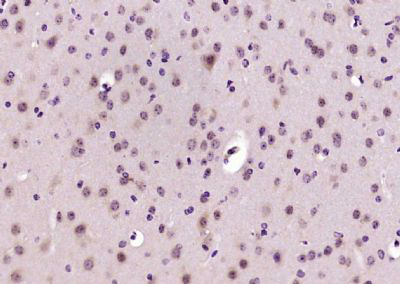
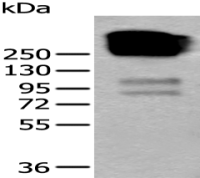
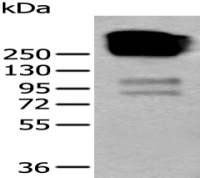
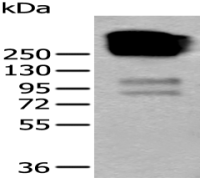
风险提示:丁香通仅作为第三方平台,为商家信息发布提供平台空间。用户咨询产品时请注意保护个人信息及财产安全,合理判断,谨慎选购商品,商家和用户对交易行为负责。对于医疗器械类产品,请先查证核实企业经营资质和医疗器械产品注册证情况。
 文献和实验
文献和实验独体—基于纤连蛋白类型Ⅲ结构域框架的抗体模拟 Akiko Koide and Shohei Koide
1. 介绍 蛋白质工程的一个主要目的是生产能够与特定靶分子结合的新的生物分子。这样的分子会应用于生物技术的许多领域,包括诊断、治疗和催化。虽然存在大量的天然蛋白,可供这些应用和开发,但用工程手段制造新的、有用的生物分子的办法仍是有吸引力的。 因为,它不受天然生物分子可用性的限制。抗体的基本构架中可变的链套呈现在基本不变的框架上,以及抗体工程的成功启发了一些研究组去发展“分子框架”[ 1,2] 。这些努力的主要目标一直是在保留呈递多重肽片段以与靶分子结合的能力的同时,克服抗体和抗体
Cell Death Differ:中大五院黄曦团队发现新冠病毒引起肺损伤的分子机制
共沉淀和线粒体胞质分离实验证实 SARS-CoV-2 M 蛋白和 BCL-2 家族蛋白促凋亡分子 BOK 相互作用,抑制 BOK 泛素化降解,并促进 BOK 发生线粒体转位(图 2)。BOK 主要通过 BH2 结构域与 M 蛋白结合。 图片来源:Cell death & differentiation 对小鼠进行气管暴露注射表达 M 蛋白慢病毒的实验表明,M 蛋白会导致小鼠肺上皮细胞凋亡和脱落,肺通透性增强和产生肺水肿,敲低 BOK 能减轻 M 蛋白导致小鼠肺部损伤(图 4)。 图片来源:Cell
Nature:施一 / 高福团队揭示埃博拉病毒聚合酶工作的分子机制
也导致 3481 人感染,2299 人死亡。今年 9 月,非洲乌干达又再次出现新的埃博拉疫情。这些数据告诉我们,埃博拉疫情并没有完全结束,并时刻威胁着我们的生命健康,因此急需加强针对埃博拉病毒的科学研究。 埃博拉病毒属于丝状病毒科,基因组为不分节段的负链 RNA,长约 19 kb,包含 7 个阅读框。病毒 RNA 基因组被核蛋白(NP)包裹,进一步与聚合酶蛋白(L),病毒辅助蛋白(VP35)和转录激活蛋白(VP30)结合形成核糖核蛋白复合体(RNP)。在病毒粒子中 RNP 进一步与核衣壳相关蛋白
 技术资料
技术资料暂无技术资料 索取技术资料

