


- ¥1580 - 2480
- gelatins
- jlcR3698
- 国内
- 2025年07月11日
- WB,ELISA等
- 人/动物/植物

企业认证
相关产品推荐更多 >



万千商家帮你免费找货
0 人在求购买到急需产品
- 详细信息
- 文献和实验
- 技术资料
- 供应商:
江西江蓝纯生物试剂有限公司
- 库存:
152
- 克隆性:
单克隆
- 保质期:
1年
- 抗体英文名:
PML Protein
- 抗体名:
早幼粒细胞白血病蛋白抗体
- 适应物种:
人/动物/植物
- 应用范围:
WB,ELISA等
- 浓度:
1mg/ml
- 保存条件:
-20 °
- 规格:
100ul/200ul
| 规格: | 100ul | 产品价格: | ¥1580.0 |
|---|---|---|---|
| 规格: | 200ul | 产品价格: | ¥2480.0 |
英文名称 : PML Protein
中文名称 : 早幼粒细胞白血病蛋白抗体
别 名 : PML Protein; MYL; PML; PML_HUMAN; PP8675; Probable transcription factor PML; Promyelocytic leukemia; Promyelocytic leukemia inducer of; Promyelocytic leukemia protein; Protein PML; RING finger protein 71; RNF 71; RNF71; TRIM 19; TRIM19; Tripartite motif containing protein 19; Tripartite motif protein TRIM19; Tripartite motif-containing protein 19.
研究领域 : 肿瘤 细胞生物 免疫学 细胞凋亡 细胞周期蛋白 转录调节因子
抗体来源 : Rabbit
克隆类型 : Polyclonal
交叉反应 : Human, Mouse, Rat, Dog, Pig, Cow,
产品应用 : WB=1:500-2000 ELISA=1:500-1000 IHC-P=1:400-800 IHC-F=1:400-800 IF=1:100-500 (石蜡切片需做抗原修复)
not yet tested in other applications.
optimal dilutions/concentrations should be determined by the end user.
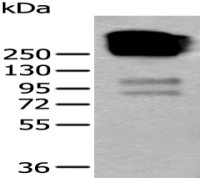
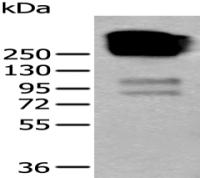
分 子 量 : 97kDa
细胞定位 : 细胞核 细胞浆 细胞膜
性 状 : Lyophilized or Liquid
浓 度 : 1mg/ml
免 疫 原 : KLH conjugated synthetic peptide derived from human PML/TRIM19:601-700/882
亚 型 : IgG
纯化方法 : affinity purified by Protein A
储 存 液 : 0.01M TBS(pH7.4) with 1% BSA, 0.03% Proclin300 and 50% Glycerol.
保存条件 : Store at -20 °C for one year. Avoid repeated freeze/thaw cycles. The lyophilized antibody is stable at room temperature for at least one month and for greater than a year when kept at -20°C. When reconstituted in sterile pH 7.4 0.01M PBS or diluent of antibody the antibody is stable for at least two weeks at 2-4 °C.
PubMed : PubMed
产品介绍 : The protein encoded by this gene is a member of the tripartite motif (TRIM) family. The TRIM motif includes three zinc-binding domains, a RING, a B-box type 1 and a B-box type 2, and a coiled-coil region. This phosphoprotein localizes to nuclear bodies where it functions as a transcription factor and tumor suppressor. Its expression is cell-cycle related and it regulates the p53 response to oncogenic signals. The gene is often involved in the translocation with the retinoic acid receptor alpha gene associated with acute promyelocytic leukemia (APL). Extensive alternative splicing of this gene results in several variations of the protein's central and C-terminal regions; all variants encode the same N-terminus. Alternatively spliced transcript variants encoding different isoforms have been identified. [provided by RefSeq, Jul 2008].
Function:
Key component of PML nuclear bodies that regulate a large number of cellular processes by facilitating post-translational modification of target proteins, promoting protein-protein contacts, or by sequestering proteins. Functions as tumor suppressor. Required for normal, caspase-dependent apoptosis in response to DNA damage, FAS, TNF, or interferons. Plays a role in transcription regulation, DNA damage response, DNA repair and chromatin organization. Plays a role in processes regulated by retinoic acid, regulation of cell division, terminal differentiation of myeloid precursor cells and differentiation of neural progenitor cells. Required for normal immunity to microbial infections. Plays a role in antiviral response. In the cytoplasm, plays a role in TGFB1-dependent processes. Regulates p53/TP53 levels by inhibiting its ubiquitination and proteasomal degradation. Regulates activation of p53/TP53 via phosphorylation at 'Ser-20'. Sequesters MDM2 in the nucleolus after DNA damage, and thereby inhibits ubiquitination and degradation of p53/TP53. Regulates translation of HIF1A by sequestering MTOR, and thereby plays a role in neoangiogenesis and tumor vascularization. Regulates RB1 phosphorylation and activity. Required for normal development of the brain cortex during embryogenesis. Can sequester herpes virus and varicella virus proteins inside PML bodies, and thereby inhibit the formation of infectious viral particles. Regulates phosphorylation of ITPR3 and plays a role in the regulation of calcium homeostasis at the endoplasmic reticulum (By similarity). Regulates transcription activity of ELF4. Inhibits specifically the activity of the tetrameric form of PKM2. Together with SATB1, involved in local chromatin-loop remodeling and gene expression regulation at the MHC-I locus. Regulates PTEN compartmentalization through the inhibition of USP7-mediated deubiquitinylation.
Subcellular Location:
Nucleus > nucleoplasm. Cytoplasm. Nucleus > PML body. Nucleus > nucleolus. Endoplasmic reticulum membrane. Early endosome membrane. Sumoylated forms localize to the PML nuclear bodies. The B1 box and the RING finger are also required for this nuclear localization. Isoforms lacking a nuclear localization signal are cytoplasmic. Detected in the nucleolus after DNA damage. Sequestered in the cytoplasm by interaction with rabies virus phosphoprotein.
Post-translational modifications:
Ubiquitinated; mediated by RNF4, SIAH1 or SIAH2 and leading to subsequent proteasomal degradation. 'Lys-6'-, 'Lys-11'-, 'Lys-48'- and 'Lys-63'-linked polyubiquitination by RNF4 is polysumoylation-dependent.
Undergoes 'Lys-11'-linked sumoylation. Sumoylation on all three sites is required for nuclear body formation. Sumoylation on Lys-160 is a prerequisite for sumoylation on Lys-65. The PML-RARA fusion protein requires the coiled-coil domain for sumoylation. Desumoylated by SENP2 and SENP6. Arsenic induces PML and PML-RARA oncogenic fusion proteins polysumoylation and their subsequent RNF4-dependent ubiquitination and proteasomal degradation, and is used as treatment in acute promyelocytic leukemia (APL).
Phosphorylated in response to DNA damage, probably by ATR.
Acetylation may promote sumoylation and enhance induction of apoptosis.
DISEASE:
Note=A chromosomal aberration involving PML may be a cause of acute promyelocytic leukemia (APL). Translocation t(15;17)(q21;q21) with RARA. The PML breakpoints (type A and type B) lie on either side of an alternatively spliced exon.
Similarity:
Contains 2 B box-type zinc fingers.
Contains 1 RING-type zinc finger.
SWISS:
P29590
Gene ID:
5371
Important Note:
This product as supplied is intended for research use only, not for use in human, therapeutic or diagnostic applications.
风险提示:丁香通仅作为第三方平台,为商家信息发布提供平台空间。用户咨询产品时请注意保护个人信息及财产安全,合理判断,谨慎选购商品,商家和用户对交易行为负责。对于医疗器械类产品,请先查证核实企业经营资质和医疗器械产品注册证情况。
 文献和实验
文献和实验人 抗麦胶蛋白抗体 ( AGA) 酶联免疫分析 试剂盒使用说明书 本试剂仅供研究使用 目的:本试剂盒用于测定人血清,血浆及相关液体样本中 抗麦胶蛋白抗体( AGA) 的 含量。 实验原理: 本试剂盒应用双抗原夹心法测定标本中人 抗麦胶蛋白抗体( AGA) 的 水平。用纯化的 抗原 包被微孔板,制成固相抗原,往包被抗原的微孔中依次加入 抗麦胶蛋白抗体( AGA) ,再与 HRP 标记的 抗原 结合
sunchangzheng 我打算用此抗体通过流式检测细胞表面P糖蛋白的表达量差异。 说明书中说是多抗,这种抗体有单抗的吧? 用于FCM: 1:20-100,这是说用于流式的稀释倍数,是不是稀释倍数越小越好呢? 同型对照抗体是不是必须要做的?如何选择阴型同型对照抗体呢! 我用的抗体是FITC标记的P-糖蛋白抗体 谢谢交流与帮助! freecell 抗体的稀释倍数是需要优化
载脂蛋白抗体的制备 抗原免疫动物产生的抗体是血清γ-球蛋白的一部分。抗体的理化性质及结构与γ-球蛋白相近似。γ-球蛋白是一组结构相似,但又有差异的蛋白质,通称为免疫球蛋白(immunoglobulin,Ig),按其结构和免疫化学性质的差异,又可分为五类,分别称为IgG、IgA、IgM、IgD和IgE。载脂蛋白抗体以IgG最为稳定。因载脂蛋白的体液中含量不同以及分离纯化的难易的差别,可分别采用多克隆抗体制备法和单克隆抗体制备法。 1.多克隆抗体的制备 (1)抗原


