


Sigma-Aldrich-Millipore货号MABN2
636现货Anti-Arrestin-C Antibody(clone 7G6)上海睿安生物Merck-Millipore-Roche-Sigma官方正式授权代理商19121878899- ¥4300.01
- Sigma-Aldrich
- MABN2636
- made in USA
- 2026年10月25日

企业认证
相关产品推荐更多 >

Roche货号11383213001氯化硝基四氮唑蓝(NBT 4-Nitro blue tetrazolium chloride,solution)上海睿安生物19121878899默克Merck-Sigma-Millipore-Roche官方正式授权代理商
¥915.87
Sigma货号MAB397抗谷氨酸受体2抗体(细胞外)克隆6C4上海睿安生物13611631389
¥6882.71
Sigma货号MAB302抗谷氨酰胺合成酶抗体(克隆GS-6)上海睿安生物13611631389
¥8874.93
现货Millipore货号WBKLS0100发光HRP底物13611631389上海睿安生物
¥1435
Sigma货号AB1569抗多巴脱羧酶抗体13611631389上海睿安生物
¥5949.51
万千商家帮你免费找货
0 人在求购买到急需产品
相关阅读
源叶生物 十万种现货试剂速发,品质稳、品类全,实验不再等!Takara 秋促来袭,提取+反转录+定量套装仅 1200 元abinScience 体内级抗体 全年锁价 低至 ¥1200阿拉丁 22万+ 科研级产品现货速发,品质严控、科研无忧- 详细信息
- 文献和实验
- 技术资料
- 英文名:
Anti-Arrestin-C Antibody(clone 7G6)
- 保质期:
1年
- 保存条件:
-20°C
- 库存:
10⁺支
- 供应商:
上海睿安生物19121878899
- 规格:
100µg/支
Sigma-Aldrich-Millipore货号MABN2636现货Anti-Arrestin-C Antibody(clone 7G6)上海睿安生物Merck-Millipore-Roche-Sigma官方正式授权代理商19121878899
Anti-Arrestin-C Antibody, clone 7G6
属性
biological source:mouse
Quality Segment:200
conjugate:unconjugated
antibody form:purified antibody
antibody product type:primary antibodies
clone:7G6, monoclonal
mol wt:calculated mol wt 42.67 kDa
purified by:using protein G
species reactivity:human, monkey, bovine
packaging:antibody small pack of 100μg
technique(s)
immunofluorescence:suitable, immunohistochemistry (formalin-fixed, paraffin-embedded sections): suitable, western blot: suitable
isotype:IgG1κ
epitope sequence:N-terminal
UniProt accession no:A0A2K5U9A7
shipped in:2-8°C
target post-translational modification:unmodified
Gene Information:mouse ... arr3>ARR3(102134564)
说明
General description
Immunogen:Crude retinal extract from Monkey (Macaca fascicularis).
Application
Isotype testing: Identity Confirmation by Isotyping Test.
Isotyping Analysis: The identity of this monoclonal antibody is confirmed by isotyping test to be mouse IgG1.
Tested Applications
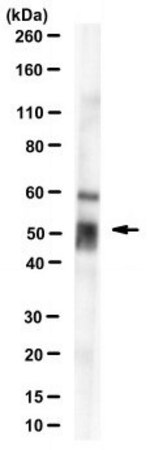
Western Blotting Analysis: A representative lot detected Arrestin-C in Western Blotting applications (Zhang, H., et al. (2003). Invest Ophthalmol Vis Sci.;44(7):2858-67).
Immunohistochemistry Applications: A representative lot detected Arrestin-C in Immunohistochemistry applications (Wikler, K.C., et al. (1997). J Comp Neurol.;377(4):500-8; John, S.K., et al. (2000). Mol Vis.;6:204-15; Zhang, H., et al. (2003). Invest Ophthalmol Vis Sci.;44(7):2858-67; O′Brien, J.J., et al. (2012). J Neurosci.;32(13):4675-87).
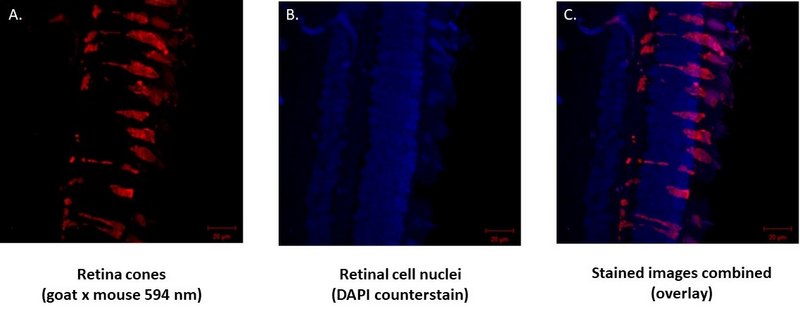
Immunofluorescence Analysis: A 1:500 dilution from a representative lot detected Arrestin-C in frozen monkey retina tissues (Courtesy of Prof. Peter MacLeish, Ph.D., photo by Talib Saafir, Ph.D., Morehouse School of Medicine, Atlanta, GA, USA).
Immunofluorescence Analysis: A representative lot detected Arrestin-C in Immunofluorescence applications (Zhang, H., et al. (2003). Invest Ophthalmol Vis Sci.;44(7):2858-67).
Note: Actual optimal working dilutions must be determined by end user as specimens, and experimental conditions may vary with the end user
Biochem/physiol Actions:Clone 7G6 is a mouse monoclonal antibody that detects cone arrestin (Arrestin-C). It targets an epitope within the N-terminal region.
Physical form:Purified mouse monoclonal antibody IgG1 in buffer containing 0.1 M Tris-Glycine (pH 7.4), 150 mM NaCl with 0.05% sodium azide.
Preparation Note:Recommend storage at +2°C to +8°C. For long term storage antibodies can be kept at -20°C. Avoid repeated freeze-thaws.
Other Notes:Concentration: Please refer to the Certificate of Analysis for the lot-specific concentration.
Disclaimer

风险提示:丁香通仅作为第三方平台,为商家信息发布提供平台空间。用户咨询产品时请注意保护个人信息及财产安全,合理判断,谨慎选购商品,商家和用户对交易行为负责。对于医疗器械类产品,请先查证核实企业经营资质和医疗器械产品注册证情况。
 文献和实验
Sigma-Aldrich-Millipore货号MABN2636现货Anti-Arrestin-C Antibody(clone 7G6)上海睿安生物Merck-Millipore-Roche-Sigma官方正式授权代理商19121878899
Anti-Arrestin-C Antibody, clone 7G6
属性
biological source:mouse
Quality Segment:200
conjugate:unconjugated
antibody form:purified antibody
antibody product type:primary antibodies
clone:7G6, monoclonal
mol wt:calculated mol wt 42.67 kDa
purified by:using protein G
species reactivity:human, monkey, bovine
packaging:antibody small pack of 100μg
technique(s)
immunofluorescence:suitable, immunohistochemistry (formalin-fixed, paraffin-embedded sections): suitable, western blot: suitable
isotype:IgG1κ
epitope sequence:N-terminal
UniProt accession no:A0A2K5U9A7
shipped in:2-8°C
target post-translational modification:unmodified
Gene Information:mouse ... arr3>ARR3(102134564)
说明
General description
Immunogen:Crude retinal extract from Monkey (Macaca fascicularis).
Application
Isotype testing: Identity Confirmation by Isotyping Test.
Isotyping Analysis: The identity of this monoclonal antibody is confirmed by isotyping test to be mouse IgG1.
Tested Applications
Western Blotting Analysis: A representative lot detected Arrestin-C in Western Blotting applications (Zhang, H., et al. (2003). Invest Ophthalmol Vis Sci.;44(7):2858-67).
Immunohistochemistry Applications: A representative lot detected Arrestin-C in Immunohistochemistry applications (Wikler, K.C., et al. (1997). J Comp Neurol.;377(4):500-8; John, S.K., et al. (2000). Mol Vis.;6:204-15; Zhang, H., et al. (2003). Invest Ophthalmol Vis Sci.;44(7):2858-67; O′Brien, J.J., et al. (2012). J Neurosci.;32(13):4675-87).
Immunofluorescence Analysis: A 1:500 dilution from a representative lot detected Arrestin-C in frozen monkey retina tissues (Courtesy of Prof. Peter MacLeish, Ph.D., photo by Talib Saafir, Ph.D., Morehouse School of Medicine, Atlanta, GA, USA).
Immunofluorescence Analysis: A representative lot detected Arrestin-C in Immunofluorescence applications (Zhang, H., et al. (2003). Invest Ophthalmol Vis Sci.;44(7):2858-67).
Note: Actual optimal working dilutions must be determined by end user as specimens, and experimental conditions may vary with the end user
Biochem/physiol Actions:Clone 7G6 is a mouse monoclonal antibody that detects cone arrestin (Arrestin-C). It targets an epitope within the N-terminal region.
Physical form:Purified mouse monoclonal antibody IgG1 in buffer containing 0.1 M Tris-Glycine (pH 7.4), 150 mM NaCl with 0.05% sodium azide.
Preparation Note:Recommend storage at +2°C to +8°C. For long term storage antibodies can be kept at -20°C. Avoid repeated freeze-thaws.
Other Notes:Concentration: Please refer to the Certificate of Analysis for the lot-specific concentration.
Disclaimer
Monoclonal Antibody Production
Order 6 six week old Balb/C mice and let the ARC know they are coming.Have your antigen ready for when they arrive.Once they get there earmark the mice and perform a pre-bleed on them to be used as an ELISA control for monitoring the titer
Antibody Screening of Expression Libraries
Over the last decade major advances in cloning technology have markedly improved the ability to construct clone libraries expressing foreign proteins and to screen them to identify clones encoding any desired gene product. A number of types
Cell Banks and Stability of Antibody Production
-term culture and it is necessary to establish a control system to ensure continuity of product supply. This is normally done by a seed lot system. A pool of cells derived from a single clone is frozen in a number of vials (say 100) to create a master cell bank
 技术资料
需要更多技术资料 索取更多技术资料