

- ¥2828
- AATBIO
- 11305
- 美国
- 2025年12月15日

企业认证
相关产品推荐更多 >



万千商家帮你免费找货
0 人在求购买到急需产品
- 详细信息
- 询价记录
- 文献和实验
- 技术资料
- 英文名:
超氧化物歧化酶SOD检测试剂盒
- 供应商:
上海研卉生物科技有限公司
- 库存:
4W
- 规格:
200T
Amplite™ 比色法超氧化物歧化酶(超氧化物歧化酶)检测试剂盒
Platform
| Absorbance microplate reader | |
| Absorbance | 560 nm |
| Recommended plate | Clear bottom |
Components
| Component A: ReadiView™ SOD560 | 2 bottles |
| Component B: 50X Xanthine | 1 vial (100 µL) |
| Component C: Xanthine Oxidase | 2 vials |
| Component D: SOD Standard | 1 vial (500 Units) |
| Component E: Assay Buffer | 1 bottle (20 mL) |
Example protocol
At a glance
Protocol summary
- Prepare SOD standards or test samples (50 µL)
- Add SOD working solution 1 (25 µL)
- Add SOD working solution 2 (25 µL)
- Incubate at room temperature for 30 - 60 minutes
- Monitor absorbance at 560 nm
Important notes
Thaw all the kit components at room temperature before starting the experiment.
Preparation of stock solution
1. SOD standard solution (10 kU/mL):
Add 50 µL of Assay Buffer (Component E) into the vial of SOD Standard (Component D) to make 10 kU/mL standard solution.
Preparation of standard solution
Add 10 µL of 10 kU/mL SOD standard solution into 990 µL of Assay Buffer (Component E) to get 100 U/mL SOD standard solution (SD7). Take 100 U/mL SOD standard solution (SD7) and perform 1:10 in Assay Buffer (Component E) to get 10 U/mL SOD standard solution (SD6). Take 10 U/mL standard solution (SD6) and perform 1:3 serial dilutions to get serially diluted SOD standards (SD5 - SD1) with Assay Buffer (Component E).
Preparation of working solution
1. SOD working solution 1:
Add 2.5 mL of Assay Buffer (Component E) into the bottle of ReadiViewTM SOD560 (Component A) and mix well. Then add 50 μL of 50X Xanthine (Component B) into this bottle to make SOD working solution 1. Note: This SOD working solution 1 should be prepared before the experiment, and kept from light. SOD working solution 1 is not stable and the unused portion should be discarded.
2. SOD working solution 2:
Add 50 μL Assay Buffer (Component E) into the vial of Xanthine Oxidase (Component C) and mix well. Then, transfer 50 μL of Xanthine Oxidase stock solution into 2.5 mL Assay Buffer (Component E) to make SOD working solution 2.
Procedure
Table 1. Layout of SOD standards and test samples in a clear bottom 96-well microplate. SD=SOD Standards (SD1 - SD7, 0.041 to 100 U/mL); BL=Blank Control; TS=Test Samples.
| BL | BL | TS | TS |
| SD1 | SD1 | ... | ... |
| SD2 | SD2 | ... | ... |
| SD3 | SD3 | ||
| SD4 | SD4 | ||
| SD5 | SD5 | ||
| SD6 | SD6 | ||
| SD7 | SD7 |
Table 2. Reagent composition for each well.
| Well | Volume | Reagent |
| SD1 - SD7 | 50 µL | Serial Dilution (0.041 to 100 U/mL) |
| BL | 50 µL | Assay Buffer (Component E) |
| TS | 50 µL | test sample |
- Prepare SOD standards (SD), blank controls (BL), and test samples (TS) according to the layout provided in Tables 1 and 2. For a 384-well plate, use 25 µL of reagent per well instead of 50 µL.
- Add 25 µL of SOD working solution 1 to each well of SOD standard, blank control, and test samples to make the total assay volume of 75 µL/well. For a 384-well plate, add 12.5 µL of SOD working solution 1 into each well instead, for a total volume of 37.5 µL/well.
- Add 25 µL of SOD working solution 2 to each well of SOD standard, blank control, and test samples to make the total assay volume of 100 µL/well. For a 384-well plate, add 12.5 µL of SOD working solution 2 into each well instead, for a total volume of 50 µL/well.
- Incubate the reaction at room temperature for 30 to 60 minutes, protected from light.
- Monitor the absorbance with an absorbance plate reader at 550 to 560 nm.
Data Analysis
The reading (% of inhibition) obtained from the blank standard well is used as a negative control. Subtract this value from the other standards' readings to obtain the base-line corrected values. Then, plot the standards' readings to obtain a standard curve and equation. This equation can be used to calculate SOD samples. We recommend using the Online Four Parameter Logistics Calculator which can be found at: https://www.aatbio.com/tools/four-parameter-logistic-4pl-curve-regression-online-calculator
Images
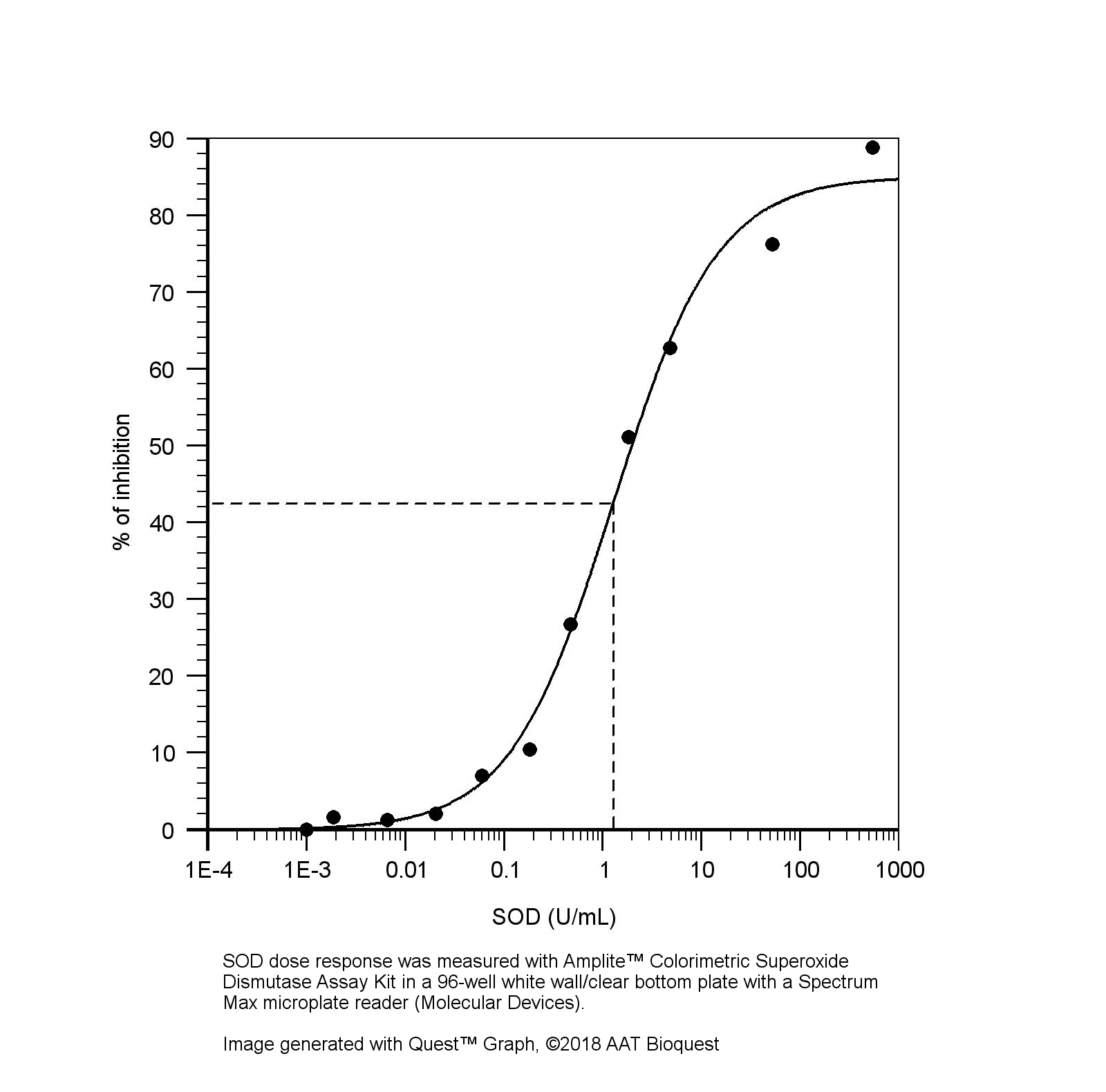 Figure 1. SOD dose response was measured with Amplite™ Colorimetric Superoxide Dismutase Assay Kit in a 96-well white wall/clear bottom plate with a Spectrum Max microplate reader (Molecular Devices). Figure 1. SOD dose response was measured with Amplite™ Colorimetric Superoxide Dismutase Assay Kit in a 96-well white wall/clear bottom plate with a Spectrum Max microplate reader (Molecular Devices). |
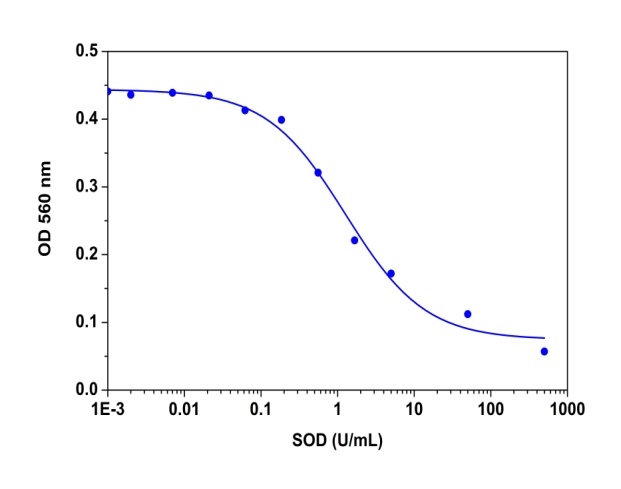 Figure 2. SOD dose response was measured with Amplite™ Colorimetric Superoxide Dismutase Assay Kit in a 96-well white wall/clear bottom plate with a Spectrum Max microplate reader (Molecular Devices). As low as 0.1 U/mL SOD was detected with 60 minutes incubation Figure 2. SOD dose response was measured with Amplite™ Colorimetric Superoxide Dismutase Assay Kit in a 96-well white wall/clear bottom plate with a Spectrum Max microplate reader (Molecular Devices). As low as 0.1 U/mL SOD was detected with 60 minutes incubation |
风险提示:丁香通仅作为第三方平台,为商家信息发布提供平台空间。用户咨询产品时请注意保护个人信息及财产安全,合理判断,谨慎选购商品,商家和用户对交易行为负责。对于医疗器械类产品,请先查证核实企业经营资质和医疗器械产品注册证情况。
- 作者
- 内容
- 询问日期
 文献和实验
文献和实验大鼠 超氧化物歧化酶( SOD ) 酶联免疫分析 试剂盒使用说明书 本试剂仅供研究使用 目的:本试剂盒用于测定大鼠血清,血浆及相关液体样本中 超氧化物歧化酶(SOD ) 的含量。 实验原理: 本试剂盒应用双抗体夹心法测定标本中 大鼠 超氧化物歧化酶( SOD ) 水平。用纯化的 大鼠 SOD 抗体包被微孔板,制成固相抗体,往包被单抗的微孔中依次加入 超氧化物歧化酶( SOD ) ,再与 HRP
【实验原理】 SOD是含金属辅基的酶,它催化以下反应: 02 - +02 - + 2H+ H2 02 +02 由于超氧阴离子自由基02 - 寿命短,不稳定,不易直接测定SOD活性,而采用 间接的方法。目前常用的方法
相关专题 摘要: SOD的催化使超氧自由基(O2-)被破坏,并针对氧毒性筑起了第一道防线。SOD的活性及其检测技术与许多不同领域都息息相关,如医药、生化、植物 生理、食品工程等。在过去的几十年中,人们已经发现了各种各样的SOD检测方法,但是,这些方法在选择性、检测速度、价格、简便程度上都存在各自的缺陷。最近,我们发现水溶性四唑盐如XTT,WST-1,WST-8适合用于O2-的检测并且也可以被用于SOD的检测。在这些四唑盐中
 技术资料
技术资料暂无技术资料 索取技术资料

