

- ¥2980
- LMAI Bio
- LM-3479R-FITC
- 中国/美国/欧洲
- 2025年07月12日
- ICC=1:50-200 IF=1:200-800
- Human, Mouse, Rat, Pig, Cow, Horse, Rabbit,
- Human, Mouse, Rat, Pig, Cow, Horse, Rabbit,

企业认证
相关产品推荐更多 >


万千商家帮你免费找货
0 人在求购买到急需产品
- 详细信息
- 文献和实验
- 技术资料
- 供应商:
上海联迈生物工程有限公司
- 库存:
大量
- 靶点:
详见说明书
- 级别:
1
- 目录编号:
LM-3479R-FITC
- 克隆性:
多克隆
- 抗原来源:
Rabbit
- 保质期:
1年
- 抗体英文名:
Anti-Phospho-ZAP70 (Tyr493)/FITC
- 抗体名:
Anti-Phospho-ZAP70 (Tyr493)/FITC
- 标记物:
FITC标记
- 宿主:
Human, Mouse, Rat, Pig, Cow, Horse, Rabbit,
- 适应物种:
Human, Mouse, Rat, Pig, Cow, Horse, Rabbit,
- 免疫原:
详见说明书
- 亚型:
IGg
- 形态:
粉末、液体、冻干粉
- 应用范围:
ICC=1:50-200 IF=1:200-800
- 浓度:
1mg/ml
- 保存条件:
-20 °C
- 规格:
100ul
| 英文名称 | Anti-Phospho-ZAP70 (Tyr493)/FITC |
| 中文名称 | FITC标记的磷酸化zeta相关蛋白70抗体 |
| 别 名 | Zap-70(Phospho-Tyr493); ZAP70 (phospho Y493); p-ZAP70 (Y292); p-Zap-70(Tyr292); p-Zap-70(Y292); ZAP-70; ZAP 70; ZAP70; zeta-associated protein 70; ZAP-70=protein tyrosine kinase Syk homolog {SH2-like and C-terminal kinase domains}; Tyrosine-protein kinase ZAP-70; 70 kDa zeta-associated protein; Syk-related tyrosine kinase. SRK; STD; TZK; ZAP70_HUMAN; Tyrosine-protein kinase ZAP-70; 70 kDa zeta-chain associated protein. |
| 规格价格 | 100ul/2980元 购买 大包装/询价 |
| 说 明 书 | 100ul |
| 产品类型 | 磷酸化抗体 |
| 研究领域 | 肿瘤 细胞生物 免疫学 信号转导 转录调节因子 激酶和磷酸酶 细胞膜受体 t-淋巴细胞 |
| 抗体来源 | Rabbit |
| 克隆类型 | Polyclonal |
| 交叉反应 | Human, Mouse, Rat, Pig, Cow, Horse, Rabbit, |
| 产品应用 | ICC=1:50-200 IF=1:200-800 not yet tested in other applications. optimal dilutions/concentrations should be determined by the end user. |
| 分 子 量 | 68kDa |
| 性 状 | Lyophilized or Liquid |
| 浓 度 | 1mg/ml |
| 免 疫 原 | KLH conjugated Synthesised phosphopeptide derived from human Zap-70 around the phosphorylation site of Tyr493 |
| 亚 型 | IgG |
| 纯化方法 | affinity purified by Protein A |
| 储 存 液 | 0.01M TBS(pH7.4) with 1% BSA, 0.03% Proclin300 and 50% Glycerol. |
| 保存条件 | Store at -20 °C for one year. Avoid repeated freeze/thaw cycles. The lyophilized antibody is stable at room temperature for at least one month and for greater than a year when kept at -20°C. When reconstituted in sterile pH 7.4 0.01M PBS or diluent of antibody the antibody is stable for at least two weeks at 2-4 °C. |
| 产品介绍 | background: This gene encodes an enzyme belonging to the protein tyrosine kinase family, and it plays a role in T-cell development and lymphocyte activation. This enzyme, which is phosphorylated on tyrosine residues upon T-cell antigen receptor (TCR) stimulation, functions in the initial step of TCR-mediated signal transduction in combination with the Src family kinases, Lck and Fyn. This enzyme is also essential for thymocyte development. Mutations in this gene cause selective T-cell defect, a severe combined immunodeficiency disease characterized by a selective absence of CD8-positive T-cells. Two transcript variants that encode different isoforms have been found for this gene. [provided by RefSeq, Jul 2008]. Function: Tyrosine kinase that plays an essential role in regulation of the adaptive immune response. Regulates motility, adhesion and cytokine expression of mature T-cells, as well as thymocyte development. Contributes also to the development and activation of primary B-lymphocytes. When antigen presenting cells (APC) activate T-cell receptor (TCR), a serie of phosphorylations lead to the recruitment of ZAP70 to the doubly phosphorylated TCR component CD247/CD3Z through ITAM motif at the plasma membrane. This recruitment serves to localization to the stimulated TCR and to relieve its autoinhibited conformation. Release of ZAP70 active conformation is further stabilized by phosphorylation mediated by LCK. Subsequently, ZAP70 phosphorylates at least 2 essential adapter proteins: LAT and LCP2. In turn, a large number of signaling molecules are recruited and ultimately lead to lymphokine production, T-cell proliferation and differentiation. Furthermore, ZAP70 controls cytoskeleton modifications, adhesion and mobility of T-lymphocytes, thus ensuring correct delivery of effectors to the APC. ZAP70 is also required for TCR-CD247/CD3Z internalization and degradation through interaction with the E3 ubiquitin-protein ligase CBL and adapter proteins SLA and SLA2. Thus, ZAP70 regulates both T-cell activation switch on and switch off by modulating TCR expression at the T-cell surface. During thymocyte development, ZAP70 promotes survival and cell-cycle progression of developing thymocytes before positive selection (when cells are still CD4/CD8 double negative). Additionally, ZAP70-dependent signaling pathway may also contribute to primary B-cells formation and activation through B-cell receptor (BCR). Subunit: Interacts with NFAM1. Interacts with adapter proteins SLA and SLA2; these interactions negatively regulates T-cell receptor signaling. Interacts with CBLB (By similarity). Interacts with DEF6. Interacts (via SH2 domains) with RHOH; this interaction regulates ZAP70 subcellular localization (By similarity). Interacts with FCRL3. Interacts with VAV1. Interacts with CD247/CD3Z; this interaction docks ZAP70 at the stimulated TCR. Interacts with CBL; this interaction promotes ubiquitination, internalization and subsequent degradation of CD247/CD3Z. Identified in a complex with CBL and UBE2L3. Subcellular Location: Cytoplasm. Cell membrane; Peripheral membrane protein. Note=In quiescent T-lymphocytes, it is cytoplasmic. Upon TCR activation, it is recruited at the plasma membrane by interacting with CD247/CD3Z. Co-localizes together with RHOH in the immunological synapse. RHOH is required for its proper localization to the cell membrane and cytoskeleton fractions in the thymocytes. Tissue Specificity: Expressed in T- and natural killer cells. Also present in early thymocytes and pro/pre B-cells. Post-translational modifications: Phosphorylated on tyrosine residues upon T-cell antigen receptor (TCR) stimulation. Phosphorylation of Tyr-315 and Tyr-319 are essential for ZAP70 positive function on T-lymphocyte activation whereas Tyr-292 has a negative regulatory role. Within the C-terminal kinase domain, Tyr-492 and Tyr-493 are phosphorylated after TCR induction, Tyr-492 playing a negative regulatory role and Tyr-493 a positive. Tyr-493 is dephosphorylated by PTN22. DISEASE: Defects in ZAP70 are the cause of selective T-cell defect (STD) [MIM:176947]. STD is an autosomal recessive form of severe combined immunodeficiency characterized by a selective absence of CD8-type T-cells. Similarity: Belongs to the protein kinase superfamily. Tyr protein kinase family. SYK/ZAP-70 subfamily. Contains 1 protein kinase domain. Contains 2 SH2 domains. Database links: Entrez Gene: 7535 Human Entrez Gene: 22637 Mouse Entrez Gene: 301348 Rat Omim: 176947 Human SwissProt: P43403 Human SwissProt: P43404 Mouse Unigene: 234569 Human Unigene: 8038 Mouse Important Note: This product as supplied is intended for research use only, not for use in human, therapeutic or diagnostic applications. ZAP70 为慢性淋巴细胞性白血病的预后指标。 |
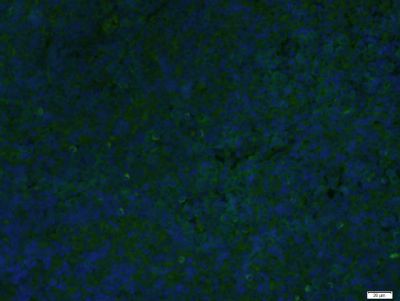
| 产品图片 | 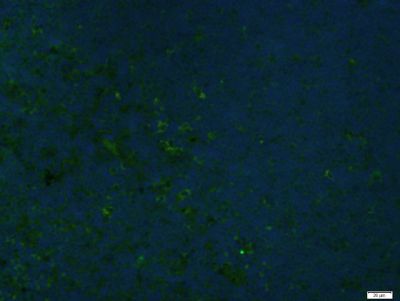 Paraformaldehyde-fixed, paraffin embedded (Rat thymus); Antigen retrieval by boiling in sodium citrate buffer (pH6.0) for 15min; Block endogenous peroxidase by 3% hydrogen peroxide for 20 minutes; Blocking buffer (normal goat serum) at 37°C for 30min; Incubation: Anti- Phospho-ZAP70 (Tyr493) Antibody, conjugated (bs-3479R-FITC) 1:400, 1.5 hours at 37°C; DAPI (5ug/ml, blue, C-0033) was used to stain the cell nuclei.  Paraformaldehyde-fixed, paraffin embedded (Rat lymph nodes); Antigen retrieval by boiling in sodium citrate buffer (pH6.0) for 15min; Block endogenous peroxidase by 3% hydrogen peroxide for 20 minutes; Blocking buffer (normal goat serum) at 37°C for 30min; Incubation: Anti- Phospho-ZAP70 (Tyr493) Antibody, conjugated (bs-3479R-FITC) 1:400, 1.5 hours at 37°C; DAPI (5ug/ml, blue, C-0033) was used to stain the cell nuclei. |
风险提示:丁香通仅作为第三方平台,为商家信息发布提供平台空间。用户咨询产品时请注意保护个人信息及财产安全,合理判断,谨慎选购商品,商家和用户对交易行为负责。对于医疗器械类产品,请先查证核实企业经营资质和医疗器械产品注册证情况。
 文献和实验
文献和实验度表达或者敲除 PD 相关蛋白(如 α-突触核蛋白或 LRRK2)来转化目标细胞从而达到模拟病理现象的效果。 但是该模型的一个主要缺点是需要超生理水平的表达相关蛋白才能显现出致病性,这与实际病理现象不符。除此之外,该模型中的 α-突触核蛋白聚集体并不是细丝状,这点特征也与实际病理现象不同。 4.活体注射 α-突触核蛋白模型 该模型是将特定条件下制作的活性蛋白聚集体(aSyn PFFs)注射到活体中来模拟 PD 病理现象。 StressMarq 的活性 aSyn PFFs 在结构功能上都与路易小体中的主要
自己知识产权的人类新基因,前期的功能研究表明,它是促进细胞凋亡的增强剂.利用荧光 素(FITC)标记的TFAR19单克隆抗体为探针,对细胞凋亡过程中TFAR19蛋白的表达水平及定位研究发现,凋亡早期TFAR19表达水平增高并出 现快速核转位现象...查看原文 了解更多有用的、有意思的前沿资讯以及酷炫的实验方法,可以向大师兄申请微信好友 师兄微信号:shixiongcoming
(终末耗竭)的对比,并可加入CXCR6以定位肿瘤微环境中靠近树突状细胞的T细胞。胞内染色对检测转录因子(如TCF1、TOX、EOMES、T-BET等)及磷酸化信号蛋白(p-STAT5/3)至关重要。此外,流式还可同步评估增殖(Ki-67/CFSE)、细胞因子分泌(IFN-γ、TNF-α、IL-2减少)及线粒体功能(MitoTracker),全面刻画耗竭T细胞的功能缺陷。菲恩生物提供专业流式配色方案与高品质抗体,优化多色检测,提升灵敏度与准确性,助力免疫、肿瘤及自身免疫病研究,诚邀合作共促创新
 技术资料
技术资料暂无技术资料 索取技术资料

