

- ¥2980
- LMAI Bio
- LM-4590R-FITC
- 中国/美国/欧洲
- 2025年07月15日
- Flow-Cyt=1:50-200 IF=1:50-200
- Human, Mouse, Rat, Dog, Pig, Cow, Sheep,
- Human, Mouse, Rat, Dog, Pig, Cow, Sheep,

企业认证
相关产品推荐更多 >

万千商家帮你免费找货
0 人在求购买到急需产品
- 详细信息
- 文献和实验
- 技术资料
- 供应商:
上海联迈生物工程有限公司
- 库存:
大量
- 靶点:
详见说明书
- 级别:
1
- 目录编号:
LM-4590R-FITC
- 克隆性:
多克隆
- 抗原来源:
Rabbit
- 保质期:
1年
- 抗体英文名:
Anti-PPAR Gamma/FITC
- 抗体名:
Anti-PPAR Gamma/FITC
- 标记物:
FITC标记
- 宿主:
Human, Mouse, Rat, Dog, Pig, Cow, Sheep,
- 适应物种:
Human, Mouse, Rat, Dog, Pig, Cow, Sheep,
- 免疫原:
详见说明书
- 亚型:
IGg
- 形态:
粉末、液体、冻干粉
- 应用范围:
Flow-Cyt=1:50-200 IF=1:50-200
- 浓度:
1mg/ml
- 保存条件:
-20 °C
- 规格:
100ul
| 英文名称 | Anti-PPAR Gamma/FITC |
| 中文名称 | FITC标记的过氧化酶活化增生受体γ抗体 |
| 别 名 | CIMT1; HUMPPARG; NR1C3; Nuclear receptor subfamily 1 group C member 3; PAX8/PPARG Fusion Gene; Peroxisome Proliferator Activated Receptor gamma; PPAR gamma; PPARG; PPARG1; PPARG2; PPARG3; CIMT1; GLM1; HUMPPARG; NR1C3; Nuclear receptor subfamily 1 group C member 3; PAX8/PPARG Fusion Gene; Peroxisome proliferator activated nuclear receptor gamma variant 1; Peroxisome proliferator activated receptor gamma 1; Peroxisome Proliferator Activated Receptor gamma; Peroxisome proliferator-activated receptor gamma; PPAR gamma; PPAR-gamma; PPARG; PPARG_HUMAN; PPARG1; PPARG2; PPARG3; PPAR gamma 1; PPAR gamma 2; PPAR gamma 3; PPAR gamma-1; PPAR gamma-2; PPAR gamma-3. |
| 规格价格 | 100ul/2980元 购买 大包装/询价 |
| 说 明 书 | 100ul |
| 研究领域 | 细胞生物 免疫学 信号转导 细胞粘附分子 |
| 抗体来源 | Rabbit |
| 克隆类型 | Polyclonal |
| 交叉反应 | Human, Mouse, Rat, Dog, Pig, Cow, Sheep, |
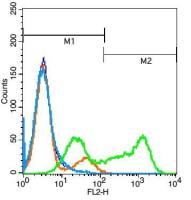
| 产品应用 | Flow-Cyt=1:50-200 IF=1:50-200 not yet tested in other applications. optimal dilutions/concentrations should be determined by the end user. |
| 分 子 量 | 57kDa |
| 性 状 | Lyophilized or Liquid |
| 浓 度 | 1mg/ml |
| 免 疫 原 | KLH conjugated synthetic peptide derived from human PPAR Gamma |
| 亚 型 | IgG |
| 纯化方法 | affinity purified by Protein A |
| 储 存 液 | 0.01M TBS(pH7.4) with 1% BSA, 0.03% Proclin300 and 50% Glycerol. |
| 保存条件 | Store at -20 °C for one year. Avoid repeated freeze/thaw cycles. The lyophilized antibody is stable at room temperature for at least one month and for greater than a year when kept at -20°C. When reconstituted in sterile pH 7.4 0.01M PBS or diluent of antibody the antibody is stable for at least two weeks at 2-4 °C. |
| 产品介绍 | background: The PPAR gamma antibody mainly is exist in the white fat organization, the fat for the PPAR gamma is born, blood sugar stability, the disease respond, the artery gruel kind hardens to rise the important function with the tumor occurrence of etc. all, but concerning the PPAR gamma to bone of function is a new research heat to order in recent years.A PPAR of many researches report gamma was go together with the body is after activate can the function promote many capable cells divided to increase to living but repress the ossification cell to divide to cause the bone measure the decrease or bone softs toward the fat cell in the marrow, the PPAR gamma promotes the ability and bones that the fat cell divide metabolize closely related, the performance is increasing along with the growth marrow fat content of the age, the ossification cell metabolism the outcome reduce, the different construction PPAR gamma 2 have the important function. Function: Receptor that binds peroxisome proliferators such as hypolipidemic drugs and fatty acids. Once activated by a ligand, the receptor binds to a promoter element in the gene for acyl-CoA oxidase and activates its transcription. It therefore controls the peroxisomal beta-oxidation pathway of fatty acids. Key regulator of adipocyte differentiation and glucose homeostasis. Subunit: Forms a heterodimer with the retinoic acid receptor RXRA called adipocyte-specific transcription factor ARF6. Interacts with NCOA6 coactivator, leading to a strong increase in transcription of target genes. Interacts with coactivator PPARBP, leading to a mild increase in transcription of target genes. Interacts with FAM120B. Interacts with PRDM16 (By similarity). Interacts with NOCA7 in a ligand-inducible manner. Interacts with NCOA1 LXXLL motifs. Interacts with TGFB1I1. Interacts with DNTTIP2. Interacts with PRMT2. Subcellular Location: Nucleus. Tissue Specificity: Highest expression in adipose tissue. Lower in skeletal muscle, spleen, heart and liver. Also detectable in placenta, lung and ovary. DISEASE: Note=Defects in PPARG can lead to type 2 insulin-resistant diabetes and hyptertension. PPARG mutations may be associated with colon cancer. Defects in PPARG may be associated with susceptibility to obesity (OBESITY) [MIM:601665]. It is a condition characterized by an increase of body weight beyond the limitation of skeletal and physical requirements, as the result of excessive accumulation of body fat. Defects in PPARG are the cause of familial partial lipodystrophy type 3 (FPLD3) [MIM:604367]. Familial partial lipodystrophies (FPLD) are a heterogeneous group of genetic disorders characterized by marked loss of subcutaneous (sc) fat from the extremities. Affected individuals show an increased preponderance of insulin resistance, diabetes mellitus and dyslipidemia. Genetic variations in PPARG can be associated with susceptibility to glioma type 1 (GLM1) [MIM:137800]. Gliomas are central nervous system neoplasms derived from glial cells and comprise astrocytomas, glioblastoma multiforme, oligodendrogliomas, and ependymomas. Note=Polymorphic PPARG alleles have been found to be significantly over-represented among a cohort of American patients with sporadic glioblastoma multiforme suggesting a possible contribution to disease susceptibility. Similarity: Belongs to the nuclear hormone receptor family. NR1 subfamily. Contains 1 nuclear receptor DNA-binding domain. Database links: Entrez Gene: 5468 Human Entrez Gene: 19016 Mouse Entrez Gene: 25664 Rat SwissProt: P37231 Human SwissProt: P37238 Mouse SwissProt: O88275 Rat Unigene: 162646 Human Unigene: 3020 Mouse Unigene: 23443 Rat Important Note: This product as supplied is intended for research use only, not for use in human, therapeutic or diagnostic applications. 过氧化物酶体增殖物激活受体γ(PPARγ)主要存在于白色脂肪组织,PPARγ对于脂肪生成、血糖稳定、炎症反应、动脉粥样硬化和肿瘤等的发生都起到重要的作用。主要在脂肪细胞内表达。PPARγ是噻唑烷二酮类药物(TZDs)作用的药靶,又是脂肪细胞分化的重要调节因子。经研究发现,PPARγ在肥胖及胰岛素抵抗的发病机制中具有十分重要的意义,是治疗糖尿病、肥胖等代谢性疾病的重要药靶。 过氧化物酶体增殖物激活受体γ(PPARγ)属Ⅱ型核受体超家族成员,主要在脂肪细胞内表达。PPARγ是噻唑烷二酮类药物(TZDs)作用的药靶,又是脂肪细胞分化的重要调节因子。现有研究(包括一次于美国加州大学进行的研究)发现PPARγ在肥胖及胰岛素抵抗的发病机制中具有十分重要的意义,是治疗糖尿病、肥胖等代谢性疾病的重要药靶。目前,该受体蛋白质水平的筛选模式已经建立,并正在建立该受体的报告基因的细胞水平筛选评价模式 |
风险提示:丁香通仅作为第三方平台,为商家信息发布提供平台空间。用户咨询产品时请注意保护个人信息及财产安全,合理判断,谨慎选购商品,商家和用户对交易行为负责。对于医疗器械类产品,请先查证核实企业经营资质和医疗器械产品注册证情况。
 文献和实验
文献和实验Tip 1:补偿控制样品必须只染一种颜色 当细胞群同时向两个通道发射荧光时,可能是由于两个原因: 细胞群表达一种 Marker,该标记物被荧光染料偶联的抗体染色,在第二个通道中检测到荧光染料的荧光溢出。 细胞群表达两种 Markers,这些标记物被两种不同荧光染料染色,发射出的荧光到两个通道中。为了在补偿期间排除双阳性细胞的干扰,调节补偿应仅用单一染料染色。 Tip 2:样本中必须包含中位数比较的阴性和阳性细胞群 要正确调节补偿,必须比较溢出通道中阴性和阳性细胞的中位数荧
#01 什么是同型对照? 同型对照(Isotype Control),是指与使用的流式抗体具有相同种属来源、亚型、荧光标记物、使用剂量和浓度,但对目标靶点无特异性结合的抗体。同型对照通常用来消除抗体与抗原的非特异性结合造成的背景染色。 #02 为什么要做同型对照? 流式抗体与靶标的结合,是通过抗体的 Fab 端与靶标 Marker 进行特异性结合而完成的。白细胞(除T细胞外)表面大多表达 CD16、CD32、CD64 等 Fc 受体,这些受体可与各种抗体的 Fc 端非特异性结合,出现非特异
,人们提出了几种策略。双特异性抗体的使用显著提高了细胞毒性,临床前研究发现,EpCAM/CD3双特异性抗体增强了γδT细胞介导的肝母细胞瘤和儿童肝细胞癌的裂解。在临床前模型中,用HER2/Vγ9双特异性抗体体外扩增γδT细胞可显著降低胰腺癌和结肠癌的生长。此外,还报告了一种tribody (HER22×CD16) ,其包含两个HER2特异性单链片段,与一个靶向γδT细胞和NK细胞上表达的CD16单链片段融合,增强了γδT细胞和NK细胞介导的HER2表达肿瘤细胞的裂解。 嵌合抗原受体转导的γδT
 技术资料
技术资料暂无技术资料 索取技术资料

