

- ¥1580
- LMAI Bio
- LM-5388R
- 进口/国产
- 2026年04月24日
- WB=1:500-2000 ELISA=1:500-1000 IHC-P=1:400-800 IHC-F=1:400-800 IF=1:100-500 (石蜡切片需做抗原修复)
- Rabbit
- Human, Mouse, Rat, Chicken, Dog, Pig, Cow, Horse, Sheep,

企业认证
相关产品推荐更多 >


万千商家帮你免费找货
0 人在求购买到急需产品
- 详细信息
- 文献和实验
- 技术资料
- 供应商:
上海联迈生物工程有限公司
- 库存:
大量
- 目录编号:
LM-5388R
- 克隆性:
多克隆
- 抗原来源:
Rabbit
- 保质期:
1年
- 抗体英文名:
phospho-HDAC1 (Ser423+Ser421)
- 抗体名:
磷酸化组蛋白去乙酰化酶1抗体
- 宿主:
Rabbit
- 适应物种:
Human, Mouse, Rat, Chicken, Dog, Pig, Cow, Horse, Sheep,
- 免疫原:
KLH conjugated Synthesised phosphopeptide derived from human HDAC1 around the pho sphorylation site of Ser423+Ser421:EF(p-S)D(p-S)E
- 亚型:
IgG
- 形态:
Lyophilized or Liquid
- 应用范围:
WB=1:500-2000 ELISA=1:500-1000 IHC-P=1:400-800 IHC-F=1:400-800 IF=1:100-500 (石蜡切片需做抗原修复)
- 浓度:
1mg/ml
- 保存条件:
Store at -20 °C
- 规格:
100ul
| 英文名称 | phospho-HDAC1 (Ser423+Ser421) |
| 中文名称 | 磷酸化组蛋白去乙酰化酶1抗体 |
| 别 名 | HDAC1 (phospho S421 + S423); p-HDAC1 (phospho S421 + S423); dHDAC1 (phospho S421 + S423); p-dHDAC1 (phospho S421 + S423); DKFZp686H12203; GON 10; HD 1; HD1; HDAC 1; hdac1: histone deacetylase 1; Histone deacetylase 1 (HD1); Histone deacetylase 1; RPD3 (reduced potassium dependency yeast homolog) like 1; RPD3 (reduced potassium dependency); RPD3; RPD3L1; HDAC2_HUMAN. |
| 规格价格 | 100ul/1580元 购买 大包装/询价 |
| 说 明 书 | 100ul |
| 产品类型 | 磷酸化抗体 |
| 研究领域 | 肿瘤 细胞生物 免疫学 信号转导 细胞凋亡 转录调节因子 |
| 抗体来源 | Rabbit |
| 克隆类型 | Polyclonal |
| 交叉反应 | Human, Mouse, Rat, Chicken, Dog, Pig, Cow, Horse, Sheep, |
| 产品应用 | WB=1:500-2000 ELISA=1:500-1000 IHC-P=1:400-800 IHC-F=1:400-800 IF=1:100-500 (石蜡切片需做抗原修复) not yet tested in other applications. optimal dilutions/concentrations should be determined by the end user. |
| 分 子 量 | 55kDa |
| 细胞定位 | 细胞核 |
| 性 状 | Lyophilized or Liquid |
| 浓 度 | 1mg/ml |
| 免 疫 原 | KLH conjugated Synthesised phosphopeptide derived from human HDAC1 around the pho sphorylation site of Ser423+Ser421:EF(p-S)D(p-S)E |
| 亚 型 | IgG |
| 纯化方法 | affinity purified by Protein A |
| 储 存 液 | 0.01M TBS(pH7.4) with 1% BSA, 0.03% Proclin300 and 50% Glycerol. |
| 保存条件 | Store at -20 °C for one year. Avoid repeated freeze/thaw cycles. The lyophilized antibody is stable at room temperature for at least one month and for greater than a year when kept at -20°C. When reconstituted in sterile pH 7.4 0.01M PBS or diluent of antibody the antibody is stable for at least two weeks at 2-4 °C. |
| PubMed | PubMed |
| 产品介绍 | background: Reversible acetylation of highly conserved lysine residues within the N-terminal tail domains of core histones, plays an important role in transcriptional regulation, cell cycle progression and developmental events. Histone acetylation is a dynamic process determined by the net activities of histone acetyltransferases (HATs) and the competing enzymes histone deacetylases (HDACs). Histone deacetylases activities are often, but not always, associated with transcriptional repression and nucleosomal condensations. Recruitment of the multiprotein complexes to promoter sites occurs by many sequence specific DNA-binding proteins such as unliganded nuclear hormone receptors, DP1-E2F, YY1 and Rb family of transcription factors, transcriptional repressors and tumor suppressors (e.g. BRCA1). Aberrant recruitment of HDACs by certain oncoproteins may occur in certain neoplastic diseases. Belongs to the histone deacetylase family. Type 1. Function: Responsible for the deacetylation of lysine residues on the N-terminal part of the core histones (H2A, H2B, H3 and H4). Histone deacetylation gives a tag for epigenetic repression and plays an important role in transcriptional regulation, cell cycle progression and developmental events. Histone deacetylases act via the formation of large multiprotein complexes. Forms transcriptional repressor complexes by associating with MAD, SIN3, YY1 and N-COR. Interacts in the late S-phase of DNA-replication with DNMT1 in the other transcriptional repressor complex composed of DNMT1, DMAP1, PCNA, CAF1. Deacetylates TSHZ3 and regulates its transcriptional repressor activity. Component of a RCOR/GFI/KDM1A/HDAC complex that suppresses, via histone deacetylase (HDAC) recruitment, a number of genes implicated in multilineage blood cell development. Subunit: Component of a RCOR/GFI/KDM1A/HDAC complex. Interacts directly with GFI1 and GFI1B. Interacts with SNW1, HDAC7, PRDM6, SAP30, SETDB1 and SUV39H1. Interacts with the H2AFY (via the non-histone region). Part of the core histone deacetylase (HDAC) complex composed of HDAC1, HDAC2, RBBP4 and RBBP7. The core complex associates with MTA2, MBD3, MTA1L1, CHD3 and CHD4 to form the nucleosome remodeling and histone deacetylation (NuRD) complex, or with SIN3, SAP18 and SAP30 to form the SIN3 HDAC complex. Component of a BHC histone deacetylase complex that contains HDAC1, HDAC2, HMG20B, KDM1A, RCOR1 and PHF21A. The BHC complex may also contain ZMYM2, ZNF217, ZMYM3, GSE1 and GTF2I. Part of a complex containing the core histones H2A, H2B, H3 and H4, DEK and unphosphorylated DAXX. Part of a complex containing ATR and CHD4. Forms a heterologous complex at least with YY1. Interacts with ATR, CBFA2T3, DNMT1, MINT, HDAC10, HCFC1, NRIP1, KDM4A and PELP1. Component of a mSin3A corepressor complex that contains SIN3A, SAP130, SUDS3, ARID4B, HDAC1 and HDAC2. Interacts with CHFR and SAP30L. Interacts (CK2 phosphorylated form) with SP3. Interacts with TSHZ3 (via its N-terminus). Interacts with APEX1; the interaction is not dependent on the acetylated status of APEX1. Part of a complex composed of TRIM28, HDAC1, HDAC2 and EHMT2. Subcellular Location: Nucleus. Tissue Specificity: Widely expressed; lower levels in brain and lung. Post-translational modifications: S-nitrosylated by GAPDH. In neurons, S-Nitrosylation at Cys-262 and Cys-274 does not affect the enzyme activity but abolishes chromatin-binding, leading to increases acetylation of histones and activate genes that are associated with neuronal development. In embryonic cortical neurons, S-Nitrosylation regulates dendritic growth and branching. Similarity: Belongs to the histone deacetylase family. HD type 1 subfamily. SWISS: Q13547 Gene ID: 3065 Database links: Entrez Gene: 3065 Human Entrez Gene: 433759 Mouse Entrez Gene: 297893 Rat Entrez Gene: 404126 Cow Omim: 601241 Human SwissProt: Q32PJ8 Cow SwissProt: Q13547 Human SwissProt: O09106 Mouse SwissProt: Q4QQW4 Rat Unigene: 88556 Human Unigene: 202504 Mouse Unigene: 391033 Mouse Unigene: 1863 Rat Important Note: This product as supplied is intended for research use only, not for use in human, therapeutic or diagnostic applications. |
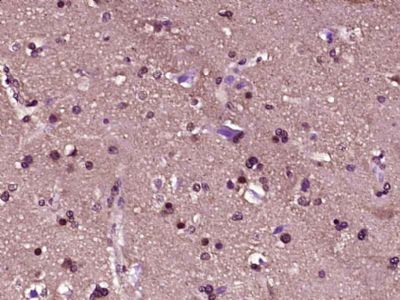
| 产品图片 | 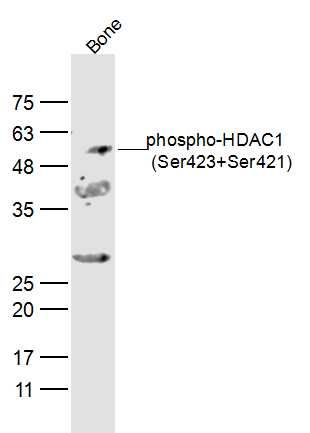 Sample: Bone (Mouse) Lysate at 40 ug Primary: Anti-phospho-HDAC1 (Ser423+Ser421) (bs-5388R) at 1/300 dilution Secondary: IRDye800CW Goat Anti-Rabbit IgG at 1/20000 dilution Predicted band size: 55 kD Observed band size: 55 kD 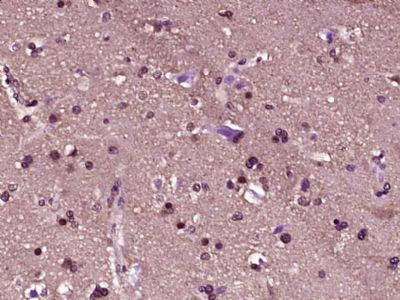 Paraformaldehyde-fixed, paraffin embedded (Human brain glioma); Antigen retrieval by boiling in sodium citrate buffer (pH6.0) for 15min; Block endogenous peroxidase by 3% hydrogen peroxide for 20 minutes; Blocking buffer (normal goat serum) at 37°C for 30min; Antibody incubation with (phospho-HDAC1 (Ser423+Ser421)) Polyclonal Antibody, Unconjugated (bs-5388R) at 1:400 overnight at 4°C, followed by operating according to SP Kit(Rabbit) (sp-0023) instructionsand DAB staining. |
风险提示:丁香通仅作为第三方平台,为商家信息发布提供平台空间。用户咨询产品时请注意保护个人信息及财产安全,合理判断,谨慎选购商品,商家和用户对交易行为负责。对于医疗器械类产品,请先查证核实企业经营资质和医疗器械产品注册证情况。
 文献和实验
文献和实验Using Phospho‐Motif Antibodies to Determine Kinase Substrates
the phosphorylation site; therefore, substrate?directed, phosphorylation?state?sensitive, motif?specific (?phospho?motif?) antibodies represent powerful tools to identify novel kinase substrates and to investigate mechanisms of substrate phosphorylation
), and causes activation of KOR. Agonist-activated KOR becomes a substrate for G protein receptor kinase (GRK), which phosphorylates the Ser369 residue at the C-terminal tail of the receptor in the first step in the β-Arrestin-dependent desensitization cascade
at 10, 25, and 50 μM). At 24 h post-treatment, celllysates were obtained; SDS-PAGE and Western blotting were performed as described in Section 3, Methods. AR-A014418dose-dependent decreases of phospho-β-catenin (Ser33/37) and phospho-glycogen synthase
 技术资料
技术资料暂无技术资料 索取技术资料

